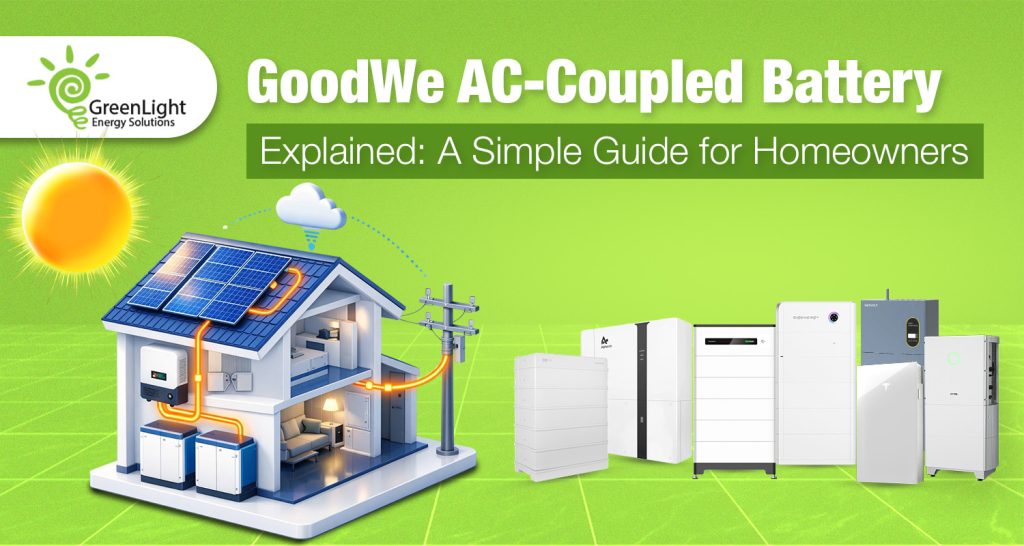
If you already have solar panels and want to add battery storage without replacing your inverter, a GoodWe AC-coupled battery could be the most practical solution.
At Greenlight Solar, we’re often asked whether homeowners in Sydney should choose AC or DC coupling. The answer depends on your current system, your energy habits, and how you want the battery to perform. This guide explains how AC-coupled systems work, when they make sense, and whether a solar battery Sydney homes install today should be AC or DC connected.
What Is an AC-Coupled Solar Battery?
An AC-coupled solar battery connects to your home’s AC wiring rather than directly to the solar panels.
Here’s how it works:
- Your solar panels generate DC electricity.
- Your existing solar inverter converts that DC into AC power for your home.
- Any excess AC electricity can then charge the battery.
- When needed, the battery supplies AC power back into your home.
In simple terms, your solar inverter and your battery inverter operate independently. This makes AC coupling ideal for retrofitting a battery to an existing solar system.
Why Many Sydney Homes Choose AC Coupling
For many Greenlight Solar clients, the decision comes down to practicality.
1. You Can Keep Your Existing Solar Inverter
If your current solar inverter is working well and still under warranty, replacing it just to add storage can feel unnecessary. AC coupling allows you to add a solar battery without touching your existing solar setup.
This makes it a strong option for homes that installed solar several years ago and now want energy independence or backup protection.
2. Installation Is Often Simpler
Because the battery is added on the AC side, there’s typically less disruption to your existing solar system. In many retrofit scenarios, this means:
- Shorter installation time
- Less system redesign
- Lower labour complexity
For established Sydney homes with limited roof access or older switchboards, this can be a significant advantage.
3. Flexible Backup Options
Many homeowners exploring a Goodwe Solar Battery are interested in blackout protection.
GoodWe AC-coupled systems can be configured to provide backup during outages (depending on the model and system design). Whether you want essential circuits only (lights, fridge, internet) or broader home backup, the system needs to be properly designed and wired from the start.
At Greenlight Solar, backup design is always customised to match your home’s load requirements.
AC-Coupled vs DC-Coupled: What’s the Difference?
The biggest difference is where the battery connects.
AC-Coupled
- Battery connects to your home’s AC wiring
- Works independently of your existing solar inverter
- Best for retrofits
DC-Coupled
- Battery connects directly to solar panels through a hybrid inverter
- Fewer energy conversions
- Often ideal for brand-new solar + battery installs
AC systems convert electricity multiple times (DC to AC, then back to DC for storage, then to AC again for use). This can mean slightly lower efficiency compared to many DC-coupled setups.
However, efficiency isn’t the only factor. In retrofit cases, avoiding a full inverter replacement can offset the difference.
The right choice depends on your goals, not just the technology.
Is a GoodWe Solar Battery Right for Your Home?
GoodWe has built a strong reputation in Australia for reliable inverters and battery systems suited to local conditions.
When assessing whether a Goodwe Solar Battery is right for your Sydney home, we look at:
Your Existing Solar System
- Age and condition of the inverter
- Remaining warranty
- Current system size
- Export limits imposed by your network
Your Energy Usage Pattern
- Evening electricity consumption
- Air conditioning loads
- EV charging plans
- Time-of-use tariff structure
Installation Environment
Sydney’s climate varies. Western suburbs can experience extreme summer heat, while coastal homes deal with salt air and humidity. Placement matters.
We assess:
- Ventilation
- Shade exposure
- Switchboard capacity
- Mounting location (garage, external wall, etc.)
A solar battery is only as good as its installation environment.
Can AC-Coupled Batteries Charge From the Grid?
Yes — in many cases they can.
Grid charging can be useful when:
- You’re preparing for forecast storms
- Solar production is low in winter
- Your electricity plan offers cheap off-peak periods
However, grid charging must be configured correctly to comply with local regulations and retailer rules. Over-aggressive cycling to chase tariff differences can also reduce long-term battery lifespan.
At Greenlight Solar, we configure systems for balanced performance prioritising long-term value over short-term gains.
Efficiency vs Practicality: What Matters More?
Some homeowners focus heavily on round-trip efficiency numbers. While efficiency is important, it should be viewed in context.
If replacing your inverter adds thousands of dollars to a project, that cost may outweigh small efficiency gains from DC coupling.
For many retrofit clients in Sydney, AC coupling provides:
- Faster payback compared to replacing hardware
- Lower installation complexity
- Greater flexibility in battery sizing
The right system is the one that fits your home, not the one that wins on a spec sheet.
Common Questions from Sydney Homeowners
Will an AC-coupled solar battery reduce my power bill?
It can especially if you use most of your electricity in the evening when solar panels are no longer producing. The savings depend on:
- Your daily usage pattern
- Your feed-in tariff
- Your electricity import rate
- How often the battery cycles
A tailored assessment is essential.
Is AC coupling less reliable?
Not inherently. AC-coupled systems use separate inverters, which can sometimes offer redundancy benefits. Reliability depends more on system design, installation quality, and brand support than on coupling type alone.
Can I expand later?
Many GoodWe systems are modular, allowing expansion over time (within product limits). This makes them appealing for households planning future EV charging or increased electricity use.
When AC Coupling May Not Be Ideal
While AC coupling works well for retrofits, DC coupling may be better if:
- You’re installing solar and battery together from scratch
- Your current inverter is nearing replacement anyway
- You want the highest possible conversion efficiency
That’s why Greenlight Solar always compares both options before recommending a solution.
Why Installation Quality Matters More Than Coupling Type
The debate between AC and DC often overshadows a more important factor: installation quality.
Battery systems involve:
- Switchboard integration
- Load separation for backup
- Compliance with Australian standards
- Network approvals
- Correct commissioning settings
A poorly designed system AC or DC can underperform or fail prematurely.
That’s why we approach every solar battery Sydney installation as a site-specific engineering project, not a product drop-in.
The Bottom Line
A GoodWe AC-coupled battery is a practical, flexible solution for homeowners who already have solar and want to add storage without replacing their inverter.
It may not win purely on conversion efficiency compared to some DC-coupled designs, but in many Sydney retrofit scenarios, it offers the best balance of cost, performance, and installation simplicity.
The key isn’t choosing AC or DC based on a blog headline. It’s designing a system around your home, usage, and long-term energy goals.
If you’re considering adding a solar battery to your home, Greenlight Solar can assess your current setup and help determine whether a Goodwe Solar Battery in an AC-coupled configuration is the right fit.
FAQs:
1. What is a GoodWe AC-coupled battery?
A GoodWe AC-coupled battery is a solar battery system that connects to your home’s AC wiring rather than directly to the solar panels. It works alongside your existing solar inverter, making it ideal for homes that already have solar installed and want to add battery storage without replacing their inverter.
2. Is an AC-coupled solar battery better than a DC-coupled battery?
It depends on your situation.
- AC-coupled systems are usually better for retrofitting batteries to existing solar systems.
- DC-coupled systems are often more efficient for brand-new solar and battery installations.
For many Sydney homeowners who already have solar, AC coupling is the more practical option.
3. Can I add a Goodwe Solar Battery to my current solar system?
In many cases, yes. That’s one of the main reasons homeowners choose AC coupling. However, compatibility depends on:
- Your existing inverter
- Switchboard capacity
- Network export limits
- Available installation space
A site inspection is essential before confirming suitability.
4. Can an AC-coupled battery provide backup power during blackouts?
Yes, many GoodWe systems can be configured for backup power. Backup can be set up for:
- Essential circuits only (fridge, lights, internet)
- Larger sections of the home
- Near whole-home backup (depending on system design)
The exact configuration depends on your wiring layout and load requirements.
5. Can a solar battery in Sydney charge from the grid?
Yes, AC-coupled batteries can often charge from the grid. This can be useful when:
- Off-peak electricity rates are low
- Solar production is reduced in winter
- You want backup readiness before severe weather
Grid charging must comply with local network and retailer rules.
6. Is an AC-coupled solar battery less efficient?
AC-coupled systems typically involve more energy conversions compared to DC-coupled systems. This can result in slightly lower round-trip efficiency.
However, if you already have a working inverter, avoiding replacement costs can make AC coupling financially smarter overall.
7. How long does a Goodwe Solar Battery last?
Battery lifespan depends on:
- Daily cycling frequency
- Installation temperature
- Depth of discharge
- System configuration
With correct installation and sensible settings, modern lithium batteries are designed for long-term residential use.
8. Is a solar battery worth it in Sydney?
A solar battery Sydney homeowners install can be worthwhile if:
- Most electricity is used in the evening
- Feed-in tariffs are low
- Electricity import rates are high
- Backup power is important
A tailored savings assessment is the best way to determine value for your home.