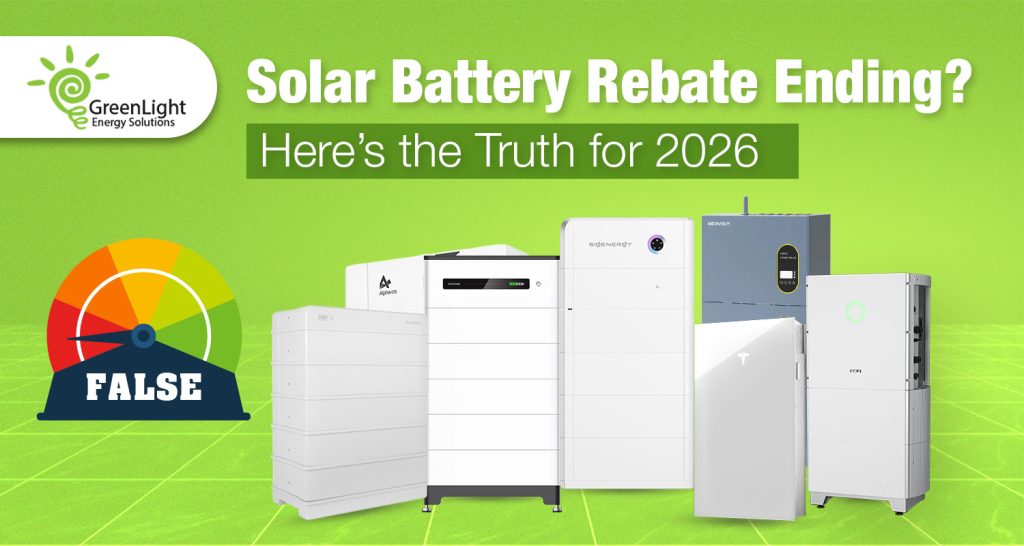
If you’ve seen claims that the solar battery rebate is ending in 2026, the reality is more nuanced. The federal incentive supporting home battery systems in Australia is not ending in 2026, but it will change from 1 May 2026. The adjustment affects how the rebate is calculated, which means some installations may receive a slightly smaller discount than earlier in the year.
Understanding these changes can help homeowners decide whether installing a solar battery sooner rather than later makes financial sense. Below is a clear breakdown of how the rebate works, what changes in 2026, and what it means for households considering solar battery storage.
What Is the Solar Battery Rebate in Australia?
Australia’s federal battery incentive is delivered through the Cheaper Home Batteries Program, designed to encourage households and businesses to install energy storage alongside rooftop solar systems.
The program does not operate as a cash payment. Instead, it works through Small-scale Technology Certificates (STCs), which reduce the upfront cost of installing a battery. When an eligible battery system is installed, certificates are created and typically applied by the installer as a discount on the system price.
To qualify, batteries must generally:
- Have a capacity between 5 kWh and 100 kWh
- Be installed with a solar PV system
- Be installed by an accredited installer
- Meet program compliance requirements
However, STCs can only be claimed on up to 50 kWh of usable battery capacity.
Is the Solar Battery Rebate Ending in 2026?
No, the solar battery rebate is not ending in 2026. The federal Cheaper Home Batteries Program is expected to continue until 2030, although the incentive gradually decreases over time. This reduction reflects the expectation that battery technology will become cheaper and more widely adopted. While rebates will still be available after 2026, the financial benefit may be slightly smaller compared with earlier installations.
For homeowners considering battery storage, this means the incentive remains available but the level of support will slowly decline over the coming years.
What Changes to the Battery Rebate in May 2026?
The major change happens on 1 May 2026, when the STC factor used to calculate the rebate decreases. From January to April 2026, the STC factor sits at 8.4, providing a stronger incentive. From May to December 2026, the factor drops to 6.8, which reduces the value of the rebate applied to new installations.
The rebate still exists after this date, but the lower factor means homeowners may receive a smaller discount compared with installations completed earlier in the year.
How Much Rebate Can You Get for a Solar Battery?
The exact rebate amount depends on factors such as battery size, STC market value and installation timing. A typical example often used in industry estimates is a 10 kWh battery system, which could attract a rebate of roughly $3,000 to $3,300 under current conditions.
Actual figures vary between installations, as certificate values fluctuate and system pricing differs between installers. Larger battery systems may generate more STCs overall, but from May 2026 the program introduces a taper that reduces incentives for larger capacities.
How the Battery Capacity Taper Works
From 1 May 2026, the incentive is structured to encourage right-sized batteries rather than oversized systems.
The STC factor applies in tiers:
Battery CapacityIncentive Applied
First 14 kWh 100% of STC factor
14–28 kWh 60% of STC factor
28–50 kWh 15% of STC factor
This means smaller systems receive the strongest incentive, while additional capacity beyond certain thresholds receives reduced support.
The change is designed to balance government support with efficient energy storage sizing.
Who Is Eligible for the Federal Battery Rebate?
Eligibility for the rebate depends on several requirements. The battery system must be new, compliant with scheme standards, and installed by an accredited installer. It must also be connected to a solar PV system, either newly installed or already operating at the property.
Another important rule is that only one battery rebate can be claimed per property. This means homeowners should carefully consider the appropriate battery size when installing, as expanding storage later may not qualify for additional incentives.
Can Western Australian Homeowners Access Extra Battery Rebates?
Homeowners in Western Australia may have access to additional incentives through the WA Residential Battery Scheme, depending on eligibility and program availability.
The scheme is designed to support energy storage adoption across the state and can potentially be combined with the federal rebate. In some scenarios, estimates suggest a 10 kWh battery could receive around $5,000 for Synergy customers and up to $7,500 for Horizon Power customers when incentives are combined.
Because eligibility rules and funding availability can change, homeowners should confirm the latest program conditions before installing a system.
Should You Install a Solar Battery Before May 2026?
For households already planning to install a battery, completing the installation before 1 May 2026 may deliver a larger rebate due to the higher STC factor. However, the rebate alone should not determine whether installing a battery is worthwhile.
Battery systems deliver value in several ways, including:
- storing excess solar energy for night-time use
- reducing reliance on grid electricity
- improving resilience during outages
- increasing self-consumption of solar power
A well-designed solar and battery system should match the home’s energy usage patterns, solar generation and electricity tariff structure.
Why the Battery Rebate Gradually Decreases
Government renewable energy programs are often designed to reduce over time. As technology becomes more common and manufacturing costs fall, less financial support is required to encourage adoption.
Australia’s rooftop solar industry followed this same pattern. Early solar rebates were high to stimulate growth, but as installation volumes increased and prices dropped, incentives were gradually reduced.
Battery storage is expected to follow a similar path, with declining rebates reflecting lower technology costs and wider adoption.
The Key Takeaway for Homeowners
The solar battery rebate is not ending in 2026. Instead, the incentive will continue with a gradual reduction in value after 1 May 2026, as part of the government’s planned phase-down of solar incentives. This means homeowners who install a battery earlier may receive a slightly higher rebate, but support for new battery installations will still be available in the years ahead.
For households looking to store excess solar energy and reduce reliance on the grid, a solar battery remains one of the most effective ways to maximise the value of rooftop solar systems. By storing unused daytime energy for evening use, households can reduce electricity costs and improve energy independence.
At Greenlight Solar, we help homeowners choose the right solar battery solution to suit their energy needs. Our team provides expert guidance on battery systems, installation, and available rebates, helping you get the most out of your solar investment while making the most of current government incentives.
FAQ :
Is the solar battery rebate ending in 2026?
No, the solar battery rebate is not ending in 2026. The federal Cheaper Home Batteries Program is expected to continue until 2030. However, the rebate value gradually decreases over time as battery technology becomes more affordable. From 1 May 2026 the STC factor used to calculate the rebate drops, which means new installations may receive a smaller discount compared with systems installed earlier in the year.
How much is the solar battery rebate in Australia?
The rebate amount depends on the battery size, installation timing and certificate market value. For a typical 10 kWh home battery system, estimates often place the rebate around $3,000 to $3,300. Larger systems may generate more certificates, but from May 2026 the incentive reduces for additional battery capacity through a tiered calculation system.
What is the Cheaper Home Batteries Program?
The Cheaper Home Batteries Program is a federal incentive designed to encourage Australians to install solar battery storage systems. The program reduces upfront installation costs through Small-scale Technology Certificates (STCs). These certificates are usually applied as a discount by the installer, helping homeowners lower the cost of adding battery storage to a solar system.
Can you combine federal and state battery rebates?
In some cases, yes. Certain states offer additional incentives that may be combined with the federal battery rebate. For example, Western Australia’s Residential Battery Scheme may allow eligible homeowners to stack state and federal support, significantly lowering the upfront cost of installing a solar battery system.
What size battery qualifies for the rebate?
Eligible battery systems must typically have a capacity between 5 kWh and 100 kWh. However, the federal incentive only applies to the first 50 kWh of usable battery capacity. This means most residential systems qualify, although extremely large commercial installations may not receive rebates on their full capacity.