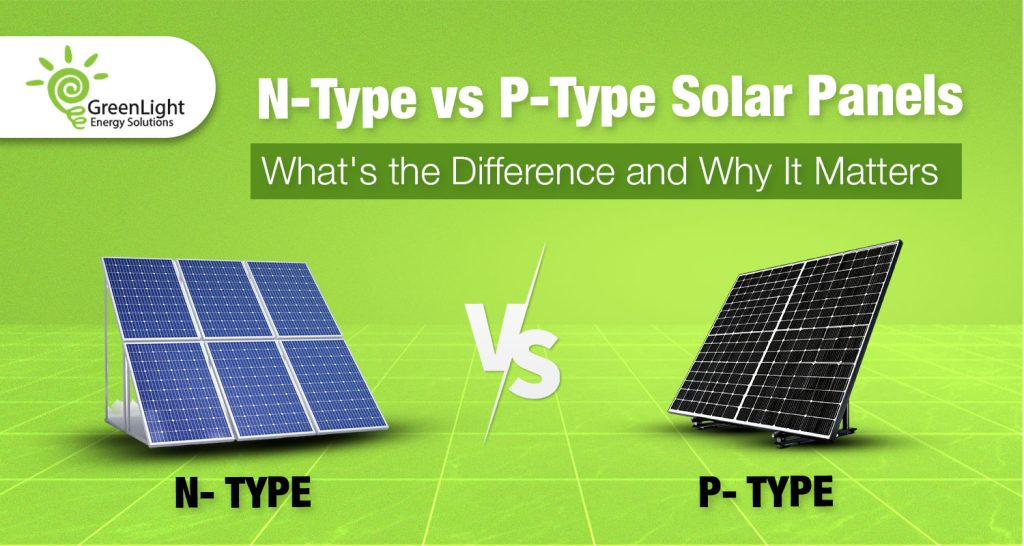
When it comes to choosing solar panels for your home or business, the conversation has moved well beyond simply picking a brand or comparing price per watt. Today, one of the most important decisions you’ll make is choosing between N-Type and P-Type solar panels, two fundamentally different solar cell technologies that deliver very different levels of performance, efficiency, and long-term value.
Whether you’re a homeowner in Sydney looking to cut electricity bills or a business owner planning a large commercial solar installation, understanding the difference between N-Type and P-Type panels will help you make a smarter, more informed investment.
At Greenlight Solar, we believe an educated customer always ends up with the right system. So let’s break it down clearly.
What Are Solar Panel Cell Types?
Every solar panel is built around a core component, the solar cell which is responsible for converting sunlight into electricity. These cells are made from silicon, and the way that silicon is treated during manufacturing determines whether a panel is classified as N-Type or P-Type.
The “N” stands for negative and the “P” stands for positive, referring to the type of electrical charge carrier dominant in each silicon layer. This seemingly small difference in chemistry has a significant impact on how the panel performs over its lifetime.
What Are P-Type Solar Panels?
P-Type solar panels have been the industry standard for decades. They are made using silicon doped with boron, which creates a positively charged silicon layer. For years, P-Type dominated the solar market simply because they were cheaper and easier to manufacture at scale.
How P-Type panels work: The boron-doped silicon layer creates “holes” (positive charge carriers) that allow electricity to flow when sunlight hits the cell. This process is well understood and has been refined over 40+ years of solar manufacturing.
Common P-Type panel technologies:
- PERC (Passivated Emitter and Rear Cell) — the most widely used P-Type upgrade, adding a rear surface passivation layer to boost efficiency
- BSF (Back Surface Field) — an older P-Type design, less common in modern installations
- Multi-crystalline (Poly) P-Type — lower cost, lower efficiency, less common today
Typical efficiency range: 18% – 21%
What Are N-Type Solar Panels?
N-Type solar panels represent the next generation of solar technology. Instead of boron, the silicon is doped with phosphorus, creating a negatively charged silicon layer. N-Type panels were initially used in space and high-performance applications due to their superior efficiency and they’ve now become increasingly accessible for residential and commercial use.
How N-Type panels work: Phosphorus doping creates an electron-rich silicon layer. Because electrons (rather than “holes”) are the primary charge carriers, N-Type cells are inherently more efficient and far less susceptible to a key degradation issue called Light-Induced Degradation (LID).
Common N-Type panel technologies:
- TOPCon (Tunnel Oxide Passivated Contact) — the most commercially popular N-Type technology today, offering high efficiency with strong temperature performance
- HJT (Heterojunction Technology) — combines crystalline silicon with amorphous silicon layers for exceptional efficiency and low temperature coefficients
- IBC (Interdigitated Back Contact) — premium technology where all contacts are on the rear of the cell, maximising light absorption
Typical efficiency range: 21% – 24%+
N-Type vs P-Type: Head-to-Head Comparison
| Feature | P-Type Panels | N-Type Panels |
| Silicon Doping | Boron (positive) | Phosphorus (negative) |
| Efficiency | 18% – 21% | 21% – 24%+ |
| Light-Induced Degradation (LID) | More susceptible | Highly resistant |
| Temperature Coefficient | Higher (more heat loss) | Lower (better in heat) |
| Annual Degradation Rate | ~0.5% – 0.7% per year | ~0.3% – 0.4% per year |
| Low-Light Performance | Good | Excellent |
| Lifespan | 25 years | 25–30+ years |
| Cost | Lower upfront | Slightly higher upfront |
| Best For | Budget-conscious installs | Maximum long-term output |
Key Differences Explained in Detail
1. Efficiency
N-Type panels are simply more efficient at converting sunlight into electricity. With efficiency ratings regularly exceeding 22–23%, premium N-Type TOPCon and HJT panels generate more power per square metre than their P-Type counterparts. This is particularly valuable when roof space is limited such as on residential rooftops or smaller commercial buildings — where you need to squeeze maximum output from a constrained area.
For a Sydney home with a 6.6kW system, the difference between P-Type and N-Type panels could mean producing 5–10% more electricity annually, which adds up to thousands of dollars in savings over the system’s lifetime.
2. Light-Induced Degradation (LID)
This is one of the most critical differences between the two technologies, and it’s one that’s often overlooked.
LID is a performance drop that occurs in the first few hours and days after a solar panel is exposed to sunlight for the first time. P-Type panels, particularly those using boron-doped silicon, are prone to LID because boron interacts with oxygen in the silicon to form efficiency-robbing defects when exposed to light.
N-Type panels, because they use phosphorus instead of boron, are naturally resistant to LID. This means an N-Type panel will perform at or very close to its rated output from day one, while a P-Type panel may experience an initial efficiency drop of 1–3% before stabilising.
3. Temperature Coefficient
Sydney summers are hot and heat is one of solar panels’ biggest enemies. All solar panels lose efficiency as temperatures rise above 25°C, but the rate of that loss varies between N-Type and P-Type.
- P-Type PERC panels typically have a temperature coefficient of around -0.35% to -0.45% per °C
- N-Type TOPCon panels typically perform at -0.30% to -0.35% per °C
- N-Type HJT panels achieve an outstanding -0.24% to -0.26% per °C
On a 40°C Sydney summer day which is 15°C above the standard test temperature of 25°C an HJT N-Type panel will retain significantly more output than a standard P-Type panel. For Australian conditions specifically, this temperature advantage is a major real-world benefit.
4. Long-Term Degradation Rate
Every solar panel degrades over time meaning it produces slightly less electricity each year. The annual degradation rate is a key metric that determines how much power your system will produce in year 10, year 15, and year 25.
- P-Type panels: Average degradation of 0.5% – 0.7% per year
- N-Type panels: Average degradation of 0.3% – 0.4% per year
Over a 25-year period, a P-Type panel retained 82–85% of its original output compared to an N-Type panel retaining 90–92%. That gap represents substantial real-world energy generation and real savings.
5. Low-Light and Diffuse Light Performance
Sydney experiences overcast days, early mornings, and late afternoons where sunlight is indirect or diffuse. N-Type panels, particularly HJT, have a superior ability to generate electricity under low-irradiance conditions. This means your system starts producing earlier in the morning, keeps generating later in the afternoon, and performs better on cloudy days compared to standard P-Type panels.
Which Panel Type Is Right for You?
Choose P-Type PERC if:
- You have a generous budget but want to minimise upfront costs
- You have ample roof space and aren’t constrained by area
- Your primary goal is a reliable, proven technology at a lower price point
- You’re installing a basic residential system with standard energy needs
Choose N-Type (TOPCon or HJT) if:
- You want maximum energy output per square metre
- Your roof space is limited
- You’re in a hot climate and want better temperature performance (ideal for Sydney)
- You’re planning a commercial or large-scale installation where long-term performance matters
- You want the best possible return on investment over 25+ years
- You’re investing in premium quality and want the latest solar technology
The Future of Solar Is N-Type
The global solar industry is rapidly shifting towards N-Type technology. Major manufacturers including Jinko Solar, LONGi, Canadian Solar, REC, and Panasonic have all invested heavily in N-Type TOPCon and HJT production lines. Market analysts project that N-Type panels will account for the majority of global solar panel shipments within the next few years and the price gap between N-Type and P-Type continues to narrow.
Choosing N-Type today means you’re investing in technology that will remain relevant, well-supported, and high-performing for the full lifespan of your system.
Ready to Choose the Right Solar Panels for Your Home or Business?
The difference between N-Type and P-Type solar panels can mean thousands of dollars in additional savings over the life of your system. Getting the right advice from a trusted, experienced solar installer is the key to making a choice you’ll be happy with for decades to come.
Greenlight Solar offers expert guidance on solar panel technology selection for both residential and commercial customers across Greater Sydney and NSW. Our team will assess your roof, energy usage, and goals to recommend the ideal panel technology for your specific situation with full transparency on costs, savings, and expected performance.
Get your free solar consultation today and let Greenlight Solar help you invest in the right technology from day one.
FAQs
Q1: What is the main difference between N-Type and P-Type solar panels?
The key difference lies in the silicon doping material used in the cell. P-Type panels use boron-doped silicon, while N-Type panels use phosphorus-doped silicon. This makes N-Type panels more resistant to Light-Induced Degradation (LID), more efficient at converting sunlight to electricity, better performing in high temperatures, and longer lasting overall. N-Type panels typically achieve 21–24%+ efficiency compared to P-Type’s 18–21%.
Q2: Are N-Type solar panels worth the extra cost?
Yes, in most cases. While N-Type panels carry a slightly higher upfront cost, they generate more electricity over their lifetime due to higher efficiency, lower annual degradation rates (0.3–0.4% vs 0.5–0.7%), and better performance in heat. For Sydney homeowners and businesses, this translates to greater long-term savings that outweigh the initial price difference often by a significant margin over a 25-year system life.
Q3: What does LID (Light-Induced Degradation) mean in solar panels?
LID refers to the efficiency drop that occurs when a solar panel is first exposed to sunlight. It is primarily a P-Type panel issue, caused by the interaction of boron and oxygen in the silicon when light hits the cell. This can cause an initial performance loss of 1–3%. N-Type panels are naturally resistant to LID because they use phosphorus instead of boron, meaning they maintain close to their rated output from the very first day of operation.
Q4: Which solar panel type performs better in hot Australian weather?
N-Type panels perform significantly better in hot conditions. They have a lower temperature coefficient meaning they lose less efficiency as temperatures rise above 25°C. N-Type HJT panels have a temperature coefficient as low as -0.24% per °C, compared to -0.45% for some P-Type panels. On a hot 40°C Sydney summer day, N-Type panels will produce noticeably more electricity, a major advantage in the Australian climate.
Q5: What are TOPCon and HJT solar panels?
TOPCon (Tunnel Oxide Passivated Contact) and HJT (Heterojunction Technology) are two leading N-Type solar panel technologies. TOPCon is currently the most commercially popular N-Type option, offering high efficiency (21–23%) at a competitive price. HJT is a premium N-Type technology that achieves the lowest temperature coefficients and highest low-light performance, with efficiencies reaching 23–24%+. Both are significant upgrades over standard P-Type PERC panels.
Q6: How long do N-Type vs P-Type solar panels last?
Both panel types are typically warrantied for 25 years, but N-Type panels degrade more slowly. P-Type panels degrade at approximately 0.5–0.7% per year, retaining around 82–85% of original output after 25 years. N-Type panels degrade at just 0.3–0.4% per year, retaining 90–92% of output over the same period. This means N-Type panels produce meaningfully more electricity in the later years of the system’s life.
Q7: Should I choose N-Type or P-Type panels for my Sydney home or business?
For most Sydney homeowners and businesses, N-Type panels (particularly TOPCon) are the recommended choice in 2024 and beyond. Sydney’s hot climate makes the temperature performance advantage of N-Type especially valuable, and the price gap between N-Type and P-Type has narrowed significantly. If budget is the primary concern and roof space is plentiful, P-Type PERC remains a solid and proven option. For limited roof space or maximum ROI over time, N-Type is the clear winner.