iStore Solar Battery
Modular 5 kWh storage blocks, built to pair with iStore hybrid inverters.
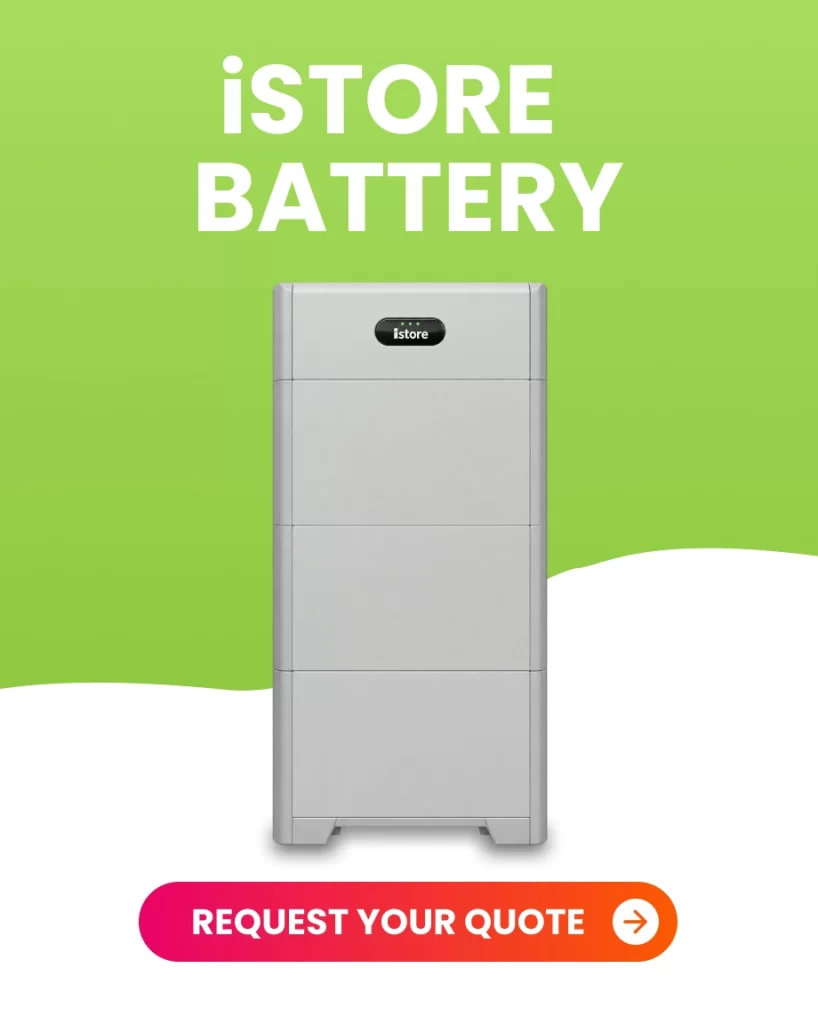
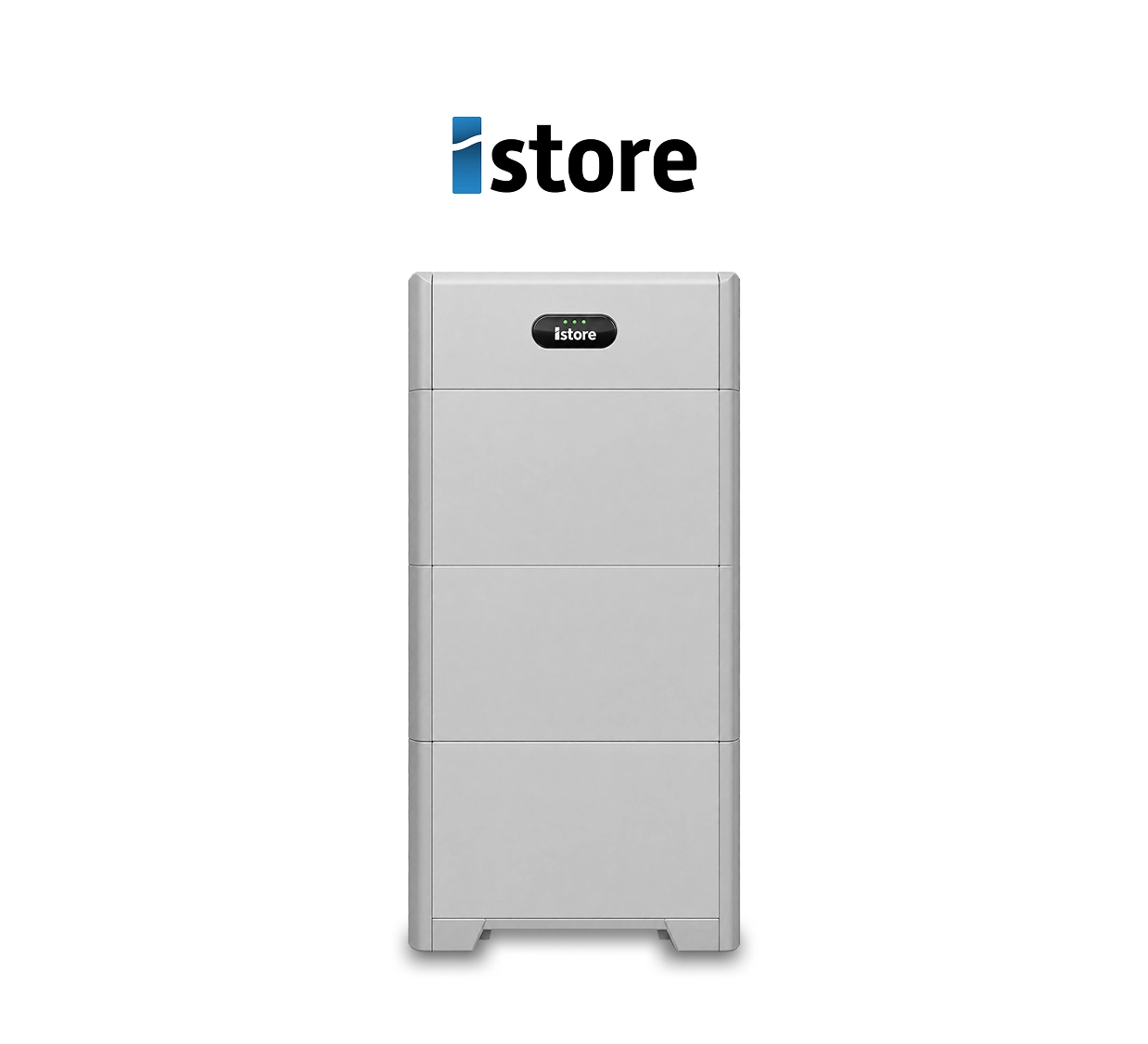
Most home batteries ask you to commit to a fixed capacity on day one. The iStore 5000ES works differently: it is built from 5 kWh battery modules that stack onto a single power module, so a household can start with the storage it needs now and add modules later as consumption changes.
The trade-off worth understanding before you go further is compatibility. The iStore battery is a high-voltage, DC-coupled system that connects to selected iStore hybrid inverters. It is not a universal retrofit battery. If you already have solar, the first question our team will ask is what inverter is on your wall, because that determines whether an iStore battery is a sensible fit or whether a different product suits your site better.
Greenlight Solar supplies and installs iStore battery systems for homes and small businesses, and we will tell you honestly if the numbers do not stack up for your property.
Capacity options: start at 5 kWh, build to 60 kWh
Each iStore stack combines one power module with between one and three 5 kWh battery modules. Usable energy is quoted at 100% depth of discharge, which means the headline capacity is the capacity you can draw on.
Configuration | Battery modules | Usable energy | Max discharge power | Peak output (10 s) |
IS-BATT-5000-S0 | 1 | 5 kWh | 2.5 kW | 3.5 kW |
IS-BATT-10000-S0 | 2 | 10 kWh | 5 kW | 7 kW |
IS-BATT-15000-S0 | 3 | 15 kWh | 5 kW | 7 kW |
Fifteen kilowatt hours is the ceiling for a single stack. Beyond that, iStore supports parallel operation: up to two systems with the 5 kW/6 kW single-phase and 5 kW/6 kW three-phase hybrid inverters, and up to four systems with the 10 kW/15 kW/25 kW three-phase hybrid inverter, which requires the iStore SmartPS-80AI-T0 smart meter. That is how the range reaches 60 kWh for larger homes and small commercial sites.
Note the power figures as well as the energy figures. A single 5 kWh module delivers 2.5 kW of continuous output, which covers lighting, fridges and electronics but will not run a ducted air conditioner and an induction cooktop at the same time. Two or more modules lift continuous output to 5 kW. For households with heavy evening loads, the power rating often decides the configuration before capacity does.
Which size suits your home? It depends on how much solar you export on a typical day, how much electricity you use after sunset, and whether an EV or electrified hot water is on the horizon. We work that out from your bills and interval data rather than from a rule of thumb. Ask us to size your battery.
Inverter compatibility: the question that decides everything
The iStore battery is DC-coupled to an iStore hybrid inverter. The current datasheet lists three compatible inverter families:
- IS-HYB-5000-6000-10000-1PH (single phase)
- IS-HYB-5000-6000-3PH (three phase)
- IS-HYB-10000-15000-25000-3PH (three phase)
What this means in practice:
New solar and battery together. Straightforward. The hybrid inverter and battery are specified as one system from the start, and you avoid paying for conversion hardware later.
Existing solar with a non-iStore inverter. Adding an iStore battery would mean replacing or supplementing your inverter. Depending on the age of your existing system, that can still make sense, but it changes the cost picture and it may affect the warranty position on your current equipment. We will put both options in front of you before you commit.
Existing iStore hybrid inverter. Usually the cleanest retrofit of the three, subject to a check on the model number, firmware and switchboard capacity.
We never promise that a battery “works with any inverter”, because none of them do. Compatibility is confirmed against your actual inverter model before we quote. If an iStore battery is not the right pairing for your site, our solar battery range includes AC-coupled and inverter-agnostic alternatives.
Safety and build quality
The iStore battery uses lithium iron phosphate (LiFePO₄) cells, a chemistry chosen across the Australian residential market for its thermal stability.
iStore describes four layers of protection in the product:
- Stable LFP cell chemistry at the cell level
- Eight temperature sensors monitoring conditions inside each battery module
- Galvanic isolation between the battery system and connected equipment
- An automatic fire extinguisher built into each battery module
On the physical side, the battery carries an IP66 protection rating and an operating range of −20°C to +55°C. Cooling is by natural convection with no fan, and noise emission is rated below 29 dB, which matters if the installation position is near a bedroom window or a neighbour’s boundary. The 150 mm depth helps where clearance is tight down the side of a house or through a garage.
Floor standing is the standard mounting arrangement, with wall mounting available as an option.
Full specifications
Specification | Detail |
Cell technology | Lithium iron phosphate (LiFePO₄) |
Battery module energy | 5 kWh |
Usable energy per stack | 5 kWh / 10 kWh / 15 kWh (1 to 3 modules) |
Depth of discharge | 100% |
Max discharge power | 2.5 kW (1 module), 5 kW (2 to 3 modules) |
Max charge power | 2.5 kW (1 module), 5 kW (2 to 3 modules) |
Peak output | 3.5 kW for 10 s (5 kWh), 7 kW for 10 s (10 and 15 kWh) |
Nominal voltage | 450 V single phase, 600 V three phase |
Dimensions (W×D×H) | 670 × 150 × 600 mm / 960 mm / 1320 mm |
System weight | 63.8 kg / 113.8 kg / 163.8 kg (floor stand toolkit included) |
Battery module weight | 50 kg (power module 12 kg) |
Protection rating | IP66 |
Operating temperature | −20°C to +55°C |
Cooling | Natural convection |
Noise emission | <29 dB |
Communication | RS485 / CAN (parallel operation), SOC and LED indicators |
Installation | Floor stand standard, wall mount optional |
Scalability | Up to 2 systems in parallel (1PH and 5/6 kW 3PH inverters), up to 4 systems (10/15/25 kW 3PH inverter, smart meter required) |
Compliance | RCM, CEC, IEC 62619, IEC 62040, UN 38.3 |
Country of manufacture | China |
Figures are taken from the current iStore Australian specification sheet. Final configuration, parallel operation and available functions depend on the connected inverter and the installed system.
Backup power during an outage
A battery on its own does not keep the lights on. Backup requires compatible iStore inverter and backup equipment, correct circuit wiring, and a switchboard that can accommodate it. iStore advises that on a single-phase site whole-home backup is achievable, while on a three-phase site one phase can be backed up. Whether whole-home backup is the right choice is a separate question: backing up everything can drain stored energy quickly in a long outage, so many households choose to protect essential circuits only and extend their runtime. If blackout resilience is a priority for you, say so early. It affects the inverter selection, the backup hardware, the circuits we separate at the switchboard, and sometimes the capacity you choose.
Monitoring your energy
Paired with a compatible iStore inverter, the system reports solar generation, household consumption, grid import and export, and battery state of charge through the iStore monitoring platform. Compatible equipment is detected automatically during commissioning, which shortens setup time on the day. Monitoring is more useful than most people expect in the first few months. It shows you whether your battery is actually filling from solar or topping up from the grid, and whether your habits need adjusting to get the most from the system.
Eligible Households Can Be Qualified For Rebates Up To $10,000 On Solar Battery Installation!
Where an iStore battery makes sense
Households with a strong daytime solar surplus and a busy evening. If you are exporting several kilowatt hours a day for a modest feed-in tariff and then buying power back at peak rates after 5pm, storage closes that gap.
Homes planning to electrify in stages. The modular format suits households that expect to add an EV, a heat pump or reverse-cycle heating over the next few years. Starting at 10 kWh and adding a module later is a workable path, provided the inverter was specified with that in mind.
Existing iStore owners. If you already run an iStore heat pump hot water system, running the battery and the hot water system on the same solar surplus keeps more of your generation at home.
Small commercial sites with evening or early-morning load. Workshops, clinics and hospitality venues with three-phase supply can reach higher capacities through parallel operation. Export limits and load profile matter more than roof size here, so it is worth starting with a look at your interval data. See our commercial solar installation page for how we approach these sites.
It is a weaker fit for off-grid or near off-grid operation, and for households that want to retain a non-iStore inverter.
Rebates and incentives
Cheaper Home Batteries Program (federal)
Eligible battery systems between 5 kWh and 100 kWh can receive an upfront discount delivered through small-scale technology certificates, which your installer assigns at the point of sale. Since 1 May 2026 the support has been tiered: the first 14 kWh of usable capacity earns the full STC factor, capacity between 14 and 28 kWh earns a reduced rate, and capacity above 28 kWh earns a much smaller rate, with support capped at the first 50 kWh. The rate is set by the STC factor on your installation date and steps down again from 1 January 2027. The dollar value also moves with the STC market price, so we quote the figure that applies on the day. Our federal battery rebate guide explains the tiers in more detail.
NSW VPP incentive
NSW households and businesses may be able to claim a separate one-off incentive under the Peak Demand Reduction Scheme for connecting an eligible battery to a virtual power plant. It is claimed after installation through an approved VPP provider, the amount varies with capacity and provider, and it can generally be claimed once per site. Contract terms differ between providers, so compare the offer and not just the headline payment. Our explainer on whether a VPP is worth joining covers the trade-offs.
Eligibility conditions apply to both, approved product and accredited installer requirements apply, and scheme rules can change. We confirm what applies to your installation in writing before you sign anything.
Installation and what we check first
Before quoting an iStore battery we look at:
- Your existing inverter make, model and age, and whether it supports a DC-coupled iStore battery
- Switchboard capacity, main switch rating and whether an upgrade is needed
- Single-phase or three-phase supply at the property
- A suitable installation position within temperature, clearance and access limits, bearing in mind each battery module weighs 50 kg
- Whether backup circuits are required, and which ones
- Your consumption pattern across the day, taken from your bills or interval data
- Approved export capacity, which depends on your local network and connection
Installation time varies with system size, site conditions and any electrical upgrades required. Every installation is carried out by accredited installers to Australian standards.
Why homeowners choose Greenlight Solar
- Supply and installation of solar, batteries, inverters, heat pumps and EV chargers, so a battery can be specified alongside everything else on the property rather than in isolation
- Accredited installation team and Clean Energy Council membership
- NETCC Approved Seller
- Head office at Rouse Hill in NSW and an office at Ashmore in Queensland
- A product range across multiple battery brands, so there is no reason for us to push you toward a system that does not suit your inverter or your load
- Help with rebate paperwork and VPP enrolment, and monitoring set up before we leave site
- Finance options may be available, subject to eligibility and approval
iStore battery FAQs
Only if your inverter is a compatible iStore hybrid model, or you are prepared to change the inverter. The iStore battery is DC-coupled to selected iStore hybrid inverters, so it is not a drop-in retrofit for every system. Send us a photo of your inverter and we will tell you where you stand.
Each battery module holds 5 kWh and the usable figure is quoted at 100% depth of discharge, so one module gives 5 kWh, two give 10 kWh and three give 15 kWh in a single stack. There is no separate "nominal versus usable" gap to allow for.
Yes, within limits. A stack takes a maximum of three battery modules. Past 15 kWh, expansion happens by running systems in parallel, and how many you can run depends on the inverter: two with the single-phase and smaller three-phase hybrids, four with the larger three-phase hybrid, which also needs the iStore smart meter. If you expect to expand, the inverter should be chosen accordingly at the outset.
Not on its own. Backup needs a compatible iStore inverter and backup equipment plus the right circuit wiring. iStore advises that whole-home backup is achievable on single-phase sites, while three-phase sites can back up one phase. We scope the backup arrangement with you before installation rather than assuming it.
Battery systems between 5 kWh and 100 kWh installed by an accredited installer and using approved products can receive the Cheaper Home Batteries Program discount, with support tiered by capacity and capped at the first 50 kWh. Eligibility is confirmed for your specific system and installation date. We apply the discount to your quote rather than making you claim it afterwards.
The battery carries an IP66 rating and an operating range of −20°C to +55°C, so outdoor installation is possible where the manufacturer's installation conditions are met. Position still matters: direct western sun on a hot roof wall is worth avoiding, and access for a 50 kg module needs thinking through. Our installer assesses the position on site.
Yes. iStore lists both single-phase and three-phase compatible hybrid inverters, and the larger three-phase inverter supports the highest parallel capacity. Which configuration suits you depends on your supply, your loads and whether you want backup.
It is rated below 29 dB and cooled by natural convection with no fan, which is quieter than most wall-mounted alternatives. That is worth knowing if the only practical installation wall is near a bedroom.
Talk to us about an iStore battery
Send through a recent electricity bill and a photo of your existing inverter and switchboard. We will confirm whether an iStore battery is compatible with your system, recommend a capacity based on your actual usage, and set out what the federal discount brings the price down to.
We Work With Quality Brands