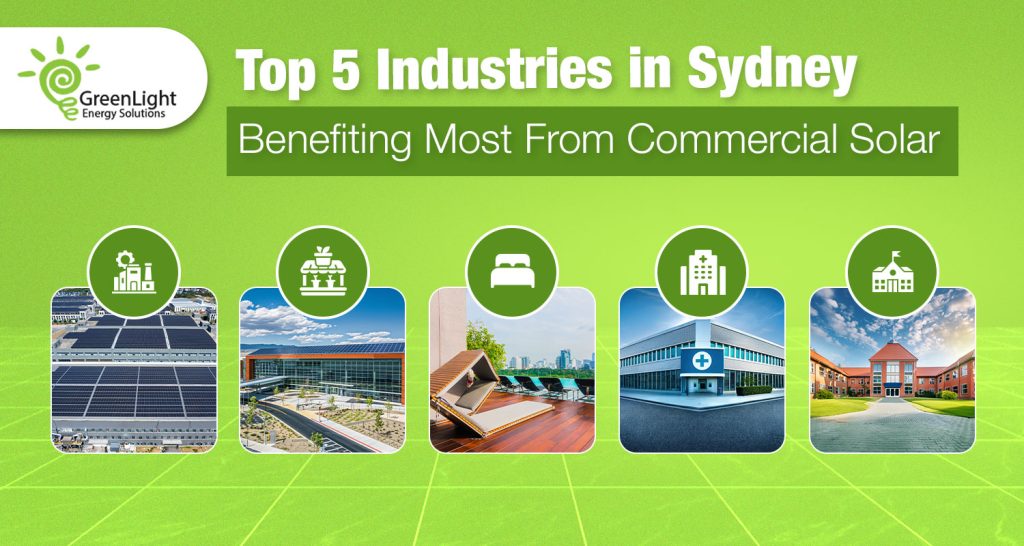
Sydney is one of Australia’s sunniest cities, and for businesses across the region, that sunshine is quickly becoming one of their greatest financial assets. As energy prices continue to rise and sustainability targets tighten, commercial solar has shifted from being a “nice to have” to an absolute business necessity. From manufacturing plants in Parramatta to hospitality venues along the harbour, more Sydney businesses than ever are turning rooftop space into reliable, long-term savings.
At Greenlight Solar , we’ve seen first-hand how solar power is transforming the way Sydney’s commercial sector operates. Here are the top five industries in Sydney that are benefiting the most from commercial solar installations and why now is the right time to make the switch.
1. Manufacturing and Industrial Facilities
Manufacturing is, without question, one of the highest energy-consuming sectors in Sydney. Factories run heavy machinery, production lines, climate control systems, and lighting around the clock often 24/7. This relentless energy demand translates to enormous electricity bills that eat directly into profit margins.
Why commercial solar works so well here:
Manufacturing facilities typically have large, flat roof space perfectly suited for high-capacity solar panel systems. Energy-intensive operations run during daylight hours, maximising direct solar consumption and reducing grid dependency. A well-designed commercial solar system can offset 30–70% of a facility’s daytime electricity usage, and battery storage solutions can extend savings into shift work and evening operations.
Industries like food processing, metal fabrication, printing, and logistics warehousing in areas such as Wetherill Park, Blacktown, and Western Sydney are already seeing substantial reductions in operating costs. With commercial solar payback periods typically ranging from 3 to 6 years and system lifespans exceeding 25 years, the return on investment for industrial solar installations is exceptional.
2. Retail and Shopping Centres
Retail businesses in Sydney face a unique set of energy challenges. Stores require consistent lighting, refrigeration, air conditioning, escalators, and security systems all running simultaneously during peak trading hours, which happen to align perfectly with peak solar generation periods (typically 9am to 3pm).
Why commercial solar is a game-changer for retail:
High daytime energy consumption lines up directly with solar production windows, making retail one of the most financially rewarding sectors for solar adoption. Large rooftops on shopping centres and big-box retailers are ideal for expansive solar arrays. Visible solar installations also resonate with environmentally conscious consumers and strengthen brand image, while reduced overheads allow businesses to offer more competitive pricing or reinvest savings back into the business.
Retail customers increasingly prefer to shop with businesses that demonstrate a genuine commitment to sustainability. Retailers in Sydney CBD, Parramatta, Bondi, and surrounding suburbs are using commercial solar not just as an energy tool, but as a powerful marketing differentiator. Solar systems ranging from 50kW to 500kW+ are becoming increasingly common across Sydney’s retail landscape. Combined with smart energy monitoring systems, retail operators can track real-time savings and manage energy usage across multiple outlets.
3. Hospitality — Hotels, Restaurants and Cafés
Sydney’s hospitality industry is one of the most energy-intensive in the country. Hotels run heating, cooling, hot water systems, commercial kitchens, lifts, and room lighting constantly. Restaurants and cafés operate high-powered appliances including commercial ovens, refrigerators, dishwashers, and exhaust systems every single day.
The energy bill reality:
A mid-sized Sydney restaurant can spend anywhere from $2,000 to $8,000+ per month on electricity alone. For hotels, that figure climbs dramatically. With energy costs making up 5–10% of total revenue in hospitality, reducing this overhead through solar power has an immediate and measurable impact on profitability.
Commercial solar delivers significant reduction in daytime electricity costs during breakfast, lunch, and afternoon service periods. Solar hot water systems dramatically reduce gas and electric hot water costs in hotels. Battery storage options maximise solar usage through evening dinner service, and enhanced sustainability credentials are increasingly important for attracting eco-conscious travellers and diners.
Tourism and hospitality businesses in Sydney that adopt solar also gain a competitive edge when applying for green certifications and awards, which can directly drive bookings and patronage. From boutique hotels in Surry Hills to beachside restaurants in Manly, solar power is helping Sydney’s hospitality sector stay profitable in a high-cost environment.
4. Healthcare and Medical Centres
Hospitals, medical centres, aged care facilities, and dental practices are facilities that simply cannot afford to have their power compromised. They also run critical equipment and climate systems around the clock meaning their energy bills are substantial and non-negotiable.
Why solar is a smart investment for healthcare:
Medical facilities run 24/7, requiring reliable and consistent energy supply. Solar panels combined with battery backup systems offer energy security and resilience against grid outages. Healthcare providers also face increasing pressure to meet sustainability and emissions reduction targets, and large rooftop areas on hospitals and aged care facilities are well-suited for sizable solar arrays.
Government incentives and solar rebates available through the NSW Government and the federal Small-scale Renewable Energy Scheme (SRES) mean healthcare providers can significantly reduce the upfront cost of commercial solar installation. Medical centres, dental clinics, and private hospitals across Sydney from Chatswood to Liverpool are already benefiting from reduced energy bills and improved energy independence. For aged care facilities in particular, where residents rely on heating, cooling, and medical equipment at all times, solar paired with battery storage provides both financial and operational security.
5. Education — Schools, TAFEs and Universities
Educational institutions are among the most strategically positioned organisations in Sydney to benefit from commercial solar. Schools and universities typically have large roof areas across multiple buildings, operate primarily during daylight hours, and have long ownership horizons meaning they capture the full long-term value of a solar investment.
Why the education sector is ideal for solar:
School hours (8am to 4pm) align almost perfectly with peak solar generation windows. Universities and TAFE campuses have expansive rooftop surfaces across lecture halls, libraries, sports facilities, and administration buildings. Long-term planning horizons mean schools can maximise the 25+ year lifespan of solar systems. There’s also a strong community and environmental education angle students learn about clean energy first-hand and solar directly reduces the school’s operating budget, freeing up funds for educational resources.
Many NSW schools have already accessed government grants and the NSW Sustainability Advantage program to offset the cost of solar installations. Community pressure from parents and students for greener campuses is also accelerating uptake across Sydney’s private and public school sectors. Universities across Camperdown, Kensington, and Macquarie Park are deploying large-scale commercial solar systems as part of broader campus sustainability strategies. Even smaller primary and secondary schools with a 30kW to 100kW solar system can save tens of thousands of dollars per year on electricity.
Why Sydney Businesses Are Making the Switch Now
The business case for commercial solar in Sydney has never been stronger, driven by three key factors:
Rising electricity prices — Australian commercial electricity rates have increased significantly, making solar-generated energy considerably cheaper than grid electricity for most businesses.
Falling solar system costs — The cost of commercial solar panels and battery storage has dropped by over 80% in the past decade, drastically improving payback periods and ROI.
Government solar incentives — The federal Small-scale and Large-scale Renewable Energy Schemes, combined with NSW state programs, provide meaningful rebates and incentives that reduce the upfront investment required.
Commercial solar payback periods in Sydney typically range between 3 and 7 years depending on system size, energy consumption, and tariff structure after which businesses enjoy essentially free electricity for the remaining 20+ years of the system’s life.
Ready to Explore Solar for Your Sydney Business?
Whether you’re running a manufacturing plant, a busy restaurant, a medical centre, or a school, commercial solar can deliver real, measurable savings while future-proofing your operations against rising energy costs.
Greenlight Solar specialises in designing, installing, and maintaining commercial solar systems for Sydney businesses across all industries. Our team of accredited solar engineers provides customised solar assessments, detailed ROI projections, and end-to-end project management from initial consultation through to installation and ongoing monitoring.
FAQs:
Q1: How much does a commercial solar system cost in Sydney?
The cost of a commercial solar system in Sydney typically ranges from $15,000 for a small 30kW system to $200,000+ for large industrial installations (100kW–500kW+). Thanks to federal government rebates through the SRES/LRET schemes, businesses can significantly reduce upfront costs. Greenlight Solar provides a free commercial solar assessment with a detailed cost and savings breakdown tailored to your business.
Q2: What is the payback period for commercial solar panels in Sydney?
Most Sydney businesses see a payback period of 3 to 7 years, depending on energy consumption, system size, and electricity tariff. High-energy industries like manufacturing and hospitality often achieve payback in as little as 3–4 years. Since systems last 25+ years, businesses enjoy 15 to 20+ years of significantly reduced electricity costs after the system pays for itself.
Q3: Are there government rebates or incentives for commercial solar in NSW?
Yes. Sydney businesses can access Federal STCs (for systems up to 100kW), LGCs (for systems over 100kW), NSW Sustainability Advantage programs, and instant asset write-off provisions. These incentives can reduce installation costs by 20–40%, making now an ideal time to invest.
Q4: Can commercial solar work for businesses that operate at night or after hours?
Absolutely. Businesses that operate in the evening can pair their solar system with commercial battery storage (such as Tesla Powerwall or BYD). Excess solar energy generated during the day is stored and used after sunset reducing reliance on expensive peak-hour grid power. Hotels, restaurants, and evening manufacturers commonly use this solar-plus-battery approach.
Q5: How do I know what size commercial solar system my Sydney business needs?
The right size depends on your average daily energy consumption, available roof space, and operational hours. As a general guide small businesses need 10kW–30kW, medium businesses 30kW–100kW, and large industrial facilities 100kW–500kW+. The best way to find out is through a free professional site assessment. Greenlight Solar offers free assessments across Greater Sydney and NSW.