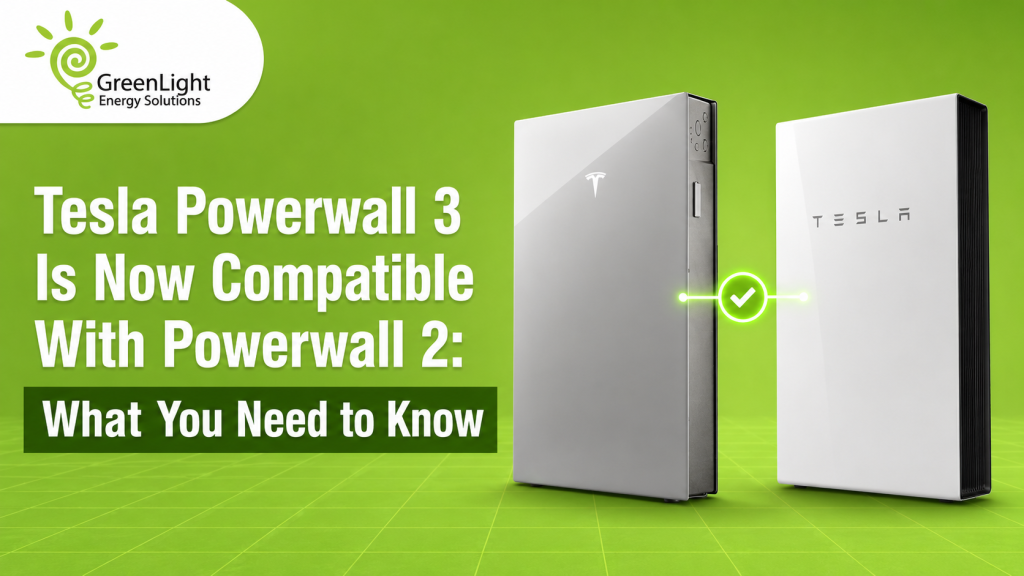
Powerwall 3 can now be added to an existing Powerwall 2 system. Tesla turned this on for Australia and New Zealand first, ahead of every other market, through an over-the-air software update that reached local systems in July 2026. Your Powerwall 2 needs software version 26.26 or later, and there is no hardware swap or rewiring on the Powerwall 2 itself.
If you installed a Powerwall 2 during the battery boom a few years back and have been waiting for a way to add storage, this is the update you were after.
What actually changed
Powerwall 2 and Powerwall 3 were built as separate product lines that could not run together. The Powerwall 2 is AC-coupled and works through an external Gateway at around 5 kW of continuous power. The Powerwall 3 has its inverter built in and delivers up to 11.04 kW continuous. Different architecture, different firmware, no shared operation.
Tesla’s compatibility update closes that gap in software. The Powerwall 2 keeps its hardware as it is. A Powerwall 3 is installed alongside it, and the update lets both generations run as one system that you control from the Tesla app.
How a combined Powerwall 2 and Powerwall 3 system works
In the supported setup, the Powerwall 3 becomes the leader unit. It runs the newer arrangement and connects any Powerwall 3 Expansion units you add. Your Powerwall 2 units carry on storing and discharging as before, now as part of one larger battery that reports as a single system.
For a Powerwall 2 owner, that is a real Tesla battery upgrade path: more storage, newer inverter technology, and longer backup, without tearing out what you already paid for.
Supported configurations and how much storage you can reach
Tesla has set a ceiling on how large a mixed system can grow. You can keep as many as four of your existing Powerwall 2 batteries, add a single Powerwall 3 to lead the system, and extend it further with as many as three Powerwall 3 Expansion units.
Every Powerwall and Expansion unit stores 13.5 kWh, so a lead Powerwall 3 paired with three Expansion units puts up to 54 kWh of fresh capacity behind whatever your Powerwall 2 already holds. Pushed to its maximum, a combined system clears 100 kWh, well beyond what a typical household draws in a day, so your installer will size the real build around your usage rather than the ceiling.
Three-phase homes: the limit to plan around
On a three-phase grid connection, common in larger Australian homes, a combined system can hold the Powerwall 3 to 5 kW of output rather than letting it run at full rating. Whether you hit that cap comes down to how evenly your load sits across the three phases. Part of a proper design is working out whether the phases can be evened up, sometimes by spreading storage across them, and confirming what your local network will sign off on.
Tesla has also signalled a native three-phase Powerwall 3 for later in 2026. If you are on three-phase and want full output, it is worth weighing that timing before you commit.
Gateway 1 and Neurio meters are not supported
Two older components do not carry into the combined configuration: the Gateway 1 and the Neurio meter. On some early Powerwall 2 jobs, a Neurio meter was fitted at the switchboard to monitor solar generation and household use. It is a compact energy-monitoring unit rather than part of the battery itself. Neither it nor the Gateway 1 will function in a combined Powerwall 2 and Powerwall 3 system, and no firmware or settings tweak works around that.
If you are not sure which Gateway or meter you have, the quickest check is to ask whoever installed the system, or have a certified installer look. Where one of these parts is present, the system needs a site assessment first, and in some cases the Gateway or meter is upgraded or replaced before a Powerwall 3 can join.
Your Powerwall 2 warranty and CEC listing
Adding a Powerwall 3 does not change your Powerwall 2 warranty. The Powerwall 2 keeps its original terms, and the new Powerwall 3 and any Expansion units come with their own 10-year warranty.
On compliance, only the new Powerwall 3 needs a current Clean Energy Council listing. Your existing Powerwall 2 is unaffected even if its original CEC listing has lapsed, and the new units go in under a fresh connection agreement.
Rebates and incentives in Australia
The timing works in your favour. Powerwall 3 and Powerwall 3 Expansion units are eligible for discounts under the federal Cheaper Home Batteries Program, which cuts the upfront cost of adding storage and makes expanding an existing Powerwall 2 more affordable. Eligibility and the exact discount depend on your system and install date, so confirm current figures with your installer before you order. Tesla also runs its own promotions from time to time, which are worth checking at the point of ordering.
Is expanding your Powerwall 2 the right move?
Adding storage pays off most when you are regularly emptying your Powerwall 2 before morning, when your usage has grown, or when you want longer backup through outages. If your battery still carries you through most nights with charge to spare, you may not need more yet. Weighing up the costs and benefits of battery storage against your usage data will show whether expansion earns its cost or whether your current setup is already the right size.
If you have a Powerwall 2 and want to know whether your site suits a Powerwall 3 addition, the team at Greenlight Solar can read your usage, check your Gateway and meter, confirm your software version, and size a combined system around your goals.
Frequently asked questions
Is Powerwall 3 compatible with Powerwall 2?
Yes. Since the July 2026 software rollout in Australia and New Zealand, a Powerwall 3 can be installed alongside an existing Powerwall 2 and run as one system. The update calls for software version 26.26 or newer, and nothing needs to change on the Powerwall 2 hardware itself.
Can I add a Powerwall 3 to my existing Powerwall 2 without replacing it?
You can. The Powerwall 3 is added to your current system rather than swapped in for it, so your Powerwall 2 stays in place and keeps working as part of the combined battery.
How many batteries can I combine in one Tesla system?
Up to four Powerwall 2 units, one Powerwall 3 as the leader, and up to three Powerwall 3 Expansion units, subject to a site assessment.
How much extra storage can I add to a Powerwall 2?
A Powerwall 3 and each Expansion unit are rated at 13.5 kWh apiece. Fit one Powerwall 3 with the full three Expansion units and you gain roughly 54 kWh, sitting on top of the storage your Powerwall 2 already provides.
Does adding a Powerwall 3 void my Powerwall 2 warranty?
No. Your Powerwall 2 stays on its existing warranty, and the Powerwall 3 carries a separate 10-year cover.
Will the compatibility update work on a three-phase home?
Yes, though the Powerwall 3 output can be limited to 5 kW in a combined three-phase system, depending on how balanced your phases are. A native three-phase Powerwall 3 is expected later in 2026.
I have a Neurio meter or a Gateway 1. Can I still add a Powerwall 3?
Not without changes first. Neither part is supported in the combined setup, so your setup has to be assessed on site, and the meter or Gateway may need upgrading, before a Powerwall 3 can join.
Do I need a software update before I can add a Powerwall 3?
Yes. Combined operation only kicks in once your Powerwall is running version 26.26 or above. A certified installer can check which version you are on.
Is the Tesla Powerwall 2 and Powerwall 3 update available across Australia?
Australia and New Zealand were the first regions to receive it, ahead of the United States. Whether it works for your home comes down to your existing hardware, your software version, and a certified installer confirming the configuration.