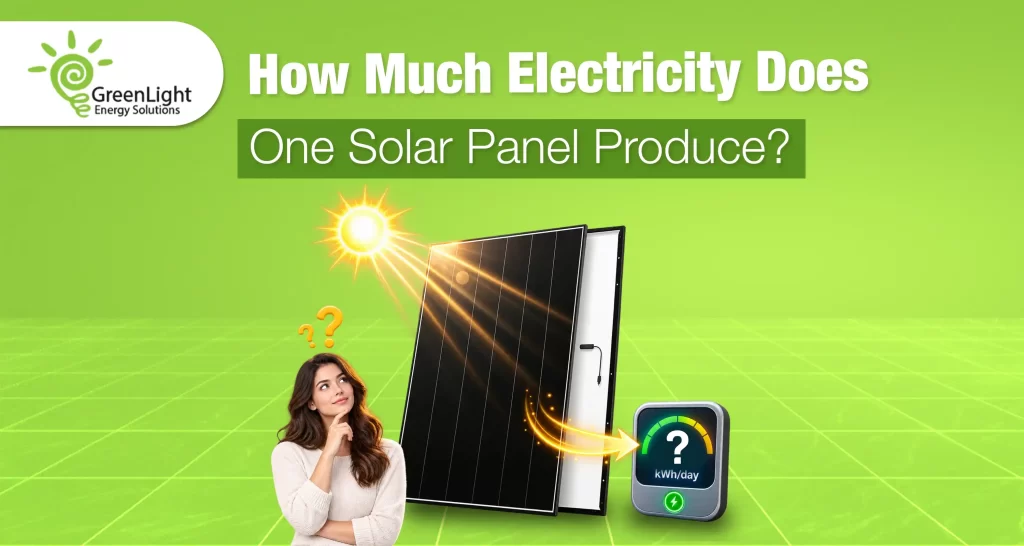
It is the question almost everyone asks before going solar: if I put one panel on the roof, how much power does it actually make? The short answer is that a single modern panel in New South Wales or Queensland produces roughly 1.6 to 2.2 kilowatt-hours (kWh) of electricity on an average day. That is enough to run a fridge, or your lights and TV, with a bit to spare.
But the honest answer has a few more layers, because output changes with the season, the weather, which way your roof faces and where in the state you live. At Greenlight Solar we design systems across NSW and QLD, so this guide breaks down what one panel really produces here, what moves that number up or down, and what it means once you multiply it across a full roof.
Power vs energy: the difference that trips people up
Two numbers matter, and mixing them up causes most of the confusion.
Power is measured in watts (W) or kilowatts (kW). It is the maximum rate a panel can generate in perfect conditions, like the top speed on a car’s speedo. A “440W panel” is rated at 440 watts under laboratory test conditions.
Energy is measured in kilowatt-hours (kWh). It is how much the panel actually delivers over time, like the distance you have driven. This is what shows up on your power bill and what you save money on.
So a 440W rating does not mean the panel makes 440 watts all day. It means that in strong midday sun it can hit that rate, and how much energy (kWh) you collect depends on how many good sunlight hours your roof gets.
How to work out what one panel produces
The simple formula installers use is:
Daily output (kWh) = panel size (kW) × peak sun hours
Peak sun hours are not the same as daylight hours. They are the equivalent number of hours where sunlight is strong enough for the panel to work near its rated power. In NSW and QLD that averages about 3.9 to 4.2 hours a day across the year, even though the sun is up far longer.
For a modern 440W panel:
- In Sydney (about 3.9 peak sun hours): 0.44 kW × 3.9 = around 1.7 kWh a day
- In Brisbane (about 4.2 peak sun hours): 0.44 kW × 4.2 = around 1.85 kWh a day
Scale a single Sydney panel up and you get roughly 51 kWh a month, or about 620 kWh a year, from one panel alone. Real delivered figures land slightly lower once you allow for system losses (more on that below), which is why we quote a working range of about 1.6 to 2.2 kWh per panel per day depending on panel size and location.
Peak sun hours in NSW and Queensland
Because Greenlight installs across both states, here is how the baseline differs. Queensland’s stronger sun gives it an edge over NSW, which flows straight through to output.
| Location | Peak sun hours (avg) | Daily output, one 440W panel | Daily output, 6.6 kW system |
| Sydney / metro NSW | ~3.9 | ~1.7 kWh | ~26 kWh |
| Brisbane / SE QLD | ~4.2 | ~1.85 kWh | ~28 kWh |
These are the Clean Energy Council’s yearly averages. Any single day can be well above or below them: a clear December day might double the winter figure, while a wet, overcast day might deliver a fraction of it. Coastal suburbs also tend to sit slightly under inland areas because of humidity and cloud.
Average solar panel output per day, per kW installed
The cleanest way to compare systems is the average daily output for every 1 kW of panels you install, written as kWh per kW per day. It rolls location, seasons and weather into one working number, and it is the figure the Clean Energy Council publishes.
Because output is driven by local sunlight, it varies from state to state. Here is how an average day looks across Australia’s capitals, including what that means for a single 440W panel and a common 6.6 kW system:
| State / capital | Output per kW, per day | One 440W panel | 6.6 kW system |
| Darwin (NT) | ~4.4 kWh | ~1.9 kWh | ~29 kWh |
| Perth (WA) | ~4.4 kWh | ~1.9 kWh | ~29 kWh |
| Canberra (ACT) | ~4.3 kWh | ~1.9 kWh | ~28 kWh |
| Brisbane (QLD) | ~4.2 kWh | ~1.85 kWh | ~28 kWh |
| Adelaide (SA) | ~4.2 kWh | ~1.85 kWh | ~28 kWh |
| Sydney (NSW) | ~3.9 kWh | ~1.7 kWh | ~26 kWh |
| Melbourne (VIC) | ~3.6 kWh | ~1.6 kWh | ~24 kWh |
| Hobart (TAS) | ~3.5 kWh | ~1.5 kWh | ~23 kWh |
So a 6.6 kW system in Sydney averages about 6.6 × 3.9 = 26 kWh a day, and the same system in sunnier Brisbane a little more. A well-oriented, well-running system with the right tilt can push a bit above these figures on a good run. Across NSW and QLD, where Greenlight designs and installs, that puts most homes in the 26 to 28 kWh a day range for a 6.6 kW system.
One honest caveat worth knowing: two systems both rated at the same kW, sitting side by side, can still produce different amounts. Component quality, how well the inverter is performing, and how the panels cope with heat all shift the real figure. It is another reason the installer and gear you choose genuinely matter, not just the sticker rating.
What actually changes the number
A panel’s rating is only the starting point. These are the factors we assess on every NSW and QLD roof before estimating output.
Sunlight hours and location. The single biggest driver. More peak sun hours means more energy, which is why QLD edges out NSW and why summer trounces winter.
Panel wattage and efficiency. Most quality residential panels sold today are rated 400 to 500W, using high-efficiency monocrystalline cells. Older panels sat around 15 to 18 per cent efficiency, while modern N-type and TOPCon cells reach roughly 22 to 24 per cent, so a newer panel pulls more from the same patch of roof. A higher-wattage, higher-efficiency panel matters most where roof space is tight.
Orientation and tilt. North-facing panels produce the most here. As a rough guide, north-east or north-west roofs still capture around 95 per cent of that, east or west about 85 per cent, and south-facing the least at roughly 75 per cent. The ideal tilt is close to your latitude, so around 30 to 34 degrees in Sydney and a little flatter in Brisbane, though most roofs simply use their existing pitch.
Shade. Solar’s biggest enemy. Even a quarter of one panel in shade, from a tree, a chimney or a TV antenna, can cut that panel’s output by half, and on some systems it drags down the whole string. Where shade is unavoidable, microinverters let each panel work independently so one shaded panel does not pull the rest down.
Temperature. This one surprises people: panels want light, not heat. Output drops by roughly 0.4 to 0.5 per cent for every degree above 25°C, so a scorching QLD or western-Sydney rooftop in a heatwave can shed 10 to 15 per cent of its efficiency. Good installation leaves an air gap under the panels to help them run cooler.
Dirt and maintenance. Dust, bird droppings and leaves block light. Rain does most of the cleaning for you, but coastal salt and dusty areas can benefit from an occasional panel clean, which can lift output by 5 to 10 per cent.
Season. Expect production around 30 to 40 per cent above the yearly average in summer and a similar amount below it in winter, when the sun sits lower and days are shorter.
Cloud cover. Panels still work on overcast days, just at reduced output, often around 10 to 30 per cent of a clear day depending on how heavy the cloud is.
Age. Panels degrade slowly, at roughly 0.5 per cent a year, so a quality panel still delivers around 85 per cent of its original output after 25 years. Most carry a 25-year performance warranty to back that.
System losses: why the delivered figure is a little lower
The panel on the roof is not the only component. Between the cells and your power point there are small, unavoidable losses: the inverter (around 2 to 5 per cent), cabling, heat, and a little dust. Added up, installers apply a real-world factor of roughly 0.8 to 0.85 to the theoretical number. It is why we quote honest working ranges rather than the laboratory maximum, and why quality gear and a clean install genuinely matter to what you get.
What can one panel actually run?
To make about 1.7 kWh a day feel real, here is what a single panel’s output roughly covers in a home:
- A modern fridge, which uses about 1 to 2 kWh a day
- A LED TV for several hours (around 0.4 kWh a day)
- Ten LED bulbs running about four hours (around 0.4 kWh)
- A few cold-water washing machine loads (about 0.25 kWh each)
- Charging phones and a laptop many times over
What one panel cannot do on its own is run the big loads: ducted air conditioning, an electric oven or a pool pump. Those are exactly why a full system, not a single panel, is what powers a home.
Scaling up: what a full system produces
Multiply one panel across a roof and the numbers get meaningful fast. A 6.6 kW system is around 15 modern panels, and here is what common sizes generate in NSW and QLD:
| System size | Approx. panels (440W) | Daily output, NSW | Daily output, QLD |
| 6.6 kW | ~15 | ~26 kWh | ~28 kWh |
| 10 kW | ~23 | ~39 kWh | ~42 kWh |
| 13 kW | ~30 | ~51 kWh | ~55 kWh |
Given the average NSW or QLD home uses 15 to 25 kWh a day, a well-designed 6.6 kW to 10 kW system covers most or all of a typical household’s daytime needs, with surplus to export or store.
There is a quick mental shortcut worth remembering: multiply your system size by about four to estimate its average daily output in kWh. A 10 kW system, then, makes roughly 40 kWh on an average day.
How many panels do you actually need?
Start with your bill and find your daily usage in kWh. Divide by the per-panel figure (around 1.7 kWh in Sydney, 1.85 in Brisbane) to get a rough panel count to match your consumption. A home using 20 kWh a day, for instance, needs somewhere around 12 panels just to match usage on paper.
In practice we usually recommend sizing a little above today’s usage. Power prices keep climbing, feed-in tariffs reward surplus, and most households’ needs grow over time as they add a battery, an EV or electric hot water. Roof space and your network’s export limit set the ceiling, and a good installer designs the most value within those.
How Greenlight Solar works it out for your roof
Averages are a useful guide, but your roof is specific: its direction, pitch, shading and location all shift the real number. We assess all of it and design a solar system to your actual usage and goals, across residential and commercial sites throughout Sydney, Brisbane and the surrounding regions of NSW and QLD.
Want to know exactly what a system would produce on your roof in NSW or Queensland? Talk to Greenlight Solar for a tailored estimate based on your location, roof and energy use.
Frequently asked questions
How much electricity does one solar panel produce per day in Australia?
A modern 400 to 500W panel produces roughly 1.6 to 2.2 kWh a day on average in NSW and QLD, depending on panel size, location, orientation and the season. In Sydney that is around 1.7 kWh; in sunnier Brisbane, closer to 1.85 kWh.
What is the difference between kW and kWh?
kW (kilowatts) measures power, the rate a panel can generate at a moment in time. kWh (kilowatt-hours) measures energy, how much it actually produces over time. Your bill is charged in kWh.
How many kWh does a 6.6 kW solar system produce per day?
Around 26 kWh a day in Sydney and about 28 kWh in Brisbane on average, varying with season, roof orientation and weather. That suits most medium-sized NSW and QLD homes.
Do solar panels work on cloudy days?
Yes, but at reduced output, often around 10 to 30 per cent of a clear day depending on cloud cover. Over a full year the good and poor days average out.
How many solar panels do I need for my home?
Most NSW and QLD homes use 15 to 25 kWh a day and are well served by a 6.6 kW to 10 kW system, roughly 15 to 23 modern panels. The exact number depends on your usage, roof space and whether you are planning for a battery or EV.
Does one panel produce the same amount all year?
No. Output runs about 30 to 40 per cent above the yearly average in summer and a similar amount below in winter, when days are shorter and the sun is lower.
What reduces a solar panel’s output the most?
Shade is the biggest culprit, followed by poor orientation, high rooftop temperatures and dirt. Good panel placement, quality gear and the occasional clean keep output where it should be.