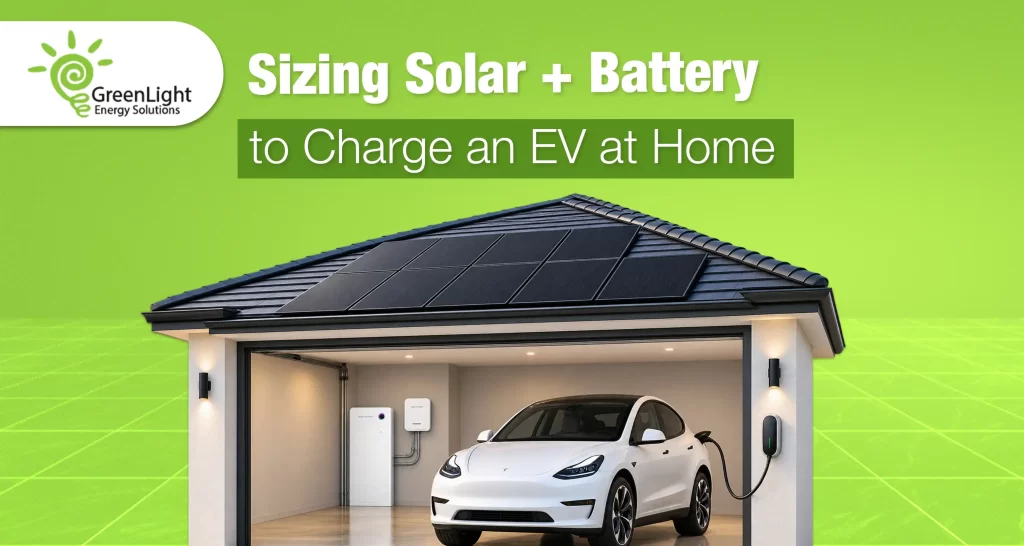
An electric car is often the single biggest new electricity load a home ever adds. It can quietly double your daily power use. So the question we hear constantly from EV owners across New South Wales and Queensland is a fair one: how much solar, and how big a battery, do I actually need to run the car on sunshine instead of grid power?
The honest answer is that it depends on one thing above all else: when you charge. Charge in the middle of the day and you can run mostly on live solar with a smaller battery, or none at all. Charge overnight and the battery becomes the fuel tank, which changes the sizing completely. This guide from Greenlight Solar walks through the numbers, with real figures for NSW and QLD roofs, so you can work out what your own setup needs.
Start with how much energy your EV really uses
Charger power ratings (7kW, 11kW, 22kW) tell you how fast a car charges, not how much energy it needs. For sizing solar, the number that matters is kilowatt-hours (kWh), and it comes from how far you drive.
Most EVs in Australia use between 14 and 20kWh per 100km in real driving. A small hatch sits near 15kWh, a mid-size SUV closer to 18 to 20kWh. Using 18kWh per 100km as a safe planning figure, here is what different driving habits demand each day:
| Daily driving | Energy the EV needs per day |
| 20 km (light) | ~4 kWh |
| 40 km (average commute) | ~7 kWh |
| 60 km | ~11 kWh |
| 100 km | ~18 kWh |
| 150 km (heavy) | ~27 kWh |
The average Australian drives about 36km a day, which works out to roughly 6 to 7kWh. Many households land in the 40 to 80km range once you count the school run, work and errands. Check your own odometer over a week and you will have a far more accurate figure than any average.
Step one: add the EV to your home’s usage
Your solar system has to cover the house first, then the car. A typical NSW or QLD home uses 15 to 25kWh a day. Add the EV figure from the table above, and you have your real daily target.
For example, a household using 18kWh a day that drives 50km (about 9kWh for the car) now needs its system to deliver around 27kWh a day, up from 18. That jump is why so many EV buyers find their existing solar suddenly feels undersized.
Step two: how much solar that takes in NSW and Queensland
Solar output is stronger here than in the southern states, which works in your favour. As a rule of thumb, every 1kW of panels produces about 3.9kWh a day on average in Sydney and around 4.2kWh a day in Brisbane, measured across the whole year.
That gives real-world daily generation of roughly:
| System size | Sydney / metro NSW | Brisbane / SE QLD |
| 6.6 kW | ~26 kWh/day | ~28 kWh/day |
| 10 kW | ~39 kWh/day | ~42 kWh/day |
| 13 kW | ~51 kWh/day | ~55 kWh/day |
If your home already runs on a system sized for the house alone, adding an EV usually means adding roughly 3 to 6kW of extra panels to cover the car, depending on how far you drive. As a broad starting point for a new system that has to power both:
| Household | Typical system size (NSW/QLD) |
| Home only, no EV | 6.6 to 10 kW |
| Home plus one EV, average driving | 10 to 16 kW |
| Home plus two EVs, or long commutes | 16 to 25 kW |
Those are ranges, not rules, because the right size depends heavily on the next point, which most guides skip over.
The part most guides skip: when you charge changes everything
Here is why you will see one article say a 5kW system covers an EV and another insist you need 20kW. They are answering different questions.
Solar panels only generate while the sun is up. If your car is home and plugged in during the middle of the day, it can drink that power straight from the roof as it is made. In that case a moderately sized system does the job and you may need little or no battery. But if the car is out at work all day and only charges after dark, no amount of daytime solar reaches it directly. The energy has to be stored first, which means a battery, or bought from the grid.
So before sizing anything, answer one question honestly: is the car usually home during daylight, or only at night?
- Home during the day (works from home, hybrid roster, shift worker, retired, second car): charge from live solar with a good smart charger. Prioritise a larger solar array over a large battery.
- Home only at night (standard 9-to-5 commute): the battery becomes the EV’s fuel tank. Prioritise enough storage to move daytime solar into the evening.
Do you actually need a battery?
Not always. Plenty of NSW and QLD households charge their EV purely from solar with no battery at all, simply by charging during the day and using a smart charger that only sends surplus solar to the car. Exporting the rest to the grid at today’s low feed-in rates is worth far less than pouring it into your car.
You need a battery if you want to charge the car (or run the house) on solar after sunset. It is also what keeps your lights and fridge on during a blackout, if the system is set up for backup.
A smart or solar-diverting EV charger is the cheaper lever to pull first. It matches the charge rate to whatever your panels are producing, tops up the house loads first, and can schedule charging for peak solar hours or a cheap off-peak tariff, all without buying more storage.
Sizing the battery for overnight EV charging
If you do charge overnight, size the battery to cover your evening and overnight home use plus the car’s daily top-up. A simple way to picture it:
Usable battery needed ≈ home use from late afternoon to morning + the EV’s daily kWh
Take a home that uses about 12kWh between 4pm and 7am and an EV needing 8kWh for the daily commute. That points to around 20kWh of usable storage to get through the night without pulling from the grid. Charge the car during the day instead and a 5 to 10kWh battery, sized mainly for the home’s evening load, is often plenty.
As a general guide:
- Daytime EV charging: 5 to 10kWh battery (covers the home in the evening).
- Overnight EV charging: 15 to 30kWh, depending on driving distance and how much of your home runs on stored solar.
Two details worth knowing. First, the charger’s kW rating changes speed, not total energy: a 7kW charger simply puts 14kWh into the car in two hours instead of four, so pairing a fast charger with a small battery just empties it sooner. Second, don’t forget the household base load. Fridges, standby electronics, pumps and the like quietly draw power all night and eat into the battery before the car gets a look in.
Chargers: Level 1 vs Level 2, and charging from solar
How you charge shapes how well solar can cover it:
- Level 1 is the standard wall socket, drawing about 2.4kW. Slow, and awkward to match to solar.
- Level 2 is a dedicated wall charger installed by an electrician. On single-phase power it delivers up to about 7kW; on three-phase, up to 22kW, though most cars cap AC charging around 11kW. This is the right choice for a solar home.
A smart EV charger is what ties it all together. It can run in a solar-only mode, a solar-plus-grid mode that prioritises the sun, or a timed mode for off-peak charging, so you capture the most free energy without oversizing your system.
A worked example for a Sydney or Brisbane home
Say a family in Sydney uses 18kWh a day at home and drives 50km, needing about 9kWh for the car, for a total of 27kWh a day.
- If they charge during the day: a 10kW system generating around 39kWh a day comfortably covers the home and the car from live solar, with surplus left over. A small battery, or none, is enough.
- If they charge overnight: they need to bank the car’s 9kWh plus their evening home use. That points to a 10kW-plus system to fill the battery during the day and roughly 18 to 20kWh of usable storage to run the house and charge the car after dark.
Same household, same car, very different battery, decided entirely by timing.
Grid connection rules in NSW and Queensland
Bigger systems bump into local network rules. Across NSW and QLD, the networks (Ausgrid, Endeavour and Essential Energy in NSW, Energex and Ergon in QLD) set limits on inverter size and how much power you can export. A large EV-ready system can push you toward an export limit or a more detailed connection approval. It is rarely a dealbreaker, but it is something we check against your specific network and property before finalising a design, so there are no surprises at connection time.
Two EVs, or planning ahead
If a second EV is likely, or you are electrifying other things like hot water or cooking, it is usually cheaper to size up the solar now than to add panels later. Panels are the low-cost part of the system, roof space is finite, and a slightly larger array lifts your self-consumption for years. A two-EV household that wants to charge mostly from solar generally lands in the 16 to 25kW range, often paired with 20kWh or more of storage if either car charges at night.
How Greenlight Solar sizes it for you
We don’t sell one-size-fits-all packages. For an EV home we start with your real numbers: your actual daily driving, your power bills, your roof, and crucially when the car is home to charge. From there we size the solar, the hybrid inverter, the battery and the EV charger as one system rather than three separate purchases.
We install across residential and commercial sites throughout NSW and QLD, and we handle the federal battery rebate paperwork so the incentive comes off your quote up front.
Adding an EV, or planning solar and a battery around one in NSW or Queensland? Talk to Greenlight Solar and we will size a system to your real driving and charging habits, then show you the numbers after the rebate.
Frequently asked questions
How much solar do I need to charge an EV at home?
For a home charging one EV during the day, a system of about 10 to 16kW usually covers the house and the car in NSW and QLD. If you already have solar sized for the home, adding roughly 3 to 6kW of extra panels is often enough for one car. Overnight charging needs a battery on top.
How many kWh does an EV use per 100km?
Most EVs use 14 to 20kWh per 100km in real conditions. A small car is nearer 15kWh, a mid-size SUV closer to 18 to 20kWh. Multiply by your daily distance to get your daily energy need.
Do I need a battery to charge my EV with solar?
Only if you want to charge after dark. If the car is home during the day, a smart charger can run it straight off your panels with no battery. If it charges overnight, you need storage to shift daytime solar into the evening.
How big a battery do I need for overnight EV charging?
Size it to cover your evening and overnight home use plus the car’s daily charge. For many households that means around 15 to 30kWh of usable storage. Charging during the day instead usually needs only 5 to 10kWh, sized for the home.
Can I charge my EV from solar at night?
Not directly, since the panels aren’t generating. You either store the day’s solar in a battery and use it overnight, or charge from the grid on a cheap off-peak tariff.
Can I add an EV to my existing solar system?
Often yes. If your current system comfortably covers the home, adding 3 to 6kW of panels (or a battery for night charging) is usually enough for one EV. We check your inverter capacity and roof space first.
Is a bigger solar system worth it for an EV?
Usually. Panels are the cheapest part of a system, so sizing up front for the car, and for future electrification, tends to cost less than adding capacity later.