Once you have decided to add a battery to your solar system, one technical question decides how much of your solar you actually keep: should the battery be AC-coupled or DC-coupled? It sounds like installer jargon, and most homeowners glaze over when they hear it. But the choice affects how efficient your system is, what it costs, and how well it holds up in a blackout.
At Greenlight Solar we install both across New South Wales and Queensland, on brand-new systems and as retrofits onto solar that has been on the roof for years. This guide explains the difference in plain terms, weighs up the real advantages and drawbacks of each, and shows you how to work out which one suits your home.
First, the only bit of theory you need
Three things in your home speak different electrical languages:
- Your solar panels generate direct current (DC).
- Your home and the grid run on alternating current (AC).
- Your battery stores energy as DC.
An inverter is the translator that converts between DC and AC. The whole AC-versus-DC coupling question comes down to one thing: how many times your solar energy has to be translated on its way from the roof to the battery and back out to your home. Every conversion loses a little energy as heat, so fewer conversions means more of your solar ends up powering your house instead of evaporating along the way.
Keep that idea in mind and the rest falls into place.
What is a DC-coupled battery?
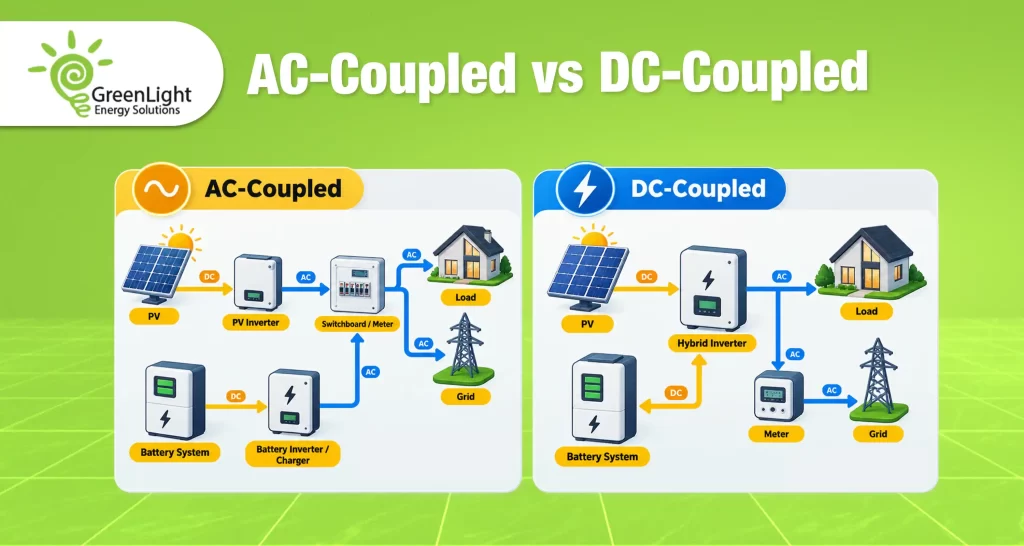
A DC-coupled system uses a single hybrid inverter as the hub for everything: panels, battery, home and grid. The panels and the battery both connect to that one inverter on the DC side.
When your panels are generating and the battery needs charging, the power goes straight from panel to battery as DC, with only a small DC-to-DC adjustment in between. It is not converted to AC and back. The single conversion to AC happens later, when you actually draw the stored power into your home. One box, one app, one warranty, and a short, direct path for your solar energy.
This is the standard setup for a new solar-and-battery system installed together. Hybrid inverters from brands like Sungrow, Solis and Sigenergy are built for exactly this, paired with high-voltage batteries from the likes of BYD, GoodWe, FoxESS and Growatt.
What is an AC-coupled battery?
An AC-coupled system is the classic way to add a battery to a home that already has solar. Your existing solar inverter stays where it is and keeps running the panels. A second, separate battery inverter is installed alongside it to manage charging and discharging. Two boxes, working in parallel off the same switchboard.
The trade-off is a longer route for your solar energy. To store daytime solar in an AC-coupled battery, the power is converted from DC to AC by your solar inverter, then converted back from AC to DC to charge the battery, and later converted from DC to AC again when you use it at night. That is three conversions, sometimes called the “triple conversion” path, and each one shaves off a little energy.
The upside is flexibility. Because the battery has its own inverter, you can pair almost any AC-coupled battery with almost any existing solar inverter. Batteries such as the Tesla Powerwall, Enphase and retrofit-focused Neovolt systems are designed to be added this way.
AC vs DC coupling at a glance
| Factor | AC-coupled | DC-coupled |
| Best for | Adding a battery to existing, fairly new solar | New solar-and-battery systems, or replacing an ageing inverter |
| Round-trip efficiency | Around 89-90% (three conversions) | Around 94-96% (direct DC charging) |
| Captures “clipped” solar? | No; excess DC from the panels is lost | Yes; the hybrid inverter sends surplus DC straight to the battery |
| Setup | Two inverters, two apps, two warranties | One hybrid inverter, one app, one warranty |
| Brand flexibility | High; mix most battery and inverter brands | Battery usually needs to suit the hybrid inverter |
| Redundancy | Good; if one inverter fails the other can keep working | Lower; one inverter is a single point of failure |
| Grid connection (NSW/QLD) | Can be more complex; total inverter capacity may trigger a negotiated connection | Simpler; one inverter keeps you inside the rules |
| Upfront cost | Usually higher (two inverters) | Usually lower on a new install (one inverter) |
Efficiency: how much solar each one actually keeps
This is where DC coupling earns its reputation. A DC-coupled system typically delivers a round-trip efficiency of about 94 to 96 per cent, because your solar charges the battery directly on the DC side and skips the detour through AC. An AC-coupled system sits closer to 89 to 90 per cent, since it has to convert the same energy back and forth an extra time before it lands in the battery.
A few percentage points sounds trivial. Across every sunny day for the ten-plus years a battery is on your wall, it adds up to a meaningful amount of solar you either keep or quietly lose. If squeezing the most out of a limited roof is your priority, that gap matters.
There is a fair-minded caveat: both systems convert once when discharging to your home, so the efficiency edge is really about the charging path. For a household that charges its battery mostly from cheap overnight grid power rather than solar, the difference narrows.
Capturing energy that would otherwise be wasted
Installers routinely fit more panels than the inverter is rated for, say 6.6 kW of panels on a 5 kW inverter, to lift output in the morning and late afternoon. On a bright day the panels can briefly produce more DC power than the inverter can pass through, and that surplus is “clipped”, or thrown away.
A DC-coupled hybrid inverter can divert that clipped energy straight into the battery instead of losing it. An AC-coupled setup generally cannot, because the surplus is gone before it ever reaches the battery’s inverter. On an oversized array, that is free storage a DC-coupled system captures and an AC-coupled one does not.
Cost: which works out cheaper
For a brand-new system, DC coupling is usually the cheaper build, because you buy and install one hybrid inverter rather than a solar inverter plus a separate battery inverter. Fewer components, one installation.
For a retrofit, the maths flips. AC coupling lets you keep the solar inverter you already own, so you are only adding the battery and its inverter rather than replacing working equipment. That is often the more sensible spend when your solar is only a year or two old.
The catch worth knowing: most inverters last around 10 to 12 years. If your existing inverter is already past the five-year mark, bolting a brand-new battery onto it can be a poor long-term move, since you may be replacing that inverter within a few years anyway. In that situation, swapping to a modern hybrid inverter and going DC-coupled can be the smarter financial decision, giving the most important part of your system a fresh warranty.
Retrofit or new install: usually the real deciding factor
Strip away the theory and the decision often comes down to your starting point:
- Starting fresh with solar and a battery together: a DC-coupled hybrid system is normally the better call, being more efficient, simpler, and cheaper to install as one job.
- Adding a battery to newish solar (roughly one to three years old, with an inverter in good health): AC coupling lets you keep what you have and add storage without tearing anything out.
- Adding a battery to older solar (inverter over five years old): it is worth costing up a hybrid inverter replacement rather than pairing new storage with equipment near the end of its life.
Grid connection in NSW and Queensland
This is where local knowledge matters, and it is the part the generic guides skip. Networks across NSW and QLD (Ausgrid, Endeavour and Essential Energy in New South Wales, Energex and Ergon in Queensland) set rules on how much inverter capacity you can connect and how much power you can export to the grid.
Adding a second battery inverter to an existing solar inverter raises your total inverter capacity, which can push an AC-coupled retrofit into a more involved “negotiated” connection application, with the paperwork and delays that brings. A single hybrid inverter on a DC-coupled system keeps the approval cleaner and is generally easier to sign off. It is not a dealbreaker for AC coupling, but it is a real-world factor we check against your specific network area before recommending a path.
Backup power during a blackout
Both AC- and DC-coupled systems can keep your home running through an outage, provided the battery and inverter are set up with backup capability. It is not automatic, so it is worth asking for.
The difference shows up when a battery runs flat mid-blackout. A DC-coupled hybrid system can usually use the solar panels to recharge a completely drained battery during the day and carry on. Some AC-coupled setups can recharge from solar during a blackout too, but a number of them struggle to restart once the battery is fully empty. If reliable backup through a long outage is high on your list, that is a point to raise with your installer.
So which should you choose?
There is no single winner. The right answer depends on your situation:
- New system, efficiency and simplicity first: DC-coupled hybrid.
- Recent solar you are happy with, want storage added: AC-coupled retrofit.
- Ageing inverter, planning for the long term: replace with a hybrid and go DC-coupled.
- You want the freedom to pick any battery brand: AC coupling gives you the widest choice.
- Oversized solar array and a tight roof: DC-coupled, to capture the clipped energy.
How Greenlight Solar sets it up
Because we install both, our recommendation is based on your roof and your goals, not on whichever product we happen to stock. On a new residential or commercial system we usually build DC-coupled around a quality hybrid inverter. For a retrofit, we assess the age and health of your existing inverter, your network’s connection rules, and the batteries that pair well with your setup before advising AC or DC. Our battery range also covers Sungrow, AlphaESS and SAJ, so we can match the right unit to your inverter, your budget and your backup needs.
We also handle the federal battery rebate paperwork either way, so the incentive is applied to your quote up front. If you are weighing up storage, we will walk you through the options for your home in NSW or QLD and give you real numbers.
Frequently asked questions
Is AC or DC coupling better?
Neither is better in every case. DC coupling is more efficient and usually cheaper on a new install, while AC coupling is the easier, more flexible way to add a battery to solar you already have. The best choice depends on whether you are starting fresh or retrofitting, and how old your current inverter is.
Can I add a battery to my existing solar system?
Yes. Most existing solar systems can take a battery through AC coupling, which keeps your current solar inverter and adds a separate battery inverter. If your inverter is more than about five years old, it can be worth replacing it with a hybrid inverter and going DC-coupled instead.
Can the grid still charge a DC-coupled battery?
Yes. A hybrid inverter can pull power from the grid, for example to charge on a cheap overnight tariff, and convert it to store in the battery. You are not limited to charging from solar only.
How do I know if I have a hybrid inverter?
A standard solar inverter only has connections for the panels. A hybrid inverter has a second, dedicated set of connections for a battery. Your installer can confirm which one you have in seconds.
What happens if part of an AC-coupled system fails?
Because the two inverters are independent, if your solar inverter fails the battery can often still power your home and charge from the grid. If the battery inverter fails, the panels keep working but you cannot store energy until it is repaired.
Does a DC-coupled system really capture more solar?
On an oversized array it can. When the panels produce more power than the inverter is rated for, a DC-coupled hybrid can send that surplus straight to the battery, whereas an AC-coupled system usually loses it.