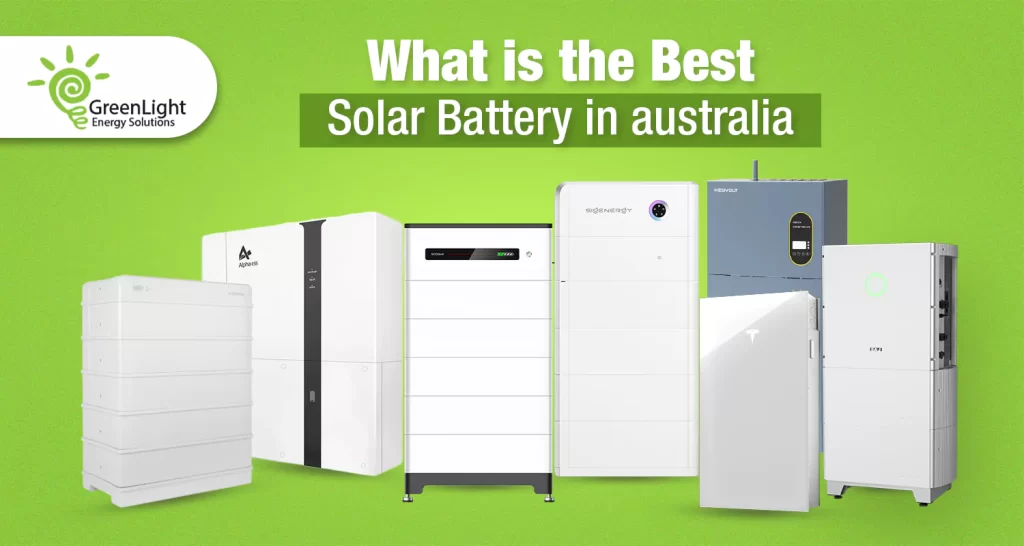
The best solar battery for most Australian homes in 2026 is the Sigenergy SigenStor, which combines a modular design, a built-in hybrid inverter and one of the strongest warranties on the market. The best value option is the Fox ESS range, which delivers the lowest cost per kilowatt hour after the federal rebate. Tesla’s Powerwall 3 remains the best-known choice, and its 13.5kWh size sits neatly inside the rebate’s full-rate tier.
There is no single best battery for every home. The right choice depends on your evening usage, whether you want backup power during outages, and how the new rebate tiers treat the size you need. This guide compares the leading options on the numbers that matter: installed price, price after rebate, warranty and real-world fit.
Solar battery comparison table 2026
| Battery | Usable capacity | Warranty | Installed price (typical) | Federal rebate | Price after rebate |
|---|---|---|---|---|---|
| Sigenergy SigenStor | 16kWh (expandable to 48kWh) | 10 years | $14,500 to $16,500 | about $3,800 | $10,700 to $12,700 |
| Tesla Powerwall 3 | 13.5kWh | 10 years | $13,500 to $15,500 | about $3,400 | $10,100 to $12,100 |
| Fox ESS EP11 | 10.4kWh | 10 years | $8,500 to $10,000 | about $2,600 | $5,900 to $7,400 |
| Sungrow SBH | 12.8kWh (expandable to 25.6kWh) | 10 years | $10,500 to $12,500 | about $3,200 | $7,300 to $9,300 |
| GoodWe ESA | 10kWh | 10 years | $8,000 to $9,500 | about $2,500 | $5,500 to $7,000 |
| SAJ B2 | 10.2kWh (expandable) | 10 years | $8,000 to $9,500 | about $2,550 | $5,450 to $6,950 |
| Neovolt | 10.2kWh (expandable) | 10 years | $7,500 to $9,000 | about $2,550 | $4,950 to $6,450 |
| BYD Battery-Box Premium | 12.8kWh (modular, expandable) | 10 years | $10,500 to $12,500 | about $3,200 | $7,300 to $9,300 |
| Alpha ESS Smile | 13.3kWh (modular) | 10 years | $8,500 to $10,500 | about $3,350 | $5,150 to $7,150 |
| Growatt ARK | 10.24kWh (modular to 25.6kWh) | 10 years | $8,000 to $9,500 | about $2,580 | $5,420 to $6,920 |
Prices are typical fully installed costs in NSW as at July 2026. Your quote will vary with site access, switchboard condition and location. Rebate figures use current STC values, which step down again later in 2026.
The May 2026 rebate change, and why it affects which battery you should buy
The federal Cheaper Home Batteries Program takes around 30 per cent off the upfront cost of an eligible home battery. The discount comes off your invoice through the installer, with no application on your end.
The rules changed on 1 May 2026. The rebate previously paid a flat rate on every kilowatt hour of usable capacity up to 50kWh, which encouraged plenty of households to install the biggest battery they could fit. It now works in three tiers:
| Usable capacity | Rebate rate | Approximate value (July 2026) |
|---|---|---|
| First 14kWh | Full rate | around $250 per kWh |
| 14kWh to 28kWh | 60 per cent of full rate | around $150 per kWh |
| 28kWh to 50kWh | 15 per cent of full rate | around $38 per kWh |
In dollar terms, a 10kWh battery attracts roughly $2,500, a 13.5kWh Powerwall 3 roughly $3,400, and a 20kWh system roughly $4,400. Beyond 28kWh, extra capacity earns almost nothing. For the NSW-specific incentives that stack on top of this, see our NSW solar rebate guide.
Two other changes are worth knowing. The rebate now steps down every six months instead of once a year, so a battery installed in late 2026 will attract slightly less than one installed today. And the program’s funding was expanded from $2.3 billion to around $7.2 billion in December 2025, which secures the scheme through to 2030. The discount shrinks on a schedule, but it is not running out.
The practical effect on your buying decision is simple: the rebate now rewards right-sizing. A 30kWh install earns only about $1,300 more in rebate than a 20kWh install, despite costing thousands more upfront. If you were planning to oversize purely to harvest rebate value, as many buyers did in 2025, that strategy no longer stacks up. Size the battery to your actual usage and the rebate will do its best work.
1. Sigenergy SigenStor: best overall
The SigenStor takes a different approach to most batteries on this list. Instead of a separate battery cabinet and wall-mounted inverter, it stacks battery modules, a hybrid inverter and optional EV charging into a single slim tower. Each module adds 5kWh or 8kWh, so a system that starts at 16kWh can grow later without a second installation crew and a second set of fixed costs.
The engineering shows in the details. Round-trip efficiency sits above most rivals, each module carries its own fire suppression, and the app gives genuinely useful control over charging behaviour rather than a dashboard of numbers you look at once. The 10-year warranty covers the whole tower, inverter included, which removes the finger-pointing risk you get when the battery and inverter come from different companies.
The main consideration is price. Per kilowatt hour, it costs more than the value brands further down this list, and if you expand past 14kWh of usable capacity, the additional modules earn rebate at the reduced 60 per cent tier. For a household that wants backup power, room to grow and one integrated unit on the wall, the premium is justified. For a household that just wants lower bills, it may be more battery than the job requires.
Verdict: the strongest all-round battery on the Australian market in 2026, and the one to buy if you want the system to still feel current in 2033.
Read the full breakdown in our Sigenergy battery review.
2. Tesla Powerwall 3: the household name, now with the inverter built in
The Powerwall 3 fixed the biggest complaint about its predecessor by building in a hybrid inverter with 11.5kW of continuous output. That is enough to run almost any home through a blackout without shedding the air conditioner or the oven, which older battery setups routinely forced you to do. At 13.5kWh usable, it also fits entirely inside the rebate’s full-rate tier.
Installation is clean, the app is polished, and resale recognition is unmatched. Buyers know what a Powerwall is, which counts for something when you sell the house.
The limitation is that it is a sealed unit. There is no adding a module later. If 13.5kWh will not cover your evening usage, the answer is a second Powerwall, and most of that second unit’s capacity lands in the reduced rebate tiers, which makes it an expensive way to expand. Run your numbers with our battery sizing guide before assuming one is enough.
Verdict: an excellent battery if 13.5kWh matches your household. Buy it for the product, not the badge, because several batteries below store similar energy for thousands less.
3. Fox ESS: best value in 2026
Fox ESS has quietly moved from budget contender to genuine mainstream option. The EP11 delivers 10.4kWh of usable storage at one of the lowest installed prices of any established brand, and the modular CQ7 range stacks capacity in roughly 7kWh steps for households that want room to grow.
The numbers are what make the case. After the federal rebate, a Fox installation routinely lands under $7,500 fully installed. Against a typical NSW household’s evening usage on current tariffs, that shortens the payback period to somewhere between six and eight years, comfortably inside the 10-year warranty. Very few batteries on the market can say that.
The honest trade-off is brand depth. Fox’s Australian support network is smaller than Tesla’s or Sungrow’s, although it has grown considerably since 2024 and warranty claims are handled locally. You are trading a little brand assurance for a lot of upfront saving.
Verdict: the best dollars-per-kilowatt-hour on this list. If payback period is your main measure, start your quotes here.
Read the full Fox battery review including the CQ7 range.
4. Sungrow SBH: the safe pair of hands
Sungrow makes more inverters than almost anyone on earth, and its battery range benefits from that pedigree. The SBH stacks in 6.4kWh modules up to 25.6kWh, pairs naturally with Sungrow hybrid inverters, and is backed by one of the largest service networks in the country, with local testing behind its safety record.
Pricing sits between Fox and Tesla, which is exactly where the product sits overall. It is not the cheapest option, it is not the most advanced, and there is very little to criticise.
Verdict: the safe choice. Households that want a big-name brand with modular flexibility and dependable local support end up here, and they rarely regret it.
5. GoodWe ESA: reliable mid-market pick
The ESA is a 10kWh all-in-one unit designed around GoodWe’s hybrid inverters, backed by a long-established Australian support office. It does the bills-reduction job well at a sensible price, and pairing battery and inverter from one brand keeps warranty conversations simple.
One caution for existing GoodWe owners: before adding a battery to an older system, check your inverter model against the 2025 GoodWe and GE hybrid inverter recall. Our GoodWe and GE inverter recall guide lists the affected models and what to do if yours is one of them.
Verdict: a solid mid-market battery, best suited to homes already running or considering a GoodWe inverter.
Full details in our GoodWe ESA battery review.
6. SAJ: the quiet achiever
SAJ has less name recognition in Australia than the brands above, and its pricing reflects that, which is precisely the opportunity. The B2 battery grows in 5.1kWh steps, so a household can start at 10.2kWh inside the full rebate tier and add capacity later as usage grows, an approach the fixed-size Powerwall cannot match.
Build quality is better than the price suggests, and the 10-year warranty is serviced locally.
Verdict: worth shortlisting if your installer offers it. For a modular system, the price after rebate is hard to beat.
See our SAJ battery review or the SAJ battery package page for current pricing.
7. Neovolt: the budget option that earned its place
Neovolt sits at the entry point of this list, and unlike most cheap batteries it arrives with a genuine 10-year warranty and Australian-based support. After the rebate, a 10.2kWh Neovolt system can land under $6,500 installed, the lowest realistic entry to whole-evening battery coverage from any brand we would put our name behind.
Compare your final quote against Fox ESS before signing. The two trade places on price depending on configuration and what your installer has on hand, and our Neovolt battery review covers the differences in detail.
Verdict: the pick for budget-focused buyers who refuse to gamble on warranty support.
8. BYD Battery-Box: the efficiency and inverter-flexibility pick
BYD is the largest battery manufacturer in the world, and the Battery-Box Premium brings that manufacturing depth to Australian homes. It is a modular, stackable unit that grows in small steps, so you can start at a size that sits inside the full rebate tier and add capacity as your usage changes rather than paying for storage you do not yet need.
Two things make it stand out. First, round-trip efficiency of up to 95 per cent means less of your solar is lost between charging and discharging. Second, it pairs with a wide range of third-party inverters, including Growatt, Sungrow and Fronius, which makes it one of the easier premium batteries to add to an existing system without replacing hardware you already own. Its LFP chemistry also handles Australian heat well, holding up through the temperature swings that come with a QLD or western-Sydney summer.
The honest trade-off is brand recognition. BYD does not carry the household-name pull of Tesla, which can matter a little at resale, though installers rate the hardware highly.
Verdict: the pick for homes that want high efficiency and the freedom to keep or choose their own inverter, especially on a retrofit.
Read the full BYD Battery-Box breakdown.
9. Alpha ESS Smile: the value pick for warm-climate homes
Alpha ESS does not get the marketing spend of the bigger names, but its Smile range earns steady marks for value. It is a modular LFP system spanning roughly 5 to 20kWh, so a household can start at around 13kWh inside the full rebate tier and expand later. An IP65 rating means it can be wall -mounted outdoors in a shaded, protected spot, and it is built to cope with heat, which makes it a sensible fit for homes on the QLD coast, the Gold Coast and hotter parts of Perth and Sydney.
The main things to weigh are at the budget end of the market. After-sales support has drawn criticism in the past, though it has improved, and not every model in the range carries strong backup surge capacity. Both are reasons to buy through an accredited installer who stands behind the product rather than chasing the lowest online price.
Verdict: strong value for warm-climate homes with moderate evening usage, provided you buy it through an installer who backs the warranty.
See the Alpha ESS battery range for current options.
10. Growatt ARK: the flexible, budget-friendly all-rounder
Growatt has shipped millions of systems worldwide and holds a solid position in Australia through its ARK battery range. The ARK is a modular LFP system that stacks from 2.56kWh up to 25.6kWh, so it scales cleanly from a small starter setup to a whole-home battery. Real-time monitoring runs through the ShinePhone app, and while it works best alongside a Growatt hybrid inverter, it also pairs with a range of other inverter brands, which keeps retrofit options open.
The appeal is value and flexibility rather than headline brand status. Growatt sits below the premium names on price per kilowatt hour, and its small module steps make it easy to size to actual usage. The trade-off is brand depth: its Australian profile is smaller than Tesla’s or Sungrow’s, so the strongest results come from installing it as a matched Growatt package with local support behind it.
Verdict: a flexible, keenly priced choice for households that want modular room to grow without paying a premium badge.
Read the full Growatt battery review.
Also worth considering: Enphase IQ Battery
Not every home needs a single large battery. The Enphase IQ Battery takes a modular, AC-coupled approach — small stackable units that bolt onto almost any existing solar inverter, which makes it one of the simplest batteries to retrofit to a system you do not want to modify. Its standout is the warranty: 15 years, the longest of any mainstream residential battery, well beyond the 10-year norm elsewhere on this list.
The trade-off is that AC coupling carries a small efficiency loss against DC-coupled systems, and cost per kilowatt hour runs higher than the value brands at smaller sizes. It is worth asking about if a long warranty and an easy retrofit matter more to you than lowest upfront cost.
Want to know if it suits your setup? Get a free battery assessment.
How to choose the right battery in 2026
Start with your evening usage, not the rebate. Pull up your electricity bill, find your average daily consumption, and assume roughly 60 per cent of it happens outside solar hours. A household using 20kWh a day typically needs 10 to 13kWh of storage to cover the evening and overnight. Our guide to what size solar battery you need walks through the calculation step by step.
Then check that size against the rebate tiers. If your number is 14kWh or under, every kilowatt hour earns the full rebate rate and the decision is straightforward. If it is over, get your system priced at 14kWh and at your calculated size, and compare the payback on each. Often the smaller system wins.
Finally, decide how much backup matters. If you want the whole house running through an outage, the Powerwall 3 and SigenStor lead on output capacity. If backup is a nice-to-have and lower bills are the real goal, the value brands do that job for far less money.
Still weighing up whether a battery makes sense for your home at all? Our guide to the pros and cons of solar batteries makes the honest case both ways.
Get 2026 pricing for your home
Battery prices and rebate rates are moving quickly this year, and the figures on this page are reviewed after every STC schedule change. For a quote based on your actual usage, roof and switchboard, with the current rebate applied upfront on the invoice, Greenlight Solar offers a free home battery assessment.
Frequently asked questions
What is the best solar battery in Australia in 2026?
The Sigenergy SigenStor is the best overall home battery in 2026 for its integrated design, expandability and full-system warranty. The Fox ESS range offers the best value per kilowatt hour, and the Tesla Powerwall 3 is the best fit for households whose usage matches its fixed 13.5kWh capacity.
How much does a solar battery cost in Australia in 2026?
A quality 10kWh battery costs roughly $8,000 to $10,000 fully installed before incentives, or about $5,500 to $7,500 after the federal rebate. Premium 13 to 16kWh systems cost $13,500 to $16,500 installed, or roughly $10,000 to $13,000 after rebate.
How much is the federal battery rebate in 2026?
About $250 per kilowatt hour of usable capacity on the first 14kWh, with reduced rates above that. A 10kWh battery attracts around $2,500 and a 13.5kWh battery around $3,400. The rate steps down every six months, so installations later in 2026 will receive slightly less.
Did the battery rebate end in May 2026?
No. The Cheaper Home Batteries Program changed structure on 1 May 2026 but did not end. It moved from a flat per-kilowatt-hour rate to three tiers based on battery size, and its funding was expanded to around $7.2 billion, securing the program to 2030.
Is a bigger battery still better value under the new rebate?
Usually not. Capacity above 14kWh earns rebate at 60 per cent of the full rate, and above 28kWh at just 15 per cent, so oversizing no longer pays the way it did in 2025. Size the battery to your actual evening usage and put the savings toward better hardware.
Can solar batteries be installed outside?
Most quality batteries carry an IP65 rating and can be installed outdoors in a shaded, protected position, subject to clearance requirements under the Australian installation standard. Our guide to whether solar batteries can be installed outside covers the rules brand by brand, and our solar battery safety guide explains the standards behind them.
How long does a solar battery take to pay for itself in Australia?
With the federal rebate, a right-sized battery in NSW typically pays for itself in six to nine years against a 10-year warranty. Value brands sit at the lower end of that range and premium brands at the upper end. Households on time-of-use tariffs, or those earning credits through a virtual power plant, recover their costs faster.
Which solar battery has the highest round-trip efficiency?
Among the batteries covered here, the BYD Battery-Box leads on round-trip efficiency at up to 95 per cent, with three-phase configurations rated higher again. Higher efficiency means less of your stored solar is lost between charging and discharging, so more of what your panels generate actually reaches your home in the evening.
Can I add a battery to my existing solar system?
Yes, in most cases. If your current inverter is a hybrid (battery-ready) model, a compatible battery can often be added directly. If it is a standard solar inverter, you can either fit a new hybrid inverter or choose an AC-coupled battery such as the Enphase IQ, which works alongside almost any existing inverter. Modular batteries like BYD and Growatt also pair with several inverter brands, which keeps retrofit costs down. The cleanest way to know is a quick check of your inverter model and switchboard.
What is the most affordable solar battery after the rebate?
The best value per dollar currently comes from the modular value brands. After the federal rebate, entry options such as Growatt, Alpha ESS and Neovolt can land a whole-evening battery well under $7,000 installed, depending on size and configuration. Compare final quotes rather than list prices, since installed cost moves with your site, switchboard and the size that fits your usage.