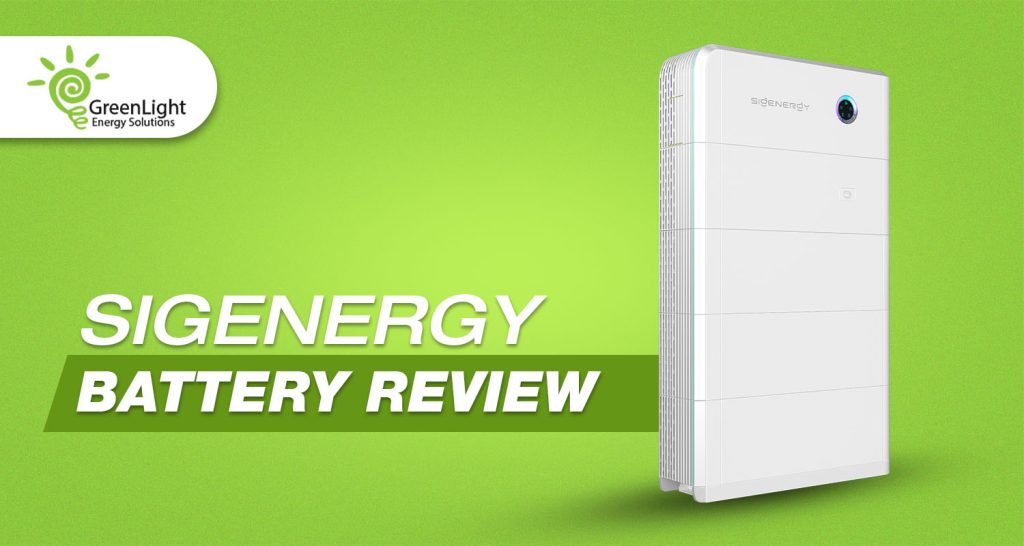
The Sigenergy SigenStor is the battery we recommend most often in 2026, and the market agrees: SunWiz ranked Sigenergy the number one battery brand in Australia by installed capacity, ahead of Sungrow and Tesla. It packs a hybrid inverter, stackable battery modules and optional EV charging into one tower, carries a 10-year whole-system warranty, and starts around $12,000 installed for a 16kWh setup after the federal rebate.
It is not without history. Sigenergy’s single-phase inverters went through an ACCC voluntary recall in late 2025 over an AC plug issue, which we cover honestly below, because any review that skips it is not doing its job. Here is the full picture: specs, real pricing, the rebate maths, the recall, and who this battery actually suits.
What is the Sigenergy SigenStor?
Launched in Australia in late 2023, the SigenStor is a modular all-in-one energy storage system. Where most setups pair a battery cabinet with a separate wall-mounted inverter, the SigenStor stacks five functions into a single tower: a solar inverter, battery power conversion, the battery modules themselves, an energy management system and an optional DC EV charger.
Sigenergy was founded in 2022 by Tony Xu, previously president of Huawei’s solar inverter division, and the pedigree shows in how quickly the product matured. In under three years it went from market entry to the best-selling battery brand in the country.
The modular design is the headline. Battery modules come in 5kWh and 8kWh sizes and stack up to 48kWh per tower, so a household can start at 16kWh and add capacity later without paying a second round of installation fixed costs.
SigenStor Neo: the new 2026 companion model
In July 2026 Sigenergy began the global rollout of the SigenStor Neo, and it is expected to reach Australia in the second half of 2026. It is worth understanding before you buy, because for a lot of homes it will become the default choice.
The Neo is not a replacement for the original SigenStor. It is a companion model, a more compact and more affordable version aimed at standard residential installs. Sigenergy estimates that around 90 per cent of the systems it installed over the past year could have used the Neo, which tells you where it sits. The original SigenStor stays in the range for larger homes, three-phase properties, high storage capacity, DC fast EV charging and vehicle-to-home backup.
What changes with the Neo:
- Simpler install. The backup port, smart port and grid port are built into the inverter, so most homes no longer need a separate gateway unit. That means neater wiring and a lower installed cost.
- Better thermal design. The Neo uses a new cell suspension architecture that physically separates the battery cells from the power board with an air gap, which helps manage heat under sustained load. It also charges faster and switches to backup with no interruption during an outage.
- Sizing. Single-phase inverter options run from 5 to 12 kW, and three-phase from 5 to 15 kW, with 6 kWh and 8 kWh battery modules. Final Australian specifications and pricing will be confirmed closer to the local release.
- Charging. The Neo handles AC EV charging. If you specifically want DC fast charging or vehicle-to-home backup, the original SigenStor remains the right fit.
For most standard homes the Neo brings the Sigenergy software, modularity and whole-home backup at a more accessible price. For larger or three-phase homes, or anyone wanting DC charging, the original SigenStor is still the stronger system.
SigenStor battery module specifications
| Feature | SigenStor BAT 5.0 | SigenStor BAT 8.0 |
|---|---|---|
| Nominal capacity | 5.38 kWh | 8.06 kWh |
| Usable capacity | 5.2 kWh | 7.8 kWh |
| Depth of discharge | 97% | 97% |
| Battery chemistry | Lithium iron phosphate (LFP) | Lithium iron phosphate (LFP) |
| Dimensions (W x H x D) | 767 x 270 x 260 mm | 767 x 270 x 260 mm |
| Weight | 55 kg | 70 kg |
| Scalable | Yes, up to 6 modules per tower | Yes, up to 6 modules per tower |
| IP rating | IP66 (indoor or outdoor) | IP66 (indoor or outdoor) |
The IP66 rating means the tower can live outdoors in a protected position. Our guide to installing solar batteries outside covers the clearance rules that apply.
Sigenergy SigenStor price in 2026
Typical fully installed prices in NSW as at July 2026, with the federal rebate applied:
| Configuration (usable) | Installed price | Federal rebate | Price after rebate |
|---|---|---|---|
| 10.4kWh (2 x 5kWh modules) | $11,500 to $13,000 | about $2,600 | $8,900 to $10,400 |
| 15.6kWh (3 x 5kWh modules) | $14,500 to $16,500 | about $3,700 | $10,800 to $12,800 |
| 23.4kWh (3 x 8kWh modules) | $18,500 to $21,000 | about $4,900 | $13,600 to $16,100 |
Prices vary with site access, switchboard condition and whether you add the EV charger. The rebate figures use current STC values, which step down again in late 2026.
Note how the rebate flattens as the system grows. Since 1 May 2026 the federal Cheaper Home Batteries Program pays full rate only on the first 14kWh of usable capacity, 60 per cent of that rate from 14kWh to 28kWh, and 15 per cent beyond that. A 15.6kWh SigenStor sits almost entirely in the full-rate tier, which makes it the sweet spot for most households. The full tier breakdown is in our federal battery rebate guide, and NSW households can stack the state’s VPP incentive on top, covered in our NSW rebate guide.
One thing to factor into 2026 pricing is that battery costs have started falling. Since May 2026, following the step-down in the federal rebate for larger systems, Sigenergy cut the price of its 5 kWh and 8 kWh modules, and GoodWe responded with a module price cut of around 20 per cent. The practical takeaway is that mid-2026 is a genuinely strong window to buy, with lower product prices on top of the rebate. Because the rebate now reduces every six months rather than annually, waiting too long chips away at the saving.
The November 2025 recall, and where things stand now
In November 2025 the ACCC published a voluntary recall of Sigenergy’s single-phase 8kW, 10kW and 12kW Energy Controllers sold between March and November 2025. The quick-connect AC plug on those units could overheat if the ferrule connections were not crimped exactly to specification, and a number of melted plugs were reported. No injuries or property damage occurred.
Sigenergy’s response was substantial. A firmware update went out to every affected unit that monitors load and temporarily trims output under sustained full power, affected owners receive a free replacement inverter with a redesigned plug, and each replaced unit carries an extra two years of warranty on top of the standard ten.
What it means if you are buying in 2026: every unit sold since the recall uses the redesigned OT-type plug, which is pre-moulded and needs no ferrules or crimping, so the failure mode that caused the problem no longer exists on new installations. Three-phase units were never affected. If you already own an affected single-phase unit, keep the system online so it receives firmware updates, and your installer or Sigenergy’s service network will contact you about the free replacement if they have not already.
Our take: the plug issue was real and Sigenergy’s early communication was slower than it should have been, but the engineering fix, the free replacements and the extended warranty are a stronger response than most manufacturers manage. It does not change our recommendation for new buyers.
SigenStor vs Tesla Powerwall 3
| Feature | Sigenergy SigenStor | Tesla Powerwall 3 |
|---|---|---|
| Capacity | 5kWh to 48kWh, modular | 13.5kWh, fixed per unit |
| Depth of discharge | 97% | about 90% |
| Chemistry | LFP | LFP |
| Built-in inverter | Yes, hybrid, up to 25kW output | Yes, 11.5kW continuous |
| EV charging | Optional bi-directional DC charger (V2H and V2G) | No bi-directional charging |
| Expansion | Add modules to the same tower | Add a second full unit |
| App | mySigen, AI-assisted | Tesla app, very polished |
| Warranty | 10 years, whole tower | 10 years |
| Rebate fit (2026 tiers) | Configurable to sit inside the full-rate tier | 13.5kWh sits fully inside the full-rate tier |
The short version: the Powerwall 3 is the better-known product and its fixed 13.5kWh suits many homes perfectly. The SigenStor wins on flexibility, depth of discharge and EV integration, and expanding it later costs far less than buying a second Powerwall. See how both rank against every other brand in how the SigenStor compares against every major battery in 2026.
Key features
Modular scalability. Stack 5kWh or 8kWh modules from 5kWh to 48kWh per tower. Start with what you need, grow when usage grows, and pay installation fixed costs once.
Bi-directional EV charging. The optional 25kW DC charger supports vehicle-to-home and vehicle-to-grid, still rare in the Australian market. If an EV is in your plans, this pairs with our EV charger range better than any competing battery.
Safety design. Five layers of protection including per-module fire suppression, aerogel insulation between cells and AI-monitored temperature sensors. The standards behind battery installation are covered in our solar battery safety guide.
The mySigen app. Real-time energy flow, AI-driven usage suggestions and remote diagnostics. It is one of the few battery apps owners actually open after the first month.
Off-grid capability. With the backup gateway, the system switches automatically during outages and can run essential circuits indefinitely with enough solar input.
The mySigen app and SigenAgent. Real-time energy flow, AI-driven usage suggestions and remote diagnostics, in one of the few battery apps owners actually open after the first month. In June 2026 Sigenergy added SigenAgent, a goal-based AI energy agent inside the mySigen App 4.0 that manages solar, storage and EV charging together. You set the goal, such as lowering your bill or keeping backup power in reserve, and the system continuously optimises to hit it rather than needing you to tune settings yourself. It is a large part of why Sigenergy still leads on software.
Pros and cons in 2026
Pros
- Modular and expandable without a second installation
- 97 per cent depth of discharge, the highest of any mainstream battery
- Bi-directional EV charging option (V2H and V2G)
- 10-year warranty covering the whole tower, inverter included
- Australia’s top-selling battery brand, so parts, installers and support are easy to find
- IP66 rated for outdoor installation
Cons
- Costs more per kilowatt hour than value brands like Fox ESS or Neovolt
- The 2025 AC plug recall, resolved on new stock but a fair question for cautious buyers
- Modular stacking demands a skilled installer, so quote quality varies more than with sealed units
- Expanding beyond 14kWh usable earns rebate at reduced tier rates
Battery life and warranty
The SigenStor is warranted for 10 years or a minimum energy throughput, whichever comes first, with at least 70 per cent of usable capacity retained at the end of the period. Its LFP chemistry is rated for roughly 6,000 cycles, which at one full cycle per day works out to more than 16 years of theoretical life. Keeping the tower out of direct summer sun and extreme heat extends real-world lifespan, which is worth factoring into where you position it.
Who should buy the SigenStor?
Choose the SigenStor if you want backup power, expect your usage to grow, own or plan to own an EV, or simply want the most capable single unit on the wall. A 15.6kWh configuration covers the evening and overnight usage of most family homes while staying inside the rebate’s full-rate tier. Work out your own number with our guide to what size solar battery you need.
Look elsewhere if your only goal is the cheapest path to lower bills. A Fox ESS or Neovolt system does that job for several thousand dollars less, and our pros and cons of solar batteries guide helps you decide whether a battery stacks up for your household at all.
Current package pricing and configurations are on our Sigenergy battery and inverter page.
Frequently asked questions
Is Sigenergy better than the Tesla Powerwall 3?
The SigenStor offers more flexibility than the Powerwall 3, with modular capacity from 5kWh to 48kWh, a 97 per cent depth of discharge and optional bi-directional EV charging. The Powerwall 3 counters with a longer brand track record and a polished ecosystem. For expandability and EV integration, Sigenergy leads. For set-and-forget simplicity at exactly 13.5kWh, the Powerwall remains excellent.
Was the Sigenergy battery recalled?
The battery modules were never recalled. The ACCC published a voluntary recall in November 2025 covering single-phase 8kW, 10kW and 12kW Energy Controllers sold during 2025, due to AC plugs that could overheat. Affected owners receive a free replacement unit with a redesigned plug plus two extra years of warranty. All units sold since use the new plug design.
How much does a Sigenergy battery cost in 2026?
A 10.4kWh SigenStor typically costs $11,500 to $13,000 fully installed, or around $9,000 to $10,500 after the federal rebate. A 15.6kWh system costs $14,500 to $16,500 installed, or roughly $11,000 to $13,000 after rebate. Prices vary with site conditions and configuration.
Is the Sigenergy battery eligible for the 2026 federal rebate?
Yes. SigenStor systems are CEC approved and eligible under the Cheaper Home Batteries Program. Under the tiered structure that began on 1 May 2026, the first 14kWh of usable capacity earns the full rebate rate, currently around $250 per kilowatt hour, with reduced rates above that.
Can the SigenStor work during a blackout?
Yes. Installed with the backup gateway, the SigenStor switches automatically during an outage and supplies the circuits you nominate. With sufficient solar input it can run essential loads indefinitely off grid.
How long does a Sigenergy battery last?
The system carries a 10-year warranty guaranteeing at least 70 per cent of usable capacity, and its LFP cells are rated for around 6,000 cycles, which equates to more than 16 years at one cycle per day under normal conditions.
Can Sigenergy be installed without solar panels?
Yes, the SigenStor can operate as a battery-only system charged from the grid, though note the federal rebate requires the battery to be paired with a new or existing solar system, and pairing with solar is where the real savings come from.
What is the SigenStor Neo?
The SigenStor Neo is Sigenergy’s newer, more compact all-in-one battery system, expected in Australia in the second half of 2026. It is a companion to the original SigenStor rather than a replacement, built for standard residential homes where a simpler install and a lower price matter most.
Should I wait for the SigenStor Neo or buy the SigenStor now?
It depends on your home. If you have a larger or three-phase property, or you want DC fast EV charging or vehicle-to-home backup, the original SigenStor is available now and remains the stronger choice. If you have a standard home and simplicity and price are the priority, the Neo may be worth waiting for once local pricing is confirmed.