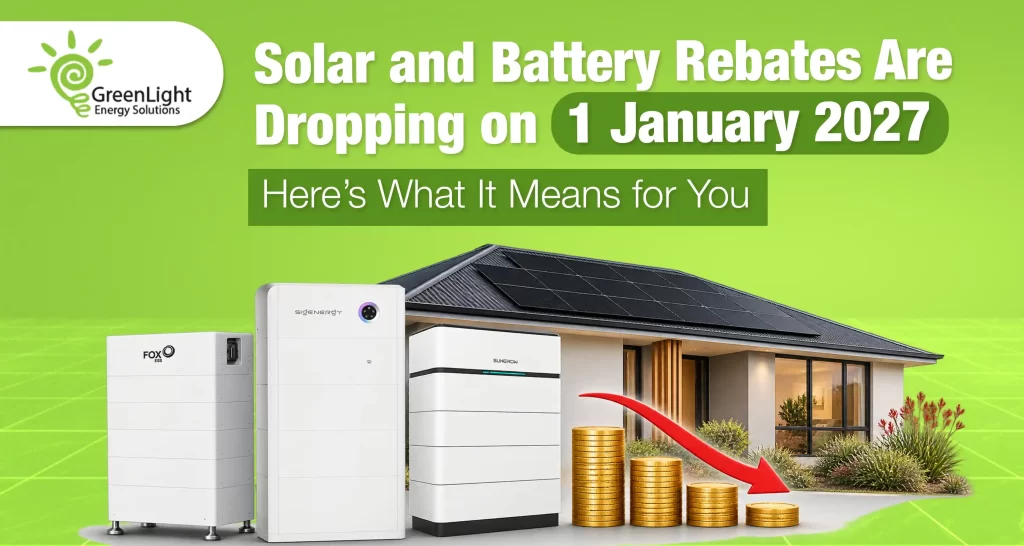
Most people think of “the solar rebate” as one thing. It is actually two: the discount on your panels and the discount on your battery. Both reset downward on 1 January 2027, and the battery discount then takes a second cut on 1 July. Neither is ending, both schemes run to 2030, but the support gets smaller each year, and the gap between installing now and installing in the new year ranges from a few hundred dollars to well over a thousand on a bigger system. At Greenlight Solar we quote these numbers every day, so here is a clear, no-spin breakdown.
Start with the battery: two step-downs are coming
The federal battery rebate, properly called the Cheaper Home Batteries Program, is paid through small-scale technology certificates (STCs). Every usable kilowatt-hour of storage earns certificates decided by an STC factor, and since the changes that landed in May that factor falls every six months instead of once a year: 6.8 per kWh now (about $258 per kWh), 5.7 from 1 January 2027 (about $217 per kWh), and 5.2 from 1 July 2027 (about $198 per kWh).
A capacity taper also applies, so the full rate only reaches the first slice of a battery: 100% of the factor on the first 14 kWh, 60% from 14 to 28 kWh, 15% from 28 to 50 kWh, and nothing beyond 50 kWh. A bigger battery earns more in total, just less per extra kilowatt-hour.
What the step-down costs on the batteries we install
Here is the first 2027 cut across a range of sizes and brands, at an STC price near $38:
| Battery | Usable size | Now (to 31 Dec 2026) | From 1 Jan 2027 | You lose by waiting |
|---|---|---|---|---|
| Tesla Powerwall 3 | 13.5 kWh | ~$3,490 | ~$2,920 | ~$570 |
| GoodWe ESA | 10 kWh | ~$2,580 | ~$2,170 | ~$410 |
| Fox ESS | 16 kWh | ~$3,930 | ~$3,290 | ~$640 |
| Sigenergy SigenStor | 20 kWh | ~$4,550 | ~$3,810 | ~$740 |
| Sungrow (modular) | 25.6 kWh | ~$5,420 | ~$4,540 | ~$880 |
| Tesla Powerwall 3 (×3) | 40.5 kWh | ~$6,250 | ~$5,240 | ~$1,010 |
Estimates only, rounded. Based on an STC value of around $38, factors of 6.8 (now) and 5.7 (from January), and the capacity taper above. Your figure varies with the certificate price on the day and usable capacity. The rate drops again on 1 July 2027.
Compare any model on our solar battery range, and our federal battery rebate guide covers how the discount applies.
What happens to the solar panel rebate?
Your panels run on the same certificate system, but the reason behind the drop is different. Panel STCs depend on a deeming period, the number of years of future output credited upfront, which shortens by one year every January to 2030. It is five years in 2026 and four from 2027, trimming the certificate count by roughly 20% on an identical system. On a 6.6kW system at an STC price near $38, that is about 45 certificates (roughly $1,710 off) in 2026 against about 36 (roughly $1,370 off) from 2027, a difference of around $340, with larger arrays losing more. Your count also depends on your postcode zone, so a Sydney roof and a cooler southern one will differ. Our STC rebate explainer breaks down the formula, and you can see current panels on our solar panels page.
Signed, deposited, or installed: which date sets your rebate?
Only one date matters. Your rebate is not locked by the day you sign, pay a deposit, or take delivery. It is locked by the day the system is installed and certified. A system signed off on 31 December claims current rates; the same system commissioned on 1 January claims the lower 2027 rates. A contract signed in November gives no protection if the install slips into the new year, which is how households lose the higher rebate every summer. Ask for a commissioning date in writing and book early. Before you sign, read our rundown of mistakes to avoid when buying solar.
If you are in NSW, don’t miss the VPP top-up
In New South Wales the state pays a separate incentive under the Peak Demand Reduction Scheme for connecting an eligible battery to an approved Virtual Power Plant, worth up to around $1,500 and paid on top of the federal discount. Stacked together, a NSW household can claim the federal panel discount, the federal battery discount, and the state VPP incentive on one install. Your battery must be VPP-capable and linked to an approved provider (most modern batteries qualify), it can be claimed once per property, and the old standalone NSW install rebate has been retired. Our guide on what a VPP is and whether it is worth it explains the trade-offs, and the NSW Home Energy Saver interest-free loan can spread the cost. In Queensland or another state, local incentives differ, so start with our NSW incentive guide or ask our team.
Already have solar? You can still claim
You do not need a new system to benefit. The federal battery rebate has no income test, covers batteries from 5 kWh to 100 kWh, and must be fitted by an accredited installer. In most cases you can add a battery to an existing setup and still claim, as long as the battery, your connection, and the installation meet the rules. Our piece on adding a battery to existing solar walks through it, and our battery sizing guide helps you avoid paying for storage you will not use.
Should you bring your install forward?
It depends on where you are up to, and we would rather tell you that than run a fake countdown. If a system was already on your list for early next year, pulling it forward is worth a few hundred dollars on panels and closer to a thousand on a solid battery. If you are not ready, do not force it, because a system sized wrong will cost you far more over its life than the rebate difference saved. The support is not disappearing, it is easing down on a timetable you can plan around. Request a no-obligation quote from Greenlight Solar and we will put your current rebate figure in writing.