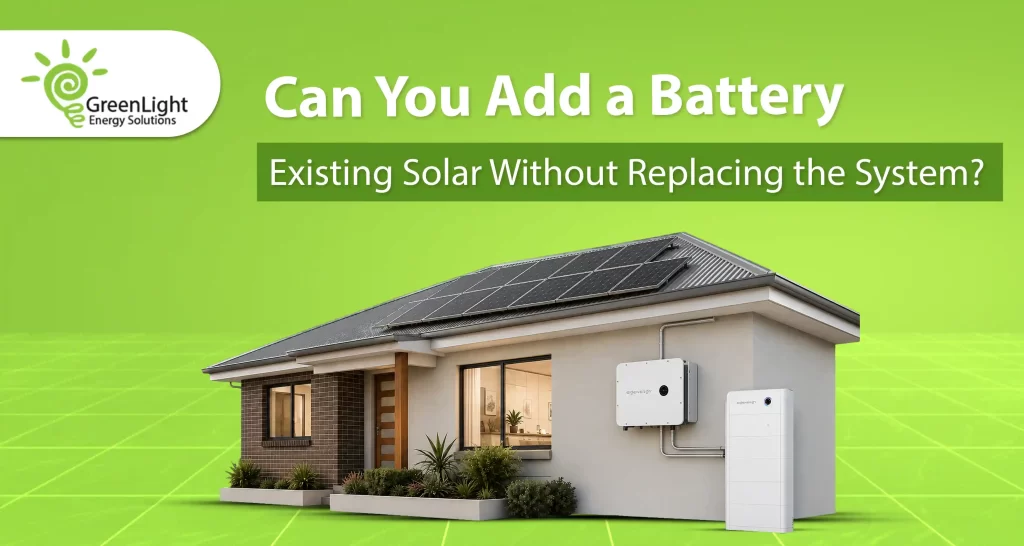
Yes, in most cases. Your panels almost never need to come off the roof, and depending on how your system is configured, your existing inverter may not need replacing either.
The question homeowners actually want answered is narrower than the one they ask. It is not really “can it be done”, it is “what will I be told I have to replace, and is that genuinely required or is it just easier for the installer”. This article separates the two.
Rooftop panels are almost always retained in a battery retrofit. They generate direct current regardless of what happens downstream, and their age rarely disqualifies them.
The inverter is where retrofits diverge. There are two accepted ways to add storage to an existing solar system, and only one of them involves replacing your current inverter. Which path suits your home depends on the age and type of your inverter, your available switchboard space, whether you want blackout backup, and whether your existing inverter meets the technical requirements attached to the federal battery discount. Sydney and wider NSW homeowners have an added variable, because network connection rules are changing through 2026, covered further down.
The Two Ways to Retrofit a Battery
AC coupling. The battery arrives with its own inverter built in, or with a separate battery inverter installed alongside your existing solar inverter. Your solar system continues to operate as it does now, though settings or firmware on the existing inverter may need updating as part of the connection alteration. Surplus solar is converted to AC by your existing inverter, stored, then delivered to your home. Charging therefore passes through an extra conversion step compared with a DC coupled system, which is where the small additional loss comes from. Discharging involves a single conversion in both designs.
DC coupling. Your existing solar inverter is replaced with a hybrid inverter that manages both the panels and the battery through a single unit. Solar charges the battery as DC without an intermediate conversion, which is marginally more efficient, and you end up with one integrated system rather than two devices coordinating with each other.
Neither is universally better. AC coupling is usually the faster and less disruptive retrofit, particularly where the existing inverter is relatively new and performing well. DC coupling tends to suit homes where the inverter is nearing the end of its service life anyway, since you are replacing hardware you would need to replace before long regardless.
Does My Existing Inverter Need to Be Replaced?
This is where a lot of quotes get vague, so it is worth being precise about what the rules actually say.
Under the Cheaper Home Batteries Program, the inverter the battery is connected to must be capable of participating in a Virtual Power Plant. Other inverters on site, including your existing solar inverter, are not required to be VPP capable.
That single distinction resolves most of the confusion. If you AC couple, the battery brings its own VPP capable inverter, and your ageing solar inverter can stay where it is. Its lack of VPP capability is not a problem, because it is not the inverter the battery connects through.
If your system was sold as “battery ready”, it usually already has a compatible hybrid inverter in place, which is the simplest starting point of all and often means a battery can connect with minimal additional hardware.
Where the rules bite is if you already have a hybrid inverter and want to connect a battery to it directly. In that case the inverter must either be currently on the Clean Energy Council’s approved inverter list, or have been on that list at the time your solar system was commissioned, and it must not have been removed from the list for safety reasons. If it fails those tests, it has to be replaced, and the replacement must be CEC listed and VPP capable.
The existing solar panels themselves are not held to the CEC approved product list at all. They only need to comply with state and territory electrical safety regulations.
So the honest answer to “do I need a new inverter” is: sometimes, and you are entitled to ask which of the above reasons applies to your house. If an installer says the inverter must go, ask whether that is a compliance requirement, a compatibility limitation, or a design preference. All three are legitimate answers. They are not the same answer. Our overview of solar inverter options covers the differences between standard and hybrid units, and there are inverter trade-in pathways worth knowing about if a replacement does turn out to be necessary.
What Actually Changes at Your Property
A typical retrofit touches less of the house than people expect:
- Panels: retained, untouched in almost all cases.
- Racking and roof penetrations: retained.
- Solar inverter: retained under AC coupling, replaced under DC coupling.
- Switchboard: frequently modified. Older boards may need a new circuit, upgraded protection devices, or in some cases replacement to accommodate the battery and any backup circuit.
- Metering: your existing meter usually stays, though monitoring hardware such as a current transformer clamp is generally added.
- Wiring: a new run between the battery location and the switchboard.
The switchboard is the most common source of unexpected cost, particularly in homes built before the 2000s. A site inspection should identify this before you sign anything, not after.
What About Backup Power During a Blackout?
Backup is a common reason to retrofit, but it is not automatic. Many batteries only power your home while the grid is up, and delivering genuine blackout backup requires the system to be specifically configured for it, usually with a dedicated backup circuit at the switchboard covering selected loads rather than the whole house.
That configuration is extra work and often extra cost, and it feeds directly into the switchboard question above. If keeping the lights, fridge and internet running through an outage matters to you, say so before the quote is drawn up, because retrofitting backup capability afterwards is dearer than building it in from the start.
Does a Retrofit Cost More Than Installing Everything at Once?
Generally yes, for the straightforward reason that a retrofit is a second visit, a second set of approvals, and a second round of electrical work that could have been done alongside the original installation.
The variables that move the number are the coupling method, whether the switchboard needs upgrading, how far the battery sits from the board, whether backup circuits are being wired, and whether an inverter replacement is in scope. A tidy AC coupled install on a modern switchboard sits at the low end. A DC coupled retrofit with a new hybrid inverter and switchboard work sits well above it. The detailed cost components are set out in our breakdown of what solar batteries cost in Australia.
The point worth holding onto is that “retrofits cost more” is a comparison against a hypothetical you can no longer choose. If your solar is already on the roof, the relevant question is whether the retrofit stacks up on its own terms, not whether you should have bought differently five years ago.
Will a Retrofit Still Qualify for the Federal Battery Discount?
Yes. The Cheaper Home Batteries Program explicitly covers batteries installed with either a new or an existing solar PV system of no more than 100 kW. Retrofitting does not disqualify you.
The conditions that do apply:
- The battery must be new, not previously installed or claimed.
- Nominal capacity between 5 kWh and 100 kWh, with certificates available for the first 50 kWh of usable capacity.
- Listed on the Clean Energy Council approved battery list.
- Compliant with AS/NZS 5139:2019 and state electrical safety law.
- Technically capable of joining a Virtual Power Plant if grid connected, though actually joining one remains optional.
- Installed by a Solar Accreditation Australia accredited installer holding battery endorsement.
The discount value moves over time. The certificate factor stepped down to 6.8 per usable kilowatt-hour from 1 May 2026, is scheduled to fall to 5.7 from January 2027, and continues declining in six-monthly steps through to the scheme’s end in 2030. The factor that applies is the one in force on your installation date, not your quote date, which matters if a job is scheduled close to a step-down. Full detail sits in our guide to how the federal battery discount is calculated.
There is also a condition people rarely read: the battery is expected to remain at the property until the end of 2030 or the end of its warranty period, whichever is later. Moving it to a new address forfeits eligibility.
The Rule That Makes Sizing Permanent
Only one battery system per premises is eligible for certificates. Once you have claimed, additional batteries installed later at the same national metering identifier are not eligible.
This changes the sizing conversation for retrofits specifically. The instinct to “start small and add more later” carries a cost that did not exist under the old solar rules, where you could expand an array and claim again. With batteries, the second unit arrives at full price.
There is a narrow exception for genuinely stackable systems, where extra modules are added to a battery that has not yet claimed certificates, subject to the final configuration appearing on the approved product list and the minimum added capacity being met. That is a manufacturer-specific design question, not a general fallback, and it needs confirming against the exact product before you rely on it.
One group sits in an unusual position. If you had a battery installed before the program began and it has never claimed certificates, adding compatible modules to it may still attract the discount on the new capacity, where a household that already claimed cannot. Whether this applies depends on your exact product appearing on the approved list in its expanded configuration, so confirm it against your specific battery before assuming it.
The practical consequence is that a retrofit deserves more sizing rigour than a first-time buyer might apply, because your consumption pattern is already known. You have real data. Use it. Our guide to sizing a battery to your evening usage walks through the method, and the range of battery systems available covers both fixed and modular configurations.
Network Approval and Export Limits
Adding a battery is a change to your grid connection, so your installer submits an application to your distribution network provider. In New South Wales that is Ausgrid, Endeavour Energy or Essential Energy depending on your address.
Export limits differ by network and by connection type, and they are shifting. Endeavour Energy has stated that flexible exports, which allow higher export most of the time by letting the network adjust the limit dynamically, will be phased in as part of the standard connection offer for new and upgraded systems from late 2026. Upgraded is the operative word for anyone retrofitting.
Two things follow for a retrofit. First, confirm your current export limit in writing before you commit to a battery size or an inverter. Second, ask whether the retrofit triggers a move to a flexible export connection at your address, since that affects both the hardware specification and what your system can send to the grid.
Safety, Standards and Where the Battery Can Go
Battery installations must comply with AS/NZS 5139:2019, which governs how and where energy storage equipment can be installed. The standard restricts certain locations and sets requirements around clearances, ventilation and separation from habitable spaces.
In practice this means the battery cannot simply go wherever there is a convenient wall. Garages and external walls are common locations. Positions under or adjacent to bedrooms, or in confined spaces without adequate clearance, may be ruled out. A site inspection determines this, and any quote produced without one is an estimate rather than a design.
Battery installations are also subject to sample-based inspection by the Clean Energy Regulator, which proceeds only with the homeowner’s written consent, and installers must hold battery endorsement specifically, not general solar accreditation alone. Checking accreditation status is worth the two minutes it takes.
Retrofit Options Compared
| AC coupled retrofit | DC coupled retrofit | |
| Existing panels | Retained | Retained |
| Existing solar inverter | Retained | Replaced with a hybrid inverter |
| Conversion losses | Slightly higher, extra step when charging | Slightly lower, single conversion for charging |
| Installation disruption | Lower, existing system untouched | Higher, solar side is rewired |
| Suits | Newer or well-performing inverters | Inverters near end of life, or where an integrated system is preferred |
| Typical cost position | Lower for the retrofit itself | Higher upfront, but replaces hardware you may soon need anyway |
| Existing inverter VPP capability | Not required | Not applicable, the new hybrid inverter must be VPP capable |
| Physical footprint | Two devices on the wall | One device |
When Replacing More of the System Actually Makes Sense
There are circumstances where a fuller upgrade is the better call rather than a sales tactic:
- The existing inverter is out of warranty, showing faults, or has been delisted for safety reasons.
- The original array is small enough that it cannot generate the surplus needed to charge a useful battery, in which case additional panels may deliver more than storage would.
- Panels are significantly degraded or damaged, or the original install has compliance defects that need rectifying regardless.
- You are planning electrification, an EV, or a heat pump hot water system, and the current system was sized for a much smaller load.
The honest test is whether the additional work solves a problem that exists independently of the battery. If it does, it belongs in the quote. If it only exists because it makes the installer’s job simpler, it is a negotiation point.
What to Ask For in a Retrofit Quote
- Which coupling method is proposed, and why that one for this house.
- Whether the existing inverter is being retained, and if not, the specific reason.
- Confirmation that the battery, and the inverter it connects through, appear on the current CEC approved lists.
- Usable capacity, not just nominal capacity, stated in writing.
- Whether switchboard work is included or excluded, following a physical site inspection.
- The proposed battery location and confirmation it complies with AS/NZS 5139.
- Whether backup circuits are included, and which circuits they cover, if blackout protection matters to you.
- The certificate factor and STC quantity applied, and what happens to the price if installation slips past a scheduled step-down.
- The installer’s Solar Accreditation Australia number with battery endorsement.
- Network approval status and your confirmed export limit.
The Practical Position
For most Australian homes with existing rooftop solar, adding a battery is a retrofit, not a rebuild. The panels stay. The inverter often stays. The work that varies is the switchboard, the wiring and the approvals, and those are determined by your specific property rather than by any general rule.
The two decisions that carry the most weight are the coupling method and the capacity, because the first shapes what you replace now and the second cannot be revisited later on the same terms.
Greenlight Solar can inspect your existing system, confirm whether your inverter can be retained, check your network’s connection requirements and size storage against your actual consumption data rather than an average. Request a site assessment to find out what your particular retrofit would involve.
Frequently Asked Questions
Can I add a battery to my existing solar system?
Yes. In most Australian homes you can add a battery to an existing solar system without replacing the panels. Compatibility depends mainly on your inverter type and age, your switchboard, and whether you AC couple or DC couple the battery.
Do I need a new inverter to add a battery to my solar?
Not always. If the battery comes with its own inverter and is AC coupled, your existing solar inverter can usually stay. A new inverter is needed if you want to connect the battery directly to an existing hybrid inverter that is no longer on the approved product list or is not VPP capable.
Can you add a battery to old solar panels?
Usually yes. Panel age rarely prevents a retrofit, because the panels only need to meet electrical safety regulations, not appear on an approved product list. What matters more is the condition of your inverter and whether the array still produces enough surplus to charge a battery.
Does a battery work with microinverters or a string inverter?
Both can be retrofitted, but the method differs. Microinverter and standard string systems are typically paired with an AC coupled battery that has its own inverter, since the battery cannot connect to the panels directly. String inverter homes can sometimes use DC coupling by moving to a hybrid inverter.
Will retrofitting a battery void my solar warranty?
It should not, provided an appropriately accredited installer carries out the work and does not modify the original equipment outside manufacturer guidance. Check your original workmanship warranty, as some installers set conditions about third-party changes to their installation.
Does adding a battery affect my feed-in tariff?
Your feed-in arrangement continues, but you earn less from it, because energy charging the battery is energy no longer being exported. Whatever surplus the battery cannot absorb is still exported and credited as normal.
How long does a battery retrofit take to install?
A straightforward retrofit is commonly a one-day job on site. Switchboard upgrades, an inverter replacement or backup wiring extend that. Network approval before installation usually adds more calendar time than the physical work itself.
Can I add a second battery later if I need more storage?
Physically often yes, but only one battery system per property is eligible for the federal certificates, so a second unit added later would not attract the discount. Some stackable products let you add modules before an initial claim, which is a product-specific point worth confirming early.