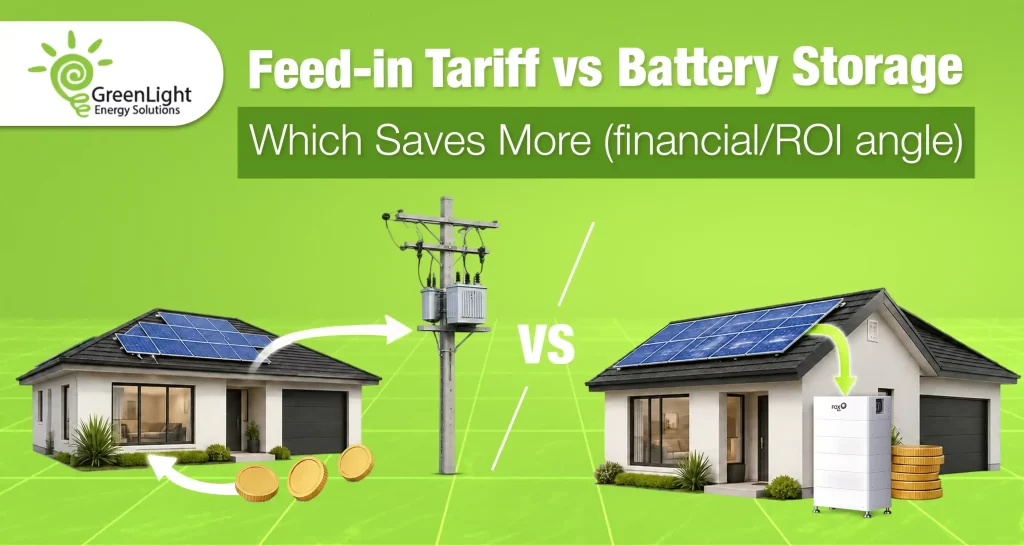
Storing a kilowatt-hour of your own solar is almost always worth more per unit than exporting it. Buying the equipment to do that storing is a separate question, and it is the one that decides whether you are better off financially.
Those two statements are not in conflict, and confusing them is the single most common mistake homeowners make when they weigh up a battery. Export credits arrive with no capital outlay. Storage delivers a much larger benefit per kilowatt-hour but only after you have paid several thousand dollars for the hardware and only if your household actually uses what the battery holds.
This article sets out the arithmetic so you can run it against your own bill rather than against a national average.
Feed-in Tariff vs Battery Storage:
Battery storage usually creates more value per kilowatt-hour than a feed-in tariff, because the retail price you avoid paying is far higher than the export rate you are paid. Whether that translates into a better overall return depends on the battery’s installed cost, how much of its capacity you use every day, and how long you hold the asset.
Exporting tends to remain the better financial position for households with modest evening consumption, limited surplus generation, an unusually strong feed-in rate, or an expensive or oversized battery quote. Storage tends to win for households that export heavily during the day and then buy expensive grid electricity through the evening peak.
How a Solar Feed-in Tariff Makes You Money
Any solar your home does not consume at the moment it is generated flows to the grid. Your retailer credits that exported energy at your feed-in rate, and the credit appears against your bill.
The appeal is straightforward: there is no additional equipment, no maintenance and no capital risk. The panels are already paid for, so every exported kilowatt-hour is incremental income.
The limitation is that you do not control the rate. Feed-in tariffs are set by retailers, not by government, and they have been trending down across the country as midday wholesale prices fall. In New South Wales, IPART publishes an annual benchmark range as a reference point for what exports are worth, and its all-day benchmark for 2026-27 sits at 3.4 to 6.5 cents per kilowatt-hour, down from 4.8 to 7.3 cents the previous year. Retailers are not obliged to pay within that range, so some pay less and some pay more to attract solar customers.
Two things follow. Your feed-in income depends entirely on how much you export and what your specific retailer pays, and neither of those is fixed. Check your current plan rather than assuming the rate you signed up on still applies.
How Battery Storage Saves Money
A battery changes what happens to your surplus. Instead of exporting the excess, you charge the battery during the day and discharge it in the evening, replacing electricity you would otherwise buy at full retail price.
That is the whole mechanism: self-consumption. You are not generating more solar, you are moving the same solar to a more valuable hour.
Two details matter financially. First, storage is not free of losses. Round-trip efficiency, the proportion of energy that survives the charge and discharge cycle, typically runs somewhere in the high eighties to low nineties as a percentage, and the manufacturer’s specification sheet will state the figure for a given product. Second, every kilowatt-hour you store is a kilowatt-hour you no longer export, so the feed-in credit you give up is a real cost that has to come off the benefit.
The Financial Difference: Exporting Solar vs Storing It
Here is the calculation that most comparisons skip.
Annual feed-in tariff income:
Annual solar exports (kWh) × feed-in tariff rate ($/kWh)
Value of storing one extra kilowatt-hour instead of exporting it:
Retail rate avoided − (feed-in tariff forgone ÷ round-trip efficiency)
The division matters. If your battery is 90 per cent efficient, delivering one kilowatt-hour to your home consumes about 1.11 kilowatt-hours of solar, so you forgo slightly more export credit than the single unit you get back.
Simple payback period:
Net battery cost after incentives ÷ estimated annual battery savings
Simple payback is a screening tool, not an investment return. It ignores capacity degradation, electricity price movements over the holding period, any warranty replacement, and the return you would have earned had the money stayed invested elsewhere. Treat it as a first filter, and treat any quote that presents it as a guaranteed outcome with caution.
Feed-in Tariff vs Battery Savings
Example only. The figures below are illustrative and are used to demonstrate the method. They are not current rates, not a quote, and not the results of any particular household. Substitute the numbers from your own bill and battery quote.
Assumed household, a Western Sydney home with existing rooftop solar:
| Assumption | Example value |
| Annual solar exports under current arrangement | 4,400 kWh |
| Feed-in tariff | 5c per kWh |
| Evening peak import rate | 40c per kWh |
| Battery usable capacity | 10 kWh |
| Round-trip efficiency | 90% |
| Average energy delivered from battery to home | 8 kWh per day |
| Battery installed cost before incentives | $11,000 |
Scenario A: keep exporting
4,400 kWh × $0.05 = $220 per year in feed-in credits.
Scenario B: store part of the surplus
Delivering 8 kWh per day to the home means the battery absorbs about 8.9 kWh of solar daily, or roughly 3,244 kWh across the year, leaving about 1,156 kWh still exported.
- Grid electricity avoided: 2,920 kWh × $0.40 = $1,168
- Feed-in credits retained: 1,156 kWh × $0.05 = $58
- Total benefit: $1,226 per year
The difference: about $1,006 per year in favour of storage.
Expressed per kilowatt-hour, storing is worth roughly 34 cents against 5 cents for exporting, close to seven times more. That gap is why battery marketing sounds so compelling, and it is entirely real.
Now add the capital. Using an illustrative federal discount of about $2,500 on a 10 kWh usable battery, the net cost lands near $8,500. Divided by $1,006 of annual saving, simple payback is roughly 8.4 years.
So both things are true at once. The energy is worth seven times more stored than exported, and the money still takes the better part of a decade to come back.
What About the Cost of the Battery?
The installed price depends on usable capacity, brand, whether the battery is going in alongside new panels or being retrofitted to an existing system, and how much electrical work your switchboard needs. Retrofits are generally dearer than doing it all at once. Our breakdown of what solar batteries cost in Australia covers the components in more detail.
Four cost factors deserve specific attention in any payback calculation:
Usable capacity, not nominal capacity. Rebates and savings both work off what you can actually draw out. A battery advertised at one figure may make less available in practice.
Degradation. Capacity falls gradually with cycling and age. A payback model built on year-one performance running unchanged for fifteen years is optimistic.
Warranty and expected life. Most residential lithium batteries carry warranties around ten years or a stated number of cycles, often with a minimum retained capacity. If your payback lands beyond the warranty term, you are relying on the asset performing past the period the manufacturer will stand behind.
Opportunity cost. Capital tied up in a battery is capital not doing something else. For some households, adding panels, replacing an electric hot water system with a heat pump, or shifting large loads into daylight hours delivers a better return per dollar than storage does. The trade-offs of battery ownership go beyond the bill.
The Break-even Point: Your Real Test
Rather than asking whether batteries are worth it in general, calculate the cost of storing one kilowatt-hour through your specific battery, then compare it to your spread.
Levelised cost of stored energy =
Net battery cost ÷ (annual kWh discharged × expected years of service)
Using the example above: $8,500 divided by 2,920 kWh per year over ten years gives about 29 cents per kilowatt-hour. The spread was 34 cents. The battery clears the bar, but not by a wide margin, and a colder look at degradation would narrow it further.
Change one variable. If that same household only draws 5 kWh a day from the battery instead of 8, annual discharge falls to 1,825 kWh, lifetime throughput drops, and the cost of stored energy rises to roughly 47 cents per kilowatt-hour. The spread is unchanged at 34 cents. The same battery, at the same price, in the same suburb, no longer stacks up.
Utilisation is the variable that decides the outcome, and it is the one most quotes never model.
When Does a Solar Battery Deliver the Better ROI?
Storage economics improve when several of these apply together:
- Your feed-in tariff is low relative to what you pay to import.
- You have genuine evening and overnight load, from air conditioning, electric hot water, cooking or an EV charging after work.
- Your system already exports a substantial surplus most days, so the battery fills reliably rather than sitting half empty through winter.
- You are on a time-of-use tariff with an expensive evening peak.
- The battery is sized to your evening consumption rather than to your ambition.
- Net cost after eligible incentives is competitive per usable kilowatt-hour.
- You intend to stay in the property long enough to see the payback through.
When Can a Feed-in Tariff Be the Better Financial Choice?
Continuing to export is often the rational position when:
- Evening and overnight consumption is low, for instance a household that is out all day and asleep early.
- Surplus generation is small, so a battery would cycle only partially.
- You hold an unusually strong feed-in rate that narrows the spread.
- The quoted battery is larger than your evening load can absorb.
- Installation is complicated or expensive, for example an ageing switchboard or an inverter that needs replacing to support storage.
- You may sell the property before recovering the investment. Storage may lift sale appeal, but that is not the same as recovering the outlay.
None of these make a battery a bad product. They make it the wrong purchase for that particular house at that particular time.
How Time-of-Use Tariffs Change the Calculation
On a flat tariff, every stored kilowatt-hour displaces electricity at the same price. On a time-of-use plan, the battery discharges into your most expensive window, which raises the value of each stored unit and shortens payback.
The reverse is also worth knowing. Time-of-use plans usually price daytime energy lower, which means the electricity you buy at other times may cost less than it would on a flat plan. Compare the whole plan, not one rate in isolation. Energy Made Easy lets you model your actual consumption against available offers.
Two NSW developments are worth factoring in. Some retailers now offer time-varying feed-in rates, where exports during the evening peak are worth considerably more than midday exports. IPART’s time-of-day benchmarks for 2026-27 reflect that, with evening ranges well above the all-day figure. Separately, from 1 July 2026 retailers with more than 1,000 customers in Default Market Offer areas must make a Solar Sharer Offer available to eligible households with a smart meter, providing up to 24 kilowatt-hours of free electricity during a three-hour midday window, 11am to 2pm in New South Wales. It is opt-in, and the rest of your usage is still charged, so whether it suits you depends on your consumption pattern. For a battery owner it opens an additional option: charging from the grid during the free window on days when solar generation is poor.
Does Battery Size Affect ROI?
Substantially, and usually in the opposite direction to what people expect.
Cost scales with capacity. Savings scale with utilisation. A battery that holds 15 kilowatt-hours in a home that uses 6 after sunset has bought nine kilowatt-hours of capacity that will rarely be cycled, which raises the cost of every kilowatt-hour it does deliver and stretches payback accordingly.
Federal support now reinforces this. Since 1 May 2026 the discount applies at its full rate for the first 14 kilowatt-hours of usable capacity, at a reduced rate between 14 and 28, and lower again from 28 to 50, meaning the incentive per kilowatt-hour falls as systems get larger.
Right-sizing is the highest-leverage decision in the whole exercise, which is why it deserves proper attention before brand selection. Our guide to sizing a battery to your evening usage walks through the calculation.
What About Government Battery Incentives?
The Cheaper Home Batteries Program is the main national support. It delivers a point-of-sale discount through Small-scale Technology Certificates under the Small-scale Renewable Energy Scheme, aimed at around 30 per cent of the installed cost for eligible systems between 5 kWh and 100 kWh nominal capacity, with certificates available for the first 50 kWh of usable capacity.
The value per kilowatt-hour is not fixed. It depends on the STC factor at the date your battery is installed and certified, and on the market price of certificates at that time. The factor steps down on a scheduled basis through to 2030, and since 1 May 2026 those step-downs occur every six months rather than annually. Your installer claims the certificates and applies the discount to your quote.
In New South Wales, the state’s separate upfront battery installation rebate has been replaced by an incentive under the Peak Demand Reduction Scheme for connecting an eligible battery to a Virtual Power Plant. It can generally be claimed alongside the federal discount. The amount is not a fixed dollar figure, because it is derived from certificate market values, so ask any provider quoting a specific number to show you the calculation. Details on how the NSW VPP incentive stacks with federal support are set out separately, alongside a breakdown of how the federal battery discount is calculated.
VPP participation itself can generate ongoing credits. It also means the operator may draw on your battery during peak events, which can reduce the stored energy available for your own evening use. Read the terms and treat any advertised VPP income as an estimate rather than a fixed return.
Feed-in Tariff vs Battery Storage Comparison Table
| Feed-in tariff (export) | Battery storage | |
| Upfront investment | None beyond existing solar | Several thousand dollars after incentives |
| How the benefit is generated | Retailer credits for exported energy | Avoided grid purchases through self-consumption |
| Value of surplus solar | Feed-in rate only | Retail rate avoided, less forgone export credit and losses |
| Evening grid dependence | Full | Reduced while stored capacity lasts |
| Payback consideration | Not applicable, no capital deployed | Typically years, driven by utilisation and net cost |
| Exposure to electricity price rises | Fully exposed on imports | Partially insulated for the energy you store |
| Feed-in tariff dependency | Complete | Reduced, and less affected if rates fall further |
| Backup during outages | None | Only if the system is specifically configured for it |
| Best suited to | Low evening use, small surplus, strong export rate | High evening use, large surplus, expensive peak periods |
So, Should You Export Your Solar or Install a Battery?
A battery deserves closer analysis if your bill shows meaningful evening and overnight consumption, your exports are substantial, your feed-in rate is at or below the benchmark range, you are on or could move to a time-of-use tariff with a high peak, and you expect to stay in the home well past the payback point.
Exporting probably remains the sensible position if your evening use is light, your surplus is modest, you hold a strong feed-in rate, the quotes you have received are expensive per usable kilowatt-hour, or you might move within a few years.
If you land between the two, the deciding factor is usually utilisation. A smaller battery cycled fully every day will often outperform a larger one cycled halfway.
How to Calculate Whether a Battery Makes Sense for Your Home
Gather these before you model anything:
- Twelve months of electricity bills, ideally with interval data from your retailer or smart meter portal.
- Your annual solar generation and how much of it you exported.
- Your current feed-in rate, taken from a recent bill rather than memory.
- Your import rates, including peak, shoulder and off-peak if you are on time-of-use.
- Your evening and overnight consumption, which sets the ceiling on useful battery size.
- A written quote showing usable capacity, round-trip efficiency, warranty terms and the incentive applied.
- Whether your existing inverter supports a battery or needs replacing.
Then run three numbers: your per-kilowatt-hour spread, your levelised cost of stored energy, and your simple payback. If the spread comfortably exceeds the cost of storage, the case is sound. If they are close, the decision rests on how confident you are about utilisation and how long you intend to stay.
Final Verdict
There is no universal winner, and any article that declares one is not looking at your bill.
Storage almost always makes each surplus kilowatt-hour worth more than exporting it does. Whether it makes you better off depends on three things multiplied together: the size of the gap between your import rate and your feed-in rate, the net cost of the battery per usable kilowatt-hour, and how much of that capacity your household actually cycles each day. Get a large gap, a competitive price and high utilisation, and the case is strong. Weakening any one of the three and exporting may serve you better.
Rather than working from national averages, Greenlight Solar can review your generation and export data, your current tariff structure and your evening consumption pattern to estimate whether storage is likely to suit your household and what capacity would be appropriate. No guaranteed savings figures, just the arithmetic applied to your own numbers. Request an assessment to see where you land.
Frequently Asked Questions
Is it better to store solar or sell it back to the grid?
Per kilowatt-hour, storing is generally worth more, because avoiding a retail purchase saves you more than an export credit earns. Selling back requires no investment, so the better option overall comes down to whether the additional value justifies the battery’s cost across its working life.
Does a battery save more than a feed-in tariff?
It usually generates a larger annual benefit for households with substantial evening consumption. That benefit has to repay the hardware first. A household with light evening use may find the annual saving too small to recover the outlay within the warranty period.
How do I calculate solar battery payback?
Divide the net battery cost after incentives by your estimated annual saving. To calculate the saving, multiply the energy the battery will realistically deliver each year by your import rate, then subtract the feed-in income you give up, adjusted for round-trip efficiency.
Are solar batteries financially worth it in NSW?
For some NSW households, yes. Feed-in tariffs have fallen while evening electricity remains expensive, which widens the spread, and federal support reduces the upfront cost. Whether it works for a specific home depends on evening consumption, surplus generation, the retail plan and the quoted price per usable kilowatt-hour.
What happens to my feed-in tariff if I install a battery?
It stays in place, but you will earn less from it, because energy going into the battery is energy not being exported. That reduction is a genuine cost and belongs in the calculation. You continue to export whatever surplus the battery cannot absorb.
Does a low feed-in tariff make batteries more worthwhile?
Relatively, yes. A lower export rate means you give up less by storing, which widens the value of each stored kilowatt-hour. It does not change the battery’s price, so a low feed-in tariff improves the case without guaranteeing it.