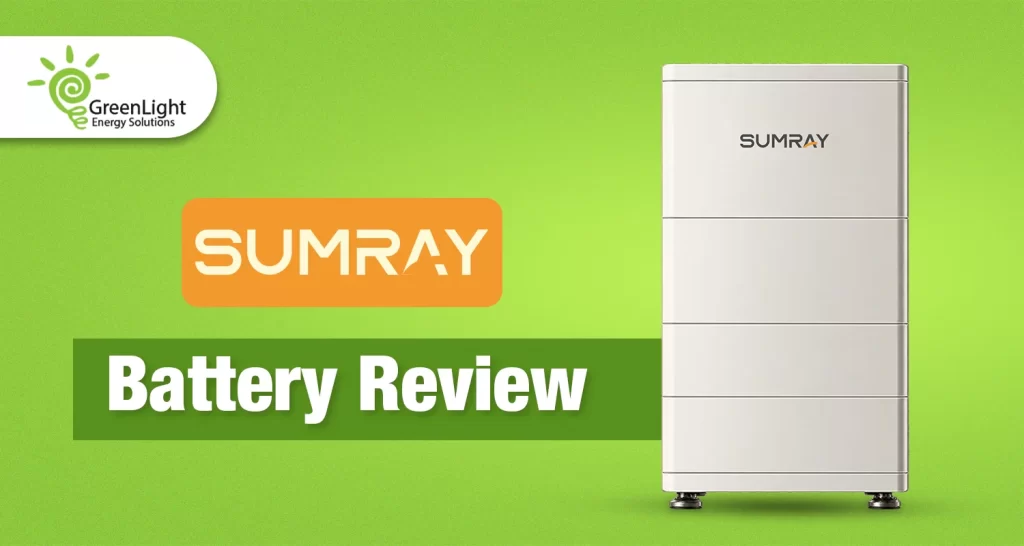
Sumray is one of the newer names appearing on Australian quotes, and most homeowners meet it the same way: a battery line item that looks unusually generous on kilowatt-hours next to a brand they already recognise. That raises a fair question. Is the number real, and does the hardware behind it hold up in Australian conditions?
This Sumray battery review works through the SR-LV14G range on the things that actually change your bill and your risk: how much of the pack you can genuinely use, how it is built for heat and salt air, what inverter it needs, how it sits against the federal rebate, and which households it suits rather than which households it merely fits.
What the Sumray SR-LV14G actually is
The SR-LV14G is a 48V low-voltage, modular storage system using lithium iron phosphate cells. Rather than a sealed single-capacity cabinet, it is built as a stack. One module gives you 13.92kWh. Stack up to four and a single tower reaches 55.68kWh, and up to four towers can run in parallel beyond that.
That architecture matters more than it sounds. A household that installs 13.92kWh now and buys an electric vehicle in three years does not have to replace the asset, it adds to it. Compare that with a fixed-capacity battery, where growth usually means a second complete unit with a second set of hardware costs.
| Configuration | Usable energy | Charge / discharge | Weight |
| SR-LV14G-L1 | 13.92kWh | 100A / 100A | 120kg |
| SR-LV14G-L2 | 27.84kWh | 200A / 200A | 230kg |
| SR-LV14G-L3 | 41.76kWh | 300A / 300A | 340kg |
| SR-LV14G-L4 | 55.68kWh | 300A / 300A | 450kg |
Across the range the chemistry, protection systems and warranty stay identical. Only capacity, current and physical footprint scale.
The usable capacity point is not marketing fluff
Most battery datasheets carry two numbers: nominal capacity and usable capacity. The gap between them is storage you paid for and will never touch, because the management system reserves it to protect cell life.
Sumray rates the SR-LV14G at 100% depth of discharge, so rated and usable energy are the same figure. A 13.92kWh module delivers 13.92kWh. Against a battery advertising 15kWh nominal but delivering around 13.5kWh usable, the headline difference shrinks to almost nothing, and on cost per genuinely usable kilowatt-hour Sumray often lands ahead.
The honest caveat: deep cycling is harder on cells, which is why the 10,000-cycle rating and the 15-year warranty are the figures that make the claim credible rather than risky. Cycled once daily, 10,000 cycles is well beyond the warranty term. If you are still working out how much capacity you need in the first place, our guide on what size solar battery you actually need is the better starting point than any brand comparison.
Built for where Australians actually put batteries
Garages are the easy case. The harder case is a wall on the shaded side of a house in Byron Bay, or a Brisbane patio that touches 45°C against brickwork in February.
The SR-LV14G carries an IP66 rating with C4 corrosion protection and salt-spray testing, and it is cooled by natural convection with no fan. That last detail is quietly important. Fans are the moving part most likely to fail first in a dusty or salty environment, and they are the component most likely to annoy anyone installing a battery near a bedroom wall.
Discharge is rated from -20°C to 50°C, with charging from 0°C to 50°C and optional heating for colder sites, which covers inland frost belts like the Southern Tablelands as readily as the coast. If outdoor placement is your situation, our article on whether solar batteries can be installed outside covers the clearance and compliance side in more detail.
Safety architecture worth understanding
Lithium iron phosphate chemistry is already the conservative choice for home storage, with far better thermal stability than the nickel-based chemistries used in most electric vehicles.
Sumray layers protection on top of that. Each module has its own circuit breaker, so a fault is isolated at module level rather than taking the tower down. Aerosol fire suppression is fitted as standard, and certification covers UN38.3 plus a stack of IEC standards including CB62619, IEC62040 and IEC62477. For context on what these standards mean in practice, see our overview of solar battery safety in Australia.
The inverter pairing is the real decision
Here is where this Sumray battery review gets practical. The SR-LV14G is a low-voltage DC battery, which means it is not a plug-and-play addition to any existing system. It runs with a Solis hybrid inverter, and an 8kW single-phase unit is the common pairing.
That is a genuine advantage for some homes and a genuine constraint for others. The advantage: an 8kW inverter moves considerably more energy in and out than a typical 5kW unit, which matters when ducted air conditioning, a heat pump and backup circuits are all running at once, and when you want to pull as much as possible from off-peak or free-power windows offered by retailers. The constraint: if you already run a brand-locked ecosystem, adopting Sumray means changing inverter.
Worth reading alongside this: AC-coupled versus DC-coupled batteries and whether you can add a battery to existing solar without replacing the system. Our Solis inverter range page covers the matching hardware.
How the rebate lands on a 13.92kWh module
The federal Cheaper Home Batteries Program delivers its discount through Small-scale Technology Certificates, applied upfront at point of sale. It pays the highest rate per usable kilowatt-hour on the first 14kWh of capacity, then steps down through higher bands up to 50kWh.
The L1 configuration sits at 13.92kWh usable, which places effectively the entire module inside that top-value band. That is a structural advantage rather than a sales line, and it is the single strongest argument for the entry configuration. Because the certificate rate steps down each January, the arithmetic rewards installing earlier in a given rate period. Our federal solar battery rebate guide explains the tier structure and state stacking, including the NSW incentive under the Peak Demand Reduction Scheme.
Who the Sumray battery suits, and who it does not
It suits you if: you want maximum usable storage per dollar, you are open on inverter brand, you are planning to grow capacity over time, or you are installing in a coastal, exposed or high-heat location. High-consumption homes and small commercial sites get particular value from the L3 and L4 configurations and their 300A current rating.
Look elsewhere if: you want a battery that integrates with an existing Tesla or Sungrow inverter setup, you want the deepest Australian service history behind the brand, or you are chasing a specific virtual power plant program. Whether a VPP is worth joining is a separate decision, and program compatibility should be checked before you commit to any brand. Our comparison of the best solar batteries in Australia puts Sumray alongside the alternatives.
Verdict
The SR-LV14G earns its place on a shortlist on three counts: usable capacity you are not paying a reservation tax on, a build genuinely specified for Australian outdoor conditions, and a 15-year warranty at the longer end of the market. The trade-off is inverter commitment and a shorter local track record than the established names.
If the rebate maths and the Solis pairing both work for your site, it is one of the better value propositions currently available. Greenlight Solar supplies and installs the full Sumray range, and you can request a quote or browse the wider solar battery range to compare.
FAQs
Is the Sumray battery any good compared to better-known brands?
On measurable specifications it is competitive: 100% usable capacity, a 15-year warranty, IP66 outdoor rating and 10,000-cycle design life match or beat several premium options. Where it trails is Australian service history, which is simply a function of being newer to the market.
How many years will a Sumray SR-LV14G last?
The warranty runs 15 years and the cells are engineered for more than 10,000 cycles. Cycled once daily, that cycle count extends well past the warranty period, so warranty term is the practical limit rather than cell wear.
Do I need a specific inverter for a Sumray battery?
Yes. It is a low-voltage DC battery designed to run with a Solis hybrid inverter, commonly an 8kW single-phase unit. This should be confirmed before you commit, particularly if you already have an inverter you intended to keep.
Can I start with one Sumray module and add more later?
Yes, and this is one of its stronger arguments. A tower stacks from 13.92kWh to 55.68kWh, and up to four towers can run in parallel, so capacity can follow your load as it grows.
Will a Sumray battery run my house during a blackout?
With the correct inverter and backup wiring, it supplies nominated essential circuits during an outage. What those circuits can realistically run is covered in our guide to what a home battery can actually power in a blackout.
Is a 13.92kWh Sumray battery enough for an average family home?
For most two to four person households it covers the evening peak and overnight base load comfortably. Homes with ducted air conditioning, a pool or an electric vehicle usually justify stepping up to the 27.84kWh configuration.