Not long ago, a solar system was simple: panels on the roof, an inverter in the garage, and a smaller electricity bill at the end of the quarter. In 2026, that picture has changed completely. Today, Australian homeowners with smart solar setups are saving thousands more and in some cases, earning money from their systems every single month.
This guide breaks down three of the biggest developments reshaping Australia’s energy landscape right now: smart solar inverters, AI-powered energy management, and Virtual Power Plants (VPPs). We’ll also show you exactly how our residential solar systems at GreenLight Solar are built to take full advantage of all three right from the day of installation.
1. What Is a Smart Inverter And Why Does It Matter?
A traditional inverter does one thing: convert the DC electricity your solar panels produce into AC electricity your home can use. A smart inverter does all of that and a great deal more.
In 2026, smart inverters will become the central control system of your entire home energy ecosystem. They communicate in real time with the electricity grid, your solar battery storage, your EV charger, and your home appliances. Instead of passively converting power, they actively manage the flow of energy based on what is cheapest and most efficient at any given moment.
What a Smart Inverter Actually Does:
- Communicates with the grid in real time — adjusting how much power is exported or drawn based on live conditions and feed-in tariff rates
- Manages your battery — decides when to charge, discharge, and how much to keep in reserve, all automatically
- Controls your EV charger — prioritises charging your car when solar generation is highest and grid prices are lowest
- Dynamic export control — limits grid exports automatically when your network distributor requires it, keeping you compliant without manual adjustments
- Fault detection — monitors panel performance and alerts you or your installer if any panel drops below expected output
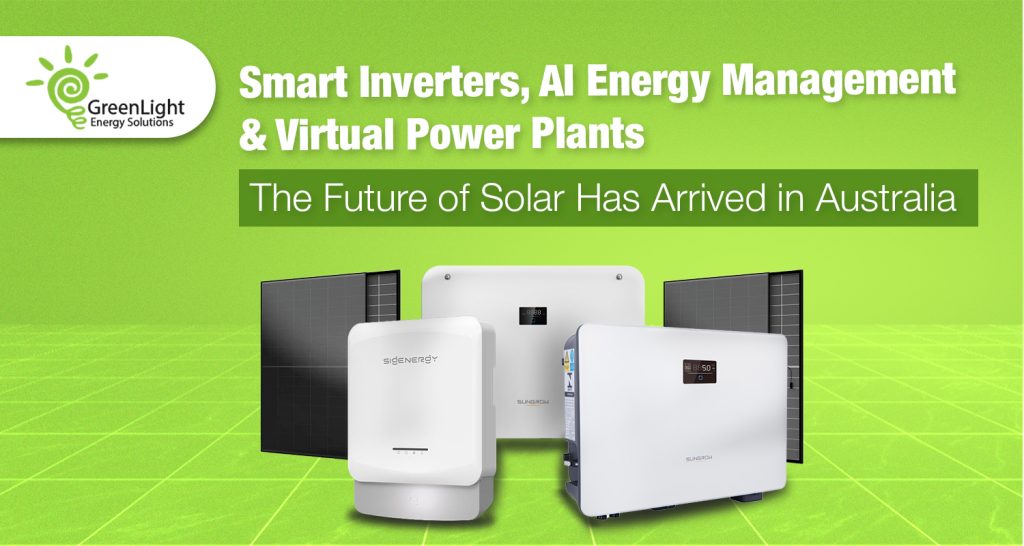
GreenLight Solar Installs: We supply and install the Sungrow inverter, Enphase inverter, Sigenergy inverter and Solis inverter all fully smart, grid-interactive and VPP-ready out of the box.
If you currently have an older “dumb” inverter installed, 2026 is the year to consider an upgrade. A smart hybrid inverter can often be retrofitted to an existing solar array without replacing your panels, instantly turning a passive system into a fully connected energy hub.
2. AI Energy Management Your Home Learning to Save Automatically
Artificial intelligence in solar energy management is not about robots or science fiction. It is practical, already-available technology being quietly installed in thousands of Australian homes right now and it works.
AI energy management systems use algorithms, live weather forecasting data, and your household’s historical usage patterns to make smarter decisions about when to store energy, when to use it, and when to export it to the grid. The result is a system that optimises itself without you having to lift a finger.
Weather Prediction & Pre-Charging
If the AI sees cloudy weather forecast for tomorrow, it will charge your battery more aggressively today ensuring you have stored power available when solar generation is limited. On a clear sunny day, it may hold back battery charging in the morning, knowing the afternoon sun will produce more than enough to fill it. Products like the Tesla Powerwall and Sungrow battery both support this kind of intelligent, weather-aware charging natively.
Learning Your Daily Habits
The system learns when you typically run high-load appliances dishwashers, washing machines, air conditioning, pool pumps and automatically schedules them during peak solar generation hours (typically 10am–3pm). This means more of your solar power is consumed directly inside your home rather than exported for a low feed-in tariff rate.
Real-Time Price Optimisation
If you are on a Time-of-Use electricity tariff common across NSW and Victoria the AI automatically switches between drawing from your battery, drawing from the grid, or exporting to the grid based on live pricing signals. This maximises your financial return at every hour of the day without any manual input from you.
Research Spotlight: UNSW researchers are currently running a government-funded trial of the AI-Enabled Smart Energy Hub project using AI-driven energy management platforms to optimise solar and battery systems across residential networks in Sydney. Early results show improved grid stability and significantly lower energy costs for participating households.
Predictive Maintenance
One of the most underappreciated benefits of AI monitoring is early fault detection. If one panel in your array starts underperforming due to shading, soiling, or a developing fault the AI system flags it within hours. For our customers across Sydney, Melbourne and Brisbane, this kind of real-time monitoring comes standard with every GreenLight installation. For a 10kW system, catching a fault early can save hundreds of dollars in lost generation.
3. Virtual Power Plants Turn Your Battery Into an Income Stream
A Virtual Power Plant (VPP) is one of the most exciting developments in Australian home energy and still one of the least understood. If you have a solar battery at home, a VPP could be earning you money right now.
What Is a VPP?
A Virtual Power Plant connects thousands of individual home batteries via smart software into a single, coordinated energy network. When the electricity grid experiences a surge in demand, such as a 40°C afternoon in Western Sydney when every household switches on air conditioning simultaneously, the VPP operator calls on all connected batteries to release stored energy into the grid at once. This stabilises the grid and removes the need for expensive, polluting peaker power plants to fire up.
In return for participating, homeowners are paid. Depending on the program and provider, rewards come in the form of monthly credits, quarterly cash payments, discounted electricity rates, or upfront battery purchase bonuses.
What VPP Incentives Are Available in Australia Right Now?
- NSW Peak Demand Reduction Scheme (PDRS): Up to $1,500 cashback for connecting a VPP-compatible battery to an approved program
- Victoria: State-level VPP credits that can be stacked on top of the federal solar battery rebate for maximum savings
- South Australia: Strong VPP programs with multiple provider options and competitive event payments
- All states: Monthly VPP event payments when your battery exports during peak demand periods paid regardless of how much energy is used
Expert Tip from GreenLight Solar: Always confirm VPP compatibility before purchasing a battery. Our Sungrow battery, Tesla Powerwall and Neovolt battery installations are all designed VPP-ready from day one no retrofitting or additional hardware required.
Is Your Current Battery VPP-Ready?
To participate in a VPP, your system needs a smart inverter capable of two-way grid communication using protocols such as IEEE 2030.5. This is exactly why inverter choice matters at installation time. If your current inverter is older, a smart hybrid inverter upgrade may be all you need to unlock VPP participation and the ongoing income that comes with it.
4. Is Smart Solar Worth the Extra Cost?
Smart solar technology does add modestly to the upfront cost. A smart inverter typically costs $300–$800 more than a basic model. An AI energy management platform is usually bundled into the inverter software at no extra cost. VPP connection is free and pays you back.
Independent analysis consistently shows that smart solar homes save 15–35% more on electricity than equivalent homes running standard non-smart systems. For a household spending $2,500 per year on electricity, that is an additional $375–$875 in annual savings purely from smarter energy management. Add VPP income ranging from $100 to $500+ per year depending on participation and provider, and the total financial improvement is substantial.
Bottom Line: For most Australian households in 2026, upgrading from a standard solar system to a smart solar system pays for itself within 1–2 years through improved savings and VPP income and then continues delivering those returns for 20+ years.
5. What GreenLight Solar Installs for Smart, Future-Proof Homes
At GreenLight Solar, we do not just sell solar panels. We design complete home energy ecosystems built to take full advantage of everything smart solar technology offers in 2026 and beyond. Whether you are a residential homeowner or managing a commercial solar operation, every system we design includes:
- Smart inverter compatibility: Sungrow, Enphase and Sigenergy all grid-smart, AI-capable and VPP-ready
- Battery selection: Tesla Powerwall, Sungrow battery and Neovolt battery chosen for smart charging capability and VPP compatibility
- EV charger integration: Smart EV chargers that draw power preferentially from solar generation, reducing your charging cost to near zero
- Wi-Fi solar monitoring: Track live generation, household consumption, battery state of charge, and estimated savings directly from your smartphone
- CEC-certified installation: Every installation carried out by accredited, insured Clean Energy Council professionals with over 20 years of industry experience
Ready to Make Your Solar System Smart?
Whether you are starting fresh with a brand new system or looking to upgrade an older installation, GreenLight Solar can design a smart solar solution tailored specifically to your home, your energy usage, and your budget. Contact us today for a free, no-pressure consultation or explore our latest blog articles for more guides on getting the most from solar in Australia in 2026.
Frequently Asked Questions
Do I need a brand new solar system to get a smart inverter?
Not necessarily. In many cases, a smart hybrid inverter can be retrofitted to an existing solar array without replacing your panels. Contact GreenLight Solar and our team will assess your current setup and advise on the most cost-effective upgrade path for your home.
How do I know if my battery is VPP-compatible?
VPP compatibility depends on your inverter’s communication capabilities. Batteries connected to Sungrow, Enphase or Tesla Powerwall inverters are typically VPP-ready. Our team confirms compatibility during every free consultation.
Can I claim the battery rebate and join a VPP at the same time?
Yes — and in many states the federal solar battery rebate can be stacked with state-level VPP incentives for maximum savings. Ask our team for a full rebate and incentive breakdown specific to your state and system size.
Can I monitor my smart solar system from my phone?
Absolutely. Every GreenLight Solar installation includes a Wi-Fi enabled smart inverter and full access to a smartphone monitoring app — so you can track live solar generation, household usage, battery charge level, and estimated savings in real time, from anywhere.