The Australian home battery market has never been more competitive or more confusing. With the federal Cheaper Home Batteries Program now active and electricity prices continuing to climb across Sydney and NSW, more homeowners than ever are adding battery storage to their solar systems in 2026.
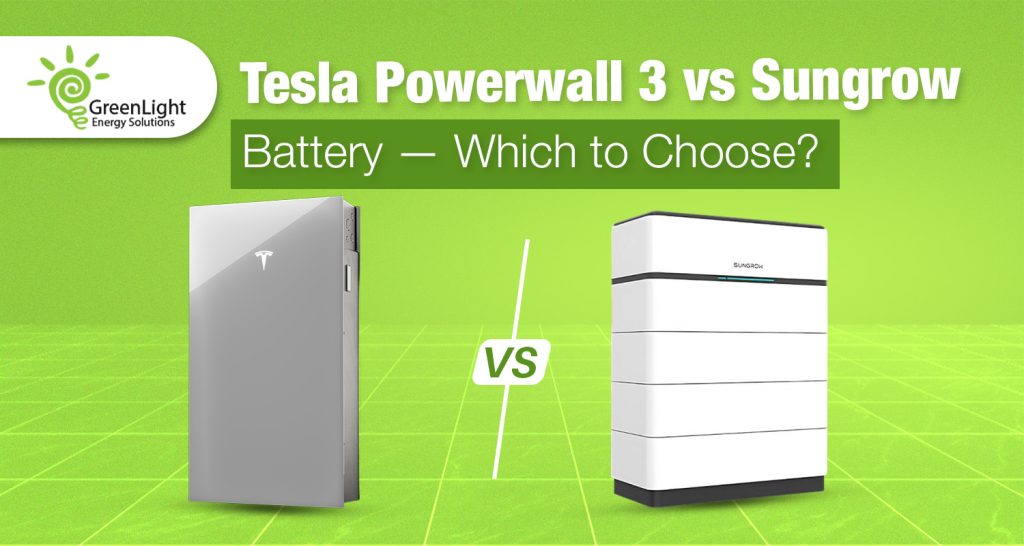
But two names keep coming up again and again in the conversation: Tesla Powerwall 3 and Sungrow Battery. Both are proven, well-supported, and available right here in Sydney. Yet they serve quite different types of homeowners and choosing the wrong one could mean paying thousands more than you need to, or missing out on features that actually matter for your lifestyle.
In this guide, we break down both batteries honestly so you can make the right call for your home. You can also browse our full solar battery range to compare all available options.
Quick Comparison: Tesla Powerwall 3 vs Sungrow Battery
| Feature | Tesla Powerwall 3 | Sungrow SBR Series |
| Usable Capacity | 13.5 kWh | 9.6–25.6 kWh (modular) |
| Continuous Output | 11.5 kW | 9.6 kW |
| Round-Trip Efficiency | 89% | 97% |
| Built-in Inverter? | ✅ Yes | ❌ No (requires Sungrow inverter) |
| Battery Chemistry | LFP | LFP |
| Scalable? | Limited (add full units) | ✅ Yes (3.2 kWh modules) |
| 3-Phase Compatible? | ✅ Yes | ✅ Yes |
| Blackout Backup | Full home (single-phase) | Partial/full (with hybrid inverter) |
| Warranty | 10 years / 70% capacity | 10 years / 60% capacity |
| Installed Cost (After Rebate) | ~$11,650 | ~$5,500–$8,000 |
| Best For | All-in-one simplicity, premium buyers | Value-focused, modular, Sungrow inverter owners |
About Tesla Powerwall 3
The Tesla Powerwall 3 is the latest generation of Tesla’s home battery system and was officially launched in Sydney in August 2024. The Powerwall 3 has 13.5 kWh usable capacity, 11.5 kW continuous output power, and 22 kW peak power. It uses LFP (lithium iron phosphate) chemistry, has a 10-year warranty with 70% capacity retention guarantee, IP67 weatherproofing rating, and operates from -20°C to 50°C. Critically, it has an integrated solar inverter no separate inverter is required.
This all-in-one design is Tesla’s biggest differentiator. You get the solar inverter, battery inverter, and battery storage in a single wall-mounted unit which simplifies installation considerably, particularly for new solar builds.
For a deep-dive review of this product, read our full Tesla Powerwall 3 Review
About Sungrow Battery (SBR Series)
Sungrow is the world’s largest inverter manufacturer by volume, and the SBR (Scalable Battery Rack) is their residential storage product for the Australian market. It’s a modular, DC-coupled lithium iron phosphate (LFP) battery that stacks 3.2 kWh modules to reach your preferred capacity.
The three most common configurations in Australia are the SBR96 (9.6 kWh), SBR160 (16 kWh), and SBR256 (25.6 kWh). The modular design means you’re not locked into a fixed capacity; you can start small and expand later as your energy needs grow.
Unlike the Powerwall 3, the Sungrow SBR requires a compatible Sungrow hybrid inverter to operate. If you’re buying a fresh solar and battery system together, this is easily handled as a package. If you have an existing non-Sungrow inverter, compatibility is a real consideration. Read our detailed Sungrow Battery Review and our Sungrow Inverter Review for more detail.
Cost Comparison: What Will You Actually Pay in Sydney?
Cost is where the two products diverge most sharply and where the decision often gets made.
The installed price for the Tesla Powerwall 3 in Australia is approximately $16,100 before any rebates apply. After the federal Cheaper Home Batteries Program reduces the cost by roughly $4,450, you are looking at around $11,650 out of pocket. That works out to $860 per usable kWh post-rebate, the highest per-kWh cost among the major brands.
However, context matters enormously here. The Powerwall 3 is an all-in-one unit with a solar inverter, battery inverter, and battery storage in a single box. No other top-selling residential battery in Australia ships with this included. When you factor in the avoided cost of a separate hybrid inverter (typically $2,000–$3,000), the true price gap between Powerwall 3 and Sungrow narrows noticeably.
At post-rebate pricing, the SBR160 at ~$5,500–$6,000 represents the best value per kWh of any mainstream 16 kWh battery in Australia. But remember this price assumes you already have a compatible Sungrow hybrid inverter installed. If you need to add one, factor in an extra $2,000–$3,000.
Don’t miss the current rebate window. The Federal Government Solar Battery Rebate provides approximately $372 per usable kWh off the installed price applied directly at point of sale by your installer. For more detail on how the rebate works and when it changes, read our dedicated Solar Battery Rebate Australia 2026 Guide.
Efficiency: Where Sungrow Has a Clear Edge
The Sungrow SBR160 achieves 97% round-trip efficiency versus Tesla’s 89% meaning Tesla loses more energy per cycle.
In practical terms, this means that for every 100 kWh of solar energy you send into a Sungrow battery, you get 97 kWh back. With a Powerwall 3, you get 89 kWh back. Over a year of daily cycling, that 8% efficiency gap translates to a measurable difference in your electricity bill savings. For Sydney households with high daily usage, this is worth taking seriously.
Backup Power: Tesla Leads for Single-Phase Homes
When the grid goes down and Sydney does experience outages, particularly in storm season backup capability matters.
The Powerwall 3 is grid-forming capable and can island your home during a grid outage and power your loads independently. The integrated 11.5kW inverter can support most standard household loads simultaneously, including air conditioning.
For single-phase homes wanting full home backup, Tesla Powerwall 3 offers the most straightforward solution. However, if you have a three-phase connection and wish to have all three phases backed up, Sungrow SBR and SBH may be the better choice, as Sungrow provides high-power hybrid inverters specifically designed for three-phase backup.
For most Sydney homeowners on standard single-phase connections to the majority of residential properties the Powerwall 3’s backup capability is a genuine, tangible advantage.
Scalability: Sungrow Wins on Flexibility
The capacity for each Sungrow battery module is 3.2 kWh. Overall, its battery storage can be equipped with up to eight battery modules, bringing the total capacity to 25.6 kWh. Sungrow’s modularity gives you flexible options so that you can easily tailor the battery size to meet your particular energy needs.
This is a significant practical advantage. If you want to start with 9.6 kWh now and expand to 16 kWh in a few years as your household grows or you add an EV, the Sungrow system allows that without replacing the core unit.
Tesla Powerwall 3 requires a whole new unit to expand capacity whereas modular batteries like Sungrow let you start small and grow. Up to 4 Powerwall 3 units can be stacked for 54 kWh total, but each additional unit comes at full cost.
Not sure how much battery capacity you actually need? Read: What Size Solar Battery Do I Need?
Warranty: Tesla Has a Slight Edge
Both Sungrow and Tesla offer a 10-year warranty for their solar batteries. The key difference is that Sungrow guarantees at least 60% of the original capacity during that period, while Tesla can maintain 70% of its capacity for 10 years.
The Tesla warranty also covers unlimited charge and discharge cycles, a meaningful assurance for households that cycle their battery daily. Sungrow’s warranty is still solid and industry-standard, but Tesla’s 70% capacity floor does provide slightly greater long-term certainty.
Software and Monitoring: Tesla’s Ecosystem Advantage
The Tesla app for real-time monitoring provides real-time data about energy production and consumption, and importantly, storage. These are all important when analysing how your energy storage system operates. It’s always helpful to know your household’s consumption to better understand your needs and patterns.
Tesla’s software ecosystem is widely regarded as the most polished consumer experience in the home battery market. The app is intuitive, the monitoring is detailed, and Tesla’s Virtual Power Plant (VPP) integration is among the most established in Australia meaning you can potentially earn money by allowing Tesla to draw on your battery during peak grid demand events.
Sungrow’s monitoring platform is competent and practical, but doesn’t quite match the polish or VPP ecosystem depth of Tesla’s offering.
Inverter Compatibility: A Key Practical Consideration
This is where many buyers get caught out. Sungrow batteries are really only designed to be used with same-brand solar inverters. Tesla Powerwall 3 offers more flexibility in the AC-coupled space. Elite Power Group
What this means for Sydney homeowners:
- Already have a Sungrow inverter? → The SBR battery is a natural, cost-effective fit
- Have a non-Sungrow inverter? → You’d need to add or replace your inverter to use SBR, which changes the cost calculation significantly
- Installing solar and battery from scratch? → Both are viable. A Sungrow hybrid + SBR package offers strong value. Tesla Powerwall 3 offers simplicity
- Retrofitting to an existing non-Sungrow system? → Tesla Powerwall 3 or an AC-coupled option is the more practical choice
For a complete guide on the installation process for battery storage, see: How to Install a Solar Battery
Who Should Choose Tesla Powerwall 3?
Tesla Powerwall 3 is the right choice if:
- You’re doing a new solar + battery installation from scratch and want everything in one unit
- You’re on a single-phase connection and want full whole-home backup during outages
- You have an existing non-Sungrow inverter and want a battery that’s AC-coupled and flexible
- You value a premium app experience and want the best VPP earning potential
- You want maximum continuous power output (11.5 kW) for running multiple high-draw appliances simultaneously
- You want the peace of mind of Tesla’s brand, 70% capacity warranty, and local certified installer network
- Your quarterly bill is over $700 and you want to maximise self-consumption savings
Who Should Choose Sungrow Battery?
Sungrow Battery (SBR Series) is the right choice if:
- You already have a Sungrow hybrid inverter installed the SBR plugs in as a seamless addition
- You’re budget-conscious and want the most kWh per dollar spent, particularly after the federal rebate
- You want a modular system that can grow from 9.6 kWh today to 25.6 kWh in the future
- You have a three-phase property and want full three-phase backup capability
- You prioritise round-trip efficiency at 97%, Sungrow wastes less of your solar energy than Tesla’s 89%
- You’re doing a new residential solar installation and want a combined solar + battery package from one brand
For a full cost breakdown of adding a battery to a 6.6kW system, see: 6.6kW Solar System with Battery — Cost Australia
Australian Conditions: Which Battery Handles Them Better?
For Australian conditions, the improved thermal tolerance of LFP chemistry over older NMC is a practical benefit that will likely show up in long-term capacity retention. Why Solar Importantly, both the Tesla Powerwall 3 and the Sungrow SBR now use LFP chemistry meaning both are well-suited to Australia’s harsh heat, UV, and temperature cycling.
Australia is genuinely one of the world’s toughest environments for battery storage. High ambient temperatures in Western Sydney suburbs, coastal humidity in beachside areas, and rapid temperature swings all put batteries under stress that European-designed products weren’t always engineered to handle. Both of these products have been tested and proven in Australian conditions but LFP chemistry in both gives them a strong foundation for longevity.
For more on this topic, read: Australia Is the World’s Cruellest Battery Test Lab
Honest Pros and Cons Summary
Tesla Powerwall 3
✅ All-in-one design — no separate inverter needed
✅ 11.5 kW continuous output — best in class for single-phase
✅ Full whole-home backup on single-phase
✅ Industry-leading app and VPP ecosystem
✅ 70% capacity warranty — stronger than most
✅ Flexible AC-coupled — works with most existing systems
❌ Most expensive option at $860/kWh post-rebate
❌ Lower round-trip efficiency at 89%
❌ Limited scalability — requires full additional units
❌ Smaller certified installer pool in Sydney
Sungrow SBR Battery
✅ Outstanding value — among the lowest cost per kWh post-rebate
✅ 97% round-trip efficiency — best in category
✅ Fully modular — expand from 9.6 kWh to 25.6 kWh
✅ Excellent three-phase backup performance
✅ Proven reliability — world’s largest inverter manufacturer
✅ Widely available through most Sydney solar installers
❌ Requires compatible Sungrow inverter — not inverter-agnostic
❌ 60% capacity warranty — slightly lower than Tesla
❌ Less polished app experience than Tesla
Final Verdict
Both batteries are excellent products; the right choice comes down to your priorities, your existing equipment, and your budget.
Choose Tesla Powerwall 3 if you want a strong all-in-one unit with excellent backup power and a simplified installation experience. Choose Sungrow SBR if you want modular storage that can grow with your household and offers outstanding value per kilowatt-hour. SolarBright
For most Sydney homeowners doing a fresh solar + battery installation on a budget, the Sungrow SBR paired with a Sungrow hybrid inverter is hard to beat on value. For homeowners retrofitting to an existing system, wanting maximum backup power, or valuing the Tesla ecosystem the Powerwall 3 justifies its premium.
Not sure which is right for your home? Read our independent guide: What Is the Best Solar Battery in Australia? and What Are the Pros and Cons of Solar Batteries? Ready to get a tailored battery recommendation for your Sydney home? Contact our team at Greenlight Solar for a free, no-obligation consultation and quote today. We service all areas across NSW and can help you find the right battery for your exact situation.