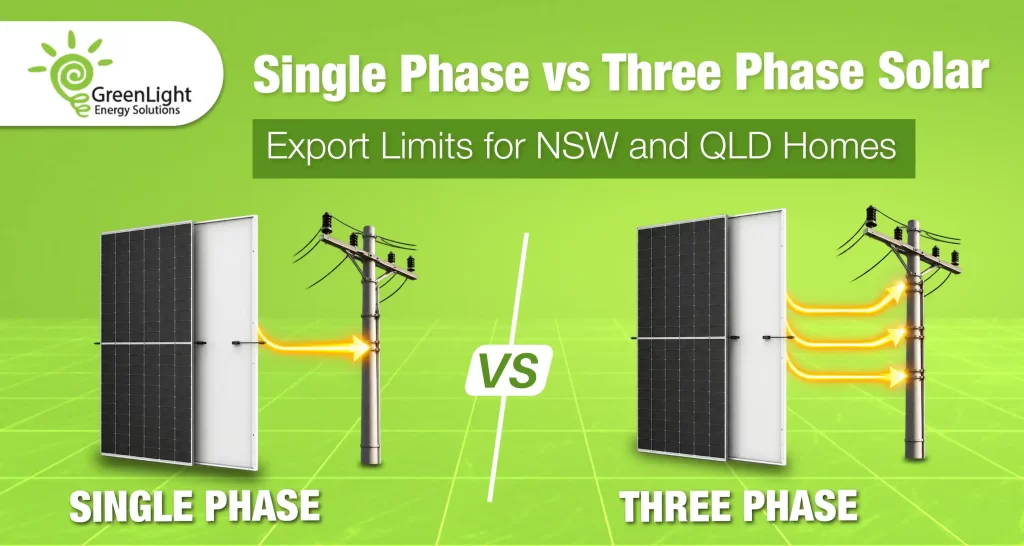
Two neighbours install the same 13kW solar system on the same street. One exports 15kW to the grid on a good day. The other is throttled back to 5kW and watches the difference disappear. The hardware is identical. The difference is how many phases of electricity supply each house has.
This is one of the least understood parts of a solar quote, and it has a direct effect on system sizing, payback and whether a battery makes sense. Here is how single phase and three phase actually differ, what the networks in New South Wales and Queensland currently allow, and when paying to upgrade is worth considering.
The difference in plain terms
A single phase connection brings one live conductor into your switchboard. It is the standard arrangement for most older and smaller Australian homes, and it comfortably handles typical household loads.
A three phase connection brings three live conductors, each carrying power offset in timing from the others. More capacity, more evenly delivered. Three phase is common in newer and larger homes, properties with ducted air conditioning, pools, workshops, or anything with a large motor, and almost universal in commercial premises.
Checking which you have takes thirty seconds. Open your switchboard and look at the main switch. One wide switch at the top, usually a single pole, means single phase. Three main switches side by side, or one large triple-pole switch, means three phase. If there are three fuses or three service wires coming into the property, that is three phase.
Export limits are set per phase, and that is the whole point
Here is the mechanism that drives everything else.
Your distribution network sets a cap on how much power you may push back into the grid at any instant. That cap is defined per phase. A three phase connection therefore gets the per-phase allowance multiplied by three.
So if your network allows 5kW of export per phase:
- Single phase home: 5kW maximum export
- Three phase home: 15kW maximum export
This is a limit on export, not on generation and not on inverter size. A single phase home with a 10kW system can still generate 10kW, and can still use all of it internally. The inverter throttles only the surplus heading out to the street, and only at the moment the surplus exceeds the cap. Our explainer on what a solar inverter does covers how that control works.
New South Wales export limits
Three distribution networks cover NSW, and they do not apply identical rules.
Ausgrid (Sydney’s north and inner areas, Central Coast, Hunter) is the most generous of the three, generally permitting up to 10kW of export per phase for residential connections. A three phase Ausgrid property can therefore export substantially more than its Endeavour or Essential equivalent.
Endeavour Energy (Sydney’s south west, Blue Mountains, Illawarra, Southern Highlands) applies a fixed limit of 5kW per phase, so 15kW across three phases.
Essential Energy (regional and rural NSW) also defaults to 5kW per phase, with some constrained rural areas restricted further.
The important change: NSW is rolling out an Emergency Backstop Mechanism and the NSW CER Installer Portal across all three networks from late in the current year, staged by postcode, with Endeavour’s first stage starting 2 November 2026. New and upgraded systems up to 200kW will need CSIP-AUS compliant equipment and an on-site capability test.
The same infrastructure enables flexible exports. Under flexible or dynamic arrangements, an internet-connected smart inverter communicates with the network in real time and is permitted to export more when the local grid has spare capacity, commonly up to 10kW per phase. Endeavour has signalled flexible exports becoming the default connection option for eligible new and upgraded systems from November 2026.
The catch worth understanding before you sign anything: under these arrangements, a system without a reliable internet connection at the inverter, or a customer who opts out of flexible exports, is capped at 1.5kW of export. That is a severe restriction. If you install in NSW from here, a hardwired ethernet connection to the inverter is no longer a nice-to-have.
Existing systems and battery-only installations are not affected by the backstop rollout.
Queensland export limits
Queensland is simpler. Energex covers the south east and Ergon Energy covers the rest of the state, and both apply a standard limit of 5kW per phase for small customers. Three phase properties get 15kW.
Both networks offer dynamic export arrangements that can lift the allowance to around 10kW per phase where local network conditions permit, using an internet-connected compliant inverter. Some rural and constrained Ergon areas sit below the standard figure, occasionally as low as 2kW, so the figure for your specific address is the only one that matters.
Because these limits move and are address-specific, treat any number in any article, including this one, as a starting point. Your installer should confirm your actual limit in writing with your network before finalising a design. Homeowners in Brisbane and across Queensland frequently find their street has a different answer to the suburb-wide assumption.
What this means when you are sizing a system
On single phase, a larger array is still worth installing, but the value has to come from self-consumption rather than export. With feed-in tariffs now sitting at a few cents per kilowatt-hour in most retail plans, that is increasingly true for everyone regardless of phase count. The economics have shifted decisively toward using your own generation rather than selling it, which is covered in our comparison of feed-in tariffs versus battery storage.
Practical responses on a single phase connection: shift heavy loads such as pool pumps, hot water and dishwashers into the solar window, charge an electric vehicle during the day where possible, and add storage to capture the surplus that would otherwise be curtailed. Our guide to solar battery storage for EV charging covers the daytime charging case.
On three phase, a larger array makes straightforward sense because the export headroom is genuinely there. Three phase properties are also better suited to systems above 10kW, and our comparison of a 6.6kW versus a 10kW system is a useful reference point for where the sizing decision usually lands.
Important nuance: with a three phase inverter, export is measured across the total, so an unbalanced household load does not waste your allowance. With three separate single phase inverters, each is limited individually, which is a less flexible arrangement.
Does a battery change the maths?
Yes, and in the direction most people expect.
A battery converts curtailed export into stored energy you use later. On a single phase connection with a 5kW cap and a 10kW array, there are hours in spring and autumn where meaningful generation is simply thrown away. Storage recovers it.
Two caveats specific to phase count. First, battery charge and discharge rates interact with your supply: a large battery discharging hard into a single phase connection may hit limits a three phase home would not. Second, backup power on a three phase property is more complicated than on single phase. Most residential hybrid inverters are single phase, so whole-home three phase backup usually requires either a three phase hybrid inverter or an accepted design where only nominated essential circuits on one phase are backed up. Clarify this at quote stage rather than discovering it during the first blackout. Our guide on sizing a battery covers the capacity side.
Is upgrading from single to three phase worth it?
Sometimes, rarely for solar reasons alone.
The cost depends almost entirely on what is already in the street. If three phase supply runs past your property and the work is confined to a new service main, a switchboard upgrade and the network connection fee, it is a moderate job costing several thousand dollars. If the street carries only single phase, or the service requires significant network augmentation, the figure climbs steeply and can exceed ten thousand dollars.
Upgrading usually stacks up when several reasons apply at once: a major renovation with the switchboard already open, ducted air conditioning or a pool being added, a three phase EV charger planned, a home workshop with three phase machinery, or an existing single phase supply already near capacity.
Upgrading purely to lift a solar export cap is seldom the best use of that money. The same spend put into battery storage usually delivers more, because it addresses the underlying problem, which is that exported solar is worth very little now anyway. This calculus differs for commercial premises, where three phase is standard and loads are large enough to change the answer.
What to ask before you sign a quote
Ask your installer to confirm, in writing: which network services your address, the export limit that applies to your specific connection, whether flexible or dynamic export is available to you and what it requires, whether your inverter is CSIP-AUS compliant, and how much generation the proposed design is expected to lose to curtailment across a year.
A design built around the actual limit at your address will outperform a larger system designed around an assumption.
Greenlight Solar designs and installs solar and battery systems across NSW and QLD and confirms network export conditions as part of every quote. Browse our inverter range or request a quote for your address.
FAQs
How do I know if my house is single phase or three phase?
Look at the main switch in your switchboard. A single wide switch indicates single phase, while three switches side by side or one triple-pole switch indicates three phase. Three service wires entering the property is another reliable sign.
Can I install a 10kW solar system on a single phase connection?
Usually yes. The export limit caps what leaves your property, not what you generate or what you may install. Approval conditions vary by network, so your installer should confirm both the inverter size permitted and the export cap for your address.
What happens when my system reaches the export limit?
The inverter throttles its output so that net export stays at or below the cap. If your panels are producing 8kW and the household is drawing 2kW against a 5kW limit, the inverter reduces generation to 7kW. The curtailed energy is simply not produced.
What is the solar export limit in NSW?
It depends on your network. Ausgrid generally permits up to 10kW per phase, while Endeavour Energy and Essential Energy apply 5kW per phase as standard. Flexible export arrangements can raise this where the local network has capacity, though systems without internet connectivity at the inverter face a much lower cap.
What is the solar export limit in Queensland?
Energex and Ergon both apply a standard 5kW per phase for small customers, giving 15kW on a three phase connection. Dynamic export arrangements can lift this to around 10kW per phase subject to local network capacity, and some constrained rural areas sit lower.
Is three phase solar better than single phase?
For export headroom and for larger systems, yes. For most average households on a well-sized system, the difference is far smaller than the cost of upgrading, and storage usually delivers more value than additional export capacity.
How much does it cost to upgrade from single phase to three phase?
It varies widely with what supply already runs to the property. Where three phase is available in the street the job is comparatively contained, while significant network work pushes the figure much higher. Obtain a specific quote from a licensed electrician before assuming either outcome.
Does a battery help if my exports are limited?
Yes, that is one of its clearest benefits. Storage captures surplus generation that would otherwise be curtailed and makes it available during the evening peak, which is worth considerably more than the current feed-in rate.