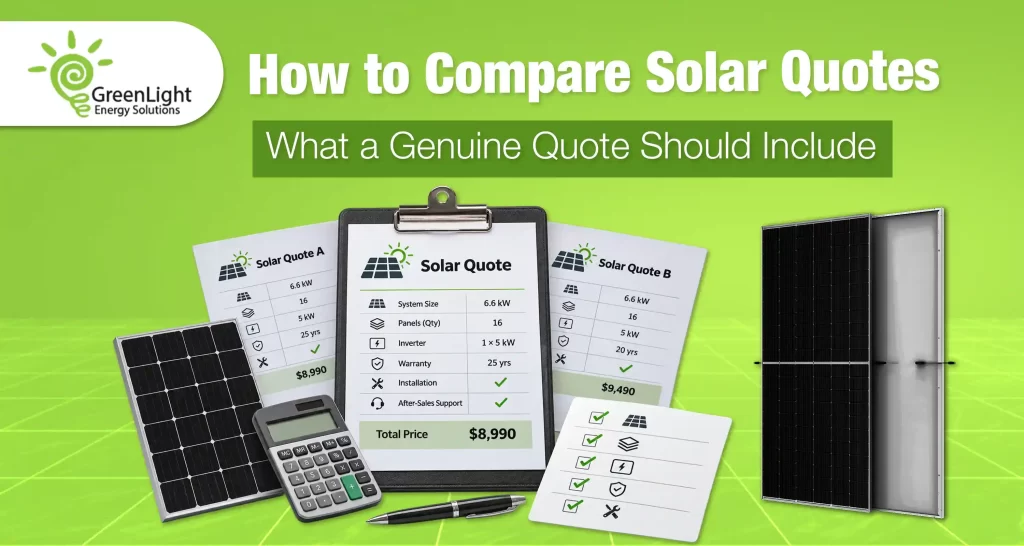
Three quotes land in your inbox. One is $9,400, one is $12,800, one is $16,200. All three say “13kW system with battery-ready inverter”. You have no idea why the gap exists, and the documents give you almost nothing to work with.
This is the normal experience, and it is not accidental. A vague quote is easier to win on price because nothing in it can be checked. A detailed quote invites questions, which is exactly why detail is the thing to demand.
What follows is how to pull three incomparable documents onto the same footing, line by line, so you are comparing the same thing rather than three different marketing positions.
First, Normalise Before You Compare
Before anything else, confirm the quotes are describing equivalent systems. They frequently are not.
Check that panel DC capacity matches across all three. A 13.2kW quote and a 12.1kW quote are not competitors, and the cheaper one is often simply smaller. Check inverter capacity separately, since array size and inverter size are different numbers. Check whether a battery is included in the headline price or listed as an optional add-on below it. Check whether GST is included, and whether the federal discount has already been deducted.
Until those four things align, price differences tell you nothing.
The Eight Things a Genuine Quote Must Specify
A quote worth taking seriously names things. If any of these is missing, the quote is incomplete and you should ask for a revised version rather than guess.
1. Panel make, model number and quantity. Not “Tier 1 panels”, not “premium German-engineered modules”. The exact model, the exact count, and the resulting total kW. Tier 1 is a bankability ranking of manufacturer financing, not a quality grade, and it tells you nothing about the panel on your roof. Compare models against our guide to the best solar panels in Australia.
2. Inverter make, model and type. String, hybrid, or microinverters, and the exact model. The difference matters: a hybrid inverter allows a battery to be added later without replacing hardware, while a standard string inverter does not. Our explainer on the three types of inverters covers which suits which roof.
Watch for the phrase “or equivalent”. It permits substitution at the installer’s discretion, and the substitute is rarely an upgrade.
3. Mounting system brand. The least glamorous line item and one of the most consequential. Racking holds your array through decades of wind loading and determines whether penetrations leak. Generic unbranded rail on a cyclone-exposed coastal roof is a genuine risk. The quote should name the mounting manufacturer and confirm the wind region the design is rated for.
4. Optimisers or microinverters, if the roof needs them. If your roof has shading, multiple orientations or anything that will cast a shadow at some point in the day, panel-level electronics materially improve output. If one quote includes them and another does not, that alone can explain a large part of the price gap, and the cheaper quote may simply have ignored a shading problem.
5. The expected generation figure with its assumptions. A credible quote states estimated annual output in kilowatt-hours and names the basis: orientation, tilt, shading analysis and the modelling software used. A figure quoted with no assumptions behind it is a sales number. Our article on how much electricity one solar panel produces gives you a reference point to sanity-check it against.
6. Your network’s export limit, stated explicitly. This should appear on any quote for a system above about 6kW. It determines how much of that generation estimate you can realistically monetise, and it varies by distributor and by address.
7. The STC value already applied. The federal discount should be shown as a line item with the certificate count and the assumed value per certificate, not folded invisibly into a bottom-line figure. If the STC price moves between quote and installation, you want to know who absorbs the difference. Our STC rebate scheme guide explains the mechanism.
8. Payment schedule and deposit. Amount, timing and what each payment releases.
What is Excluded, Which is Where Quotes Really Differ
Most of the price gap between a cheap quote and a thorough one lives in the exclusions, not the inclusions.
Items that are commonly left out of the headline price and added later as a variation:
- Switchboard or main switch upgrade, frequently required on older boards
- Meter reconfiguration or replacement, and the retailer fee attached
- Isolator or conduit relocation
- Tile replacement and roof repair where tiles break during install
- Scaffolding or elevated work platform for two-storey or steep roofs
- Rail extensions, additional penetrations or rafter reinforcement
- Travel surcharge for regional addresses
- Trenching or additional cable runs where the inverter sits far from the board
Ask each installer the same question: what circumstances on my property would trigger a price variation, and what would each one cost? The answers will differ sharply, and a company that has actually assessed your site can answer specifically while one working off satellite imagery cannot. Our article on mistakes to avoid when buying solar covers more of these traps.
Compare The Warranties Properly, Not Just The Headline Numbers
Three separate warranties apply and quotes routinely blur them into one impressive-sounding figure.
Product warranty comes from the manufacturer and covers the hardware itself. Panels commonly carry 12 to 25 years, inverters 5 to 12, batteries 10 to 15.
Performance warranty applies to panels only and guarantees a minimum output percentage at a nominated year, usually around 85% to 92% at year 25. Different term, different thing.
Workmanship warranty comes from the installing company and covers the installation: mounting, cabling, waterproofing and labour. This is the one that determines whether a free replacement part actually gets fitted at no cost to you.
Compare these as a set. A quote with 25-year panels and a two-year workmanship warranty is weaker than one with 15-year panels and a ten-year workmanship warranty, because the labour cost of a roof return visit is what hurts. Ask specifically whether the inverter warranty includes labour and shipping or parts only, since a replacement inverter still needs an electrician to fit it.
If a Battery is Included, Compare These as Well
Battery quotes have their own set of comparison points that panel quotes do not.
Usable versus nominal capacity. These are different numbers on most batteries and only one of them is yours to use. Compare price per usable kilowatt-hour, not per nominal.
Throughput limits in the warranty. Many battery warranties end after a defined total energy delivered, whichever comes first. Two batteries both quoting ten years can differ substantially once throughput is read.
Backup scope. Ask exactly which circuits are backed up during an outage, and whether the quote includes the backup changeover equipment or treats it as an extra. Whole-home backup and essential-circuit backup are very different jobs at very different prices.
Battery rebate handling. The federal battery discount should be itemised the same way the solar STC discount is. Our federal battery rebate guide and battery cost breakdown set out what to expect, and our comparison of the best solar batteries in Australia helps assess the hardware itself.
Build a One-Page Comparison
Put the three quotes into a single table with these rows and the differences become obvious in minutes:
| Line | Quote A | Quote B | Quote C |
| Panel model and count | |||
| Total DC capacity (kW) | |||
| Inverter model and type | |||
| Optimisers or micros included | |||
| Mounting system brand | |||
| Battery model and usable kWh | |||
| Estimated annual output (kWh) | |||
| Export limit stated | |||
| Workmanship warranty (years) | |||
| Inverter warranty, labour included | |||
| Price after rebate, incl GST | |||
| Cost per watt | |||
| Listed exclusions |
Cost per watt is the single most useful normalising figure. Divide the installed price by total panel watts. It strips away system size differences and shows you what you are actually paying per unit of capacity.
Document-Level Warning Signs
Separate from anything the salesperson says, the quote itself tells you things:
- Component descriptions without model numbers
- “Or equivalent” attached to any named product
- A generation estimate with no stated assumptions
- No mention of your export limit on a large system
- The STC discount folded into the total with no certificate count shown
- An open-ended variation clause with no indicative costs
- No workmanship warranty term stated anywhere
- A quote validity window measured in hours
A document that is thin on specifics is usually thin for a reason, and the gaps tend to reappear later as variations.
The Questions That Break a Tie
When two quotes genuinely look equivalent, these usually separate them: who performs the installation and are they employed or subcontracted, what is the typical response time for a service callout in year three, what happens to the price if the STC value changes before install day, and whether the generation estimate accounts for the shading you can see on your own roof.
The best quote is rarely the cheapest or the most expensive. It is the one where you can see exactly what you are buying and exactly who stands behind it.
Greenlight Solar provides itemised quotes with named components, network export conditions and written warranty terms. Browse our panel and inverter ranges, or request a quote to compare against what you already have.
FAQ:
How many solar quotes should I get?
Three is the practical number. Fewer gives you no sense of the market rate, more tends to produce diminishing returns and decision fatigue. Compare them on specified components and warranty terms rather than price alone.
Why are solar quotes so different in price?
The gap usually comes from component tier, whether panel-level electronics are included, the workmanship warranty length, and which site-specific items have been priced in rather than left as variations. Two quotes for the same stated system size are often describing very different jobs.
What does cost per watt mean and what is a reasonable figure?
Divide the installed price after rebate by the total panel wattage. It normalises quotes of different sizes onto one comparable number. Larger systems generally achieve a lower cost per watt than small ones because fixed labour and compliance costs are spread further.
Should a solar quote include the rebate?
Yes, in almost every case the STC discount is applied at point of sale and already deducted. The quote should show the certificate count and assumed value separately so you can see what has been applied. Our guide to Australian solar rebates explains how this works.
What does "Tier 1" mean on a solar quote?
It is a ranking of manufacturer bankability used by financiers, not a measure of product quality or performance. Treat it as background information and compare the actual panel model instead.
Is the cheapest solar quote ever the right one?
Occasionally, when the components, inclusions and warranty terms genuinely match the alternatives. More often a significantly lower price reflects smaller capacity, lesser components, a shorter workmanship warranty or items deferred into later variations.
What should I do if a quote has no model numbers?
Request a revised quote that names every component. If the company declines or supplies vague descriptions again, that is information in itself. You cannot evaluate what you cannot identify.
Can the price change after I accept a solar quote?
It can, where the contract contains a variation clause or the STC value moves before installation. Ask which circumstances allow a change, what each would cost, and get the answer in writing before you pay a deposit.