Now that the federal battery rebate has made home batteries far more affordable, more NSW and QLD households are asking the same follow-up question: can I earn money from my battery by joining a VPP, and is it actually worth it?
A VPP can add a bit of extra value to a battery you already own or are planning to buy. But the rewards are usually modest, and the right answer depends heavily on the specific offer. At Greenlight Solar we install and set up battery systems across New South Wales and Queensland, so here is a straight explanation of what a VPP is, what you give up, what you get back, and how to work out whether joining one stacks up for your home.
What is a VPP (Virtual Power Plant)?
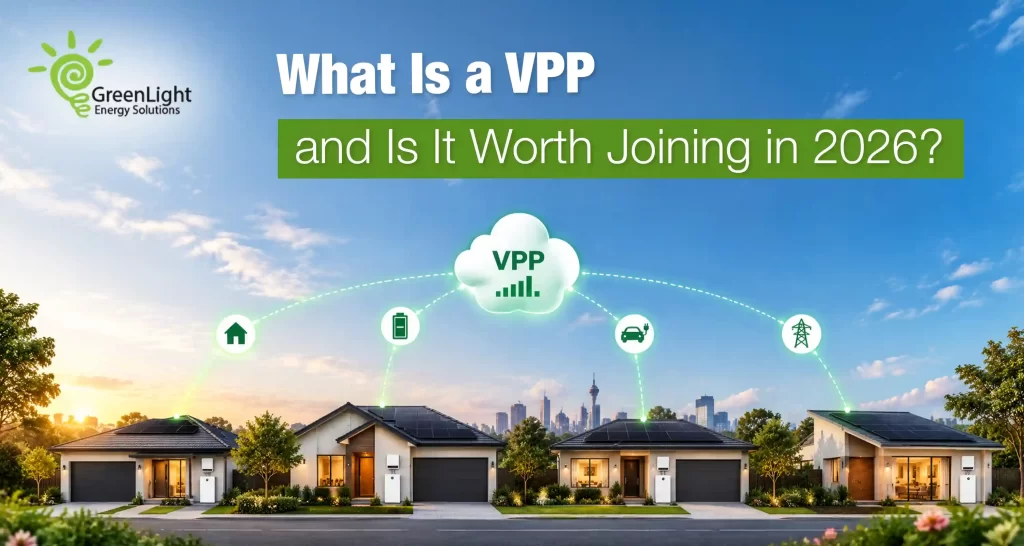
A Virtual Power Plant is a network of home solar and battery systems, linked together and coordinated by a central operator, usually an energy retailer or battery company. Individually, each battery is small. Pooled together, thousands of them can act like one large power station, which is where the name comes from.
The operator draws on that pooled storage to support the grid. It typically discharges some of the stored energy back into the grid during periods of peak demand, when wholesale electricity prices are high. It may also charge batteries when prices are low, and get paid for helping keep the grid’s frequency stable. Those services are valuable, so the operator shares part of the reward with the households taking part.
In plain terms: you let a provider control part of your battery at certain times, and in return you receive some form of payment or benefit.
How a VPP works in practice
Joining a VPP does not change how your home runs day to day. Your battery still stores your solar and powers your house first. What changes is that the provider can also charge it, hold some energy in reserve, or export power when the grid needs support, within the rules of the program.
Most programs let you set a backup reserve, so a minimum amount of charge is always kept for your own home. How much control you keep, and how much the provider can use, varies from one VPP to the next. That reserve setting is one of the most important things to check before signing up.
What you get in return
VPPs reward you in different ways, and the format matters as much as the headline number:
- An upfront battery discount. Some programs knock money off the cost of the battery when you buy it through them. This can be the most valuable reward, because it shortens payback from day one.
- Fixed bill credits. A set credit paid monthly, quarterly or annually. Predictable and easy to value.
- Event or discharge payments. You are paid when the VPP uses your battery during a grid event. These can look large (some advertise well above a dollar per kWh) but depend on how often events actually happen, which is outside your control.
- A higher feed-in tariff. A better rate for solar you export. Useful, though a home with a battery exports less than one without, so the benefit is smaller than it first appears.
- A sign-up bonus, or access to a rebate that requires VPP membership.
VPP incentives in NSW and Queensland
This is where your state matters, and where the picture differs across Greenlight’s two service areas.
In New South Wales, there is a state VPP Incentive that pays households for connecting an eligible battery to an approved VPP. That sits on top of the federal battery rebate, so a NSW home can stack a discount on the battery with a payment for joining a VPP.
In Queensland, there is currently no state VPP payment. QLD households instead lean on the federal battery rebate to bring the battery cost down, then choose from retailer-run VPPs if the ongoing rewards suit them.
One point causes a lot of confusion, so it is worth being clear: under the federal battery rebate, your battery and inverter generally need to be VPP-capable at the time of install, but you do not have to actually enrol in a VPP to claim the discount. You can run the battery privately and still keep the rebate. VPP-capable simply means the hardware is able to join one later if you choose.
The pros of joining a VPP
- It can improve your battery’s payback. Credits, event payments or a higher export rate add a little on top of your normal solar-and-battery savings, which can shorten the time the battery takes to pay for itself.
- Incentives can strengthen the whole deal. Where a rebate or state incentive is tied to a VPP, the upfront saving can tip a battery from marginal to worthwhile.
- It can be genuinely hands-off. The provider manages charging and discharging within the rules, so if you would rather not fiddle with settings, it runs in the background.
- Predictable options exist. A modest but reliable annual credit is often easier to value, and safer, than a big headline figure that depends on unpredictable grid events.
- It helps the grid. Thousands of batteries working together reduce peak-demand pressure and the need for expensive backup generation. A nice bonus, though it should come second to whether the deal works for you.
The cons and the catches
- Earnings are often modest or hard to predict. Where payments depend on grid events, your yearly return rides on how often those happen. Treat advertised maximums as a ceiling, not an expectation.
- You may have to switch retailers. Many VPPs are tied to a specific energy plan. If that plan has higher usage rates, a steeper supply charge or a lower feed-in tariff, those extra costs can quietly eat into the reward.
- You give up some battery control. The trade-off for the rewards is that the provider decides when part of your battery is used. Check how much they can take and whether you can override it.
- Grid charging can cost you. Some VPPs top up your battery from the grid so it is ready to discharge later. That imported power may still land on your bill, offset by the VPP credit. Ask exactly how this works.
- Backup reserve matters. If keeping the lights on in a blackout is a priority, confirm you can set a reserve the VPP cannot draw down.
- Some extra battery wear. More frequent charging and discharging adds some cycling. For most programs it is modest and stays within the battery’s warranty, but it is worth counting honestly.
What to check before you join
Compare the whole deal, not the headline reward. Before signing up, get clear answers on:
- How you are paid: fixed, variable, or only during events, and how often events actually occur.
- Realistic earnings: what a typical customer with your battery size, in your state, earned over the past year.
- The electricity plan: usage rates, supply charge and feed-in tariff on the required plan, versus the best plan you could otherwise choose.
- Control and reserve: how much of your battery the provider can use, and whether you set the backup reserve.
- Contract terms: minimum term, exit fees, and any clawback of sign-up bonuses if you leave early.
- Battery warranty: whether the VPP’s cycling counts against your warranty’s throughput limit.
VPP vs keeping your battery private
You never have to join a VPP. Run privately, your battery simply stores your solar and powers your home, with no one else controlling it.
| Joining a VPP | Keeping it private | |
| Main goal | Improve payback with extra credits | Maximise self-use, control and backup |
| Battery control | Shared with the provider, within limits | Entirely yours |
| Retailer choice | May be tied to a specific plan | Any retailer you like |
| Earnings | Possible extra income, often modest | Bill savings only |
| Contract risk | Possible lock-in or exit costs | None beyond your energy plan |
| Best for | Payback-focused homes comfortable sharing control | Homes wanting control, backup and simplicity |
So, is a VPP worth it?
For a household that already has a battery, or is buying one anyway, a good VPP can be worth joining. The extra credits and incentives can shorten payback, and where a state pays you to join, as NSW does, the case is stronger again.
The honest caveat is that the rewards are usually a modest bonus, not an income stream. What decides it is the whole offer: the electricity plan attached to it, how much control you hand over, your backup reserve, and the contract and exit terms. A simple VPP with fair terms and predictable payments often beats one with a bigger headline number and more restrictions.
If backup power, a simple bill and full control of your battery matter more to you than a small extra return, running the battery privately is a perfectly good choice, and you keep the federal rebate either way.
How Greenlight Solar sets you up
Whether or not you plan to join a VPP, we install VPP-capable batteries and hybrid inverters from brands like Tesla, Sungrow and Sigenergy, so your system is ready to join one later if you want to. We also handle the federal battery rebate paperwork and set a sensible backup reserve, across residential and commercial sites throughout NSW and QLD.
Thinking about a battery, or wondering whether a VPP suits your home in NSW or Queensland? Talk to Greenlight Solar and we will set up a VPP-ready system and show you the numbers after the rebate.
Frequently asked questions
Is joining a VPP worth it?
For some households, yes. A VPP can add credits or payments that improve battery payback, but the gain is usually modest and depends on the electricity plan, reserve settings and contract terms attached to it. Judge the full deal, not the headline payment.
Do I need a battery to join a VPP?
Yes. A VPP works by using part of your home battery, so a compatible battery and inverter are required. Some programs also have rules about your solar or battery size.
Does the federal battery rebate mean I have to join a VPP?
No. Your battery and inverter generally need to be VPP-capable at installation, but you do not have to enrol in a VPP to claim the discount. You can run the battery privately and keep the rebate.
Is there a VPP payment in NSW or QLD?
NSW has a state VPP Incentive that pays you for connecting an eligible battery to an approved VPP, on top of the federal rebate. Queensland has no state VPP payment currently, so QLD homes rely on the federal rebate plus retailer-run VPPs.
Can a VPP discharge my battery?
Yes. That is how it delivers value to the grid. Most programs let you set a backup reserve so a minimum charge stays for your home, but check the default and how much control you keep.
Will I still have blackout protection?
Usually, if your system is set up for backup and you keep a reserve aside. Confirm you can choose the reserve level and that the VPP cannot draw it down.
Does a VPP wear out my battery faster?
It adds some extra cycling, but for most programs the additional wear is modest and stays within the battery’s warranty. Worth counting in your sums, not a dealbreaker on its own.
Can I leave a VPP later?
Usually, but conditions vary. Some have no lock-in, others have a minimum term, exit fees or a clawback of sign-up bonuses. Read the exit terms before you join.