Battery storage has become one of the most talked-about additions to residential and commercial solar systems across Australia. As feed-in tariffs continue to shrink and grid electricity prices keep climbing, storing your own solar energy rather than selling it back cheaply to the grid is simply smart economics. But with so many battery options now available, choosing the right one can feel overwhelming.
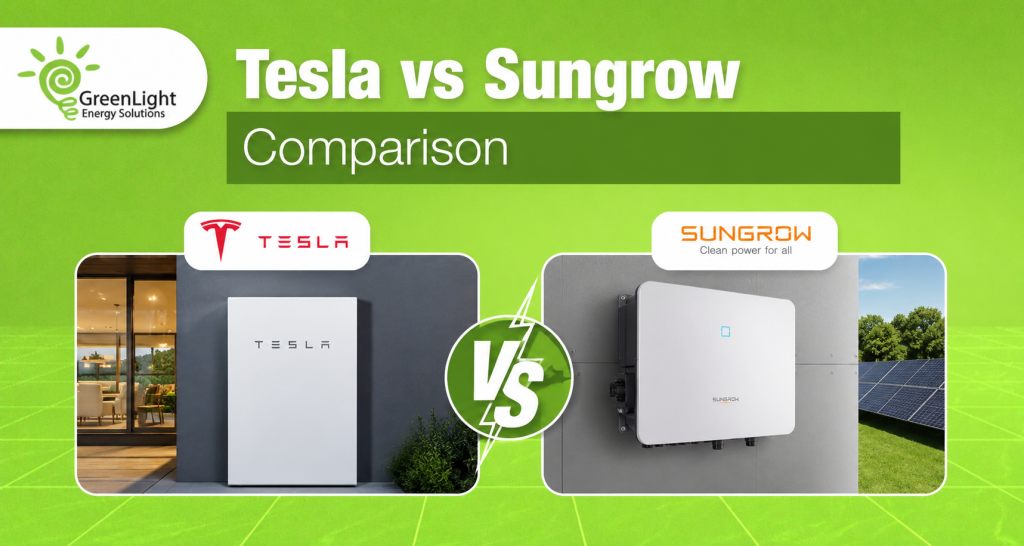
Two brands dominate the Australian battery storage market: Tesla and Sungrow. Tesla, with its globally recognised Powerwall, brings brand prestige and a seamlessly integrated ecosystem. Sungrow, the world’s largest inverter manufacturer, brings serious engineering credentials, competitive pricing, and rapidly growing market share. Both are excellent products but they suit different homeowners and different situations.
At Greenlight Solar , we install and support both Tesla and Sungrow battery systems across Greater Sydney and NSW. This guide gives you an honest, detailed comparison so you can make the right choice for your home, your budget, and your energy goals.
A Quick Introduction to Both Brands
Tesla Powerwall
Tesla entered the home battery market in 2015 with the original Powerwall and has since released the Powerwall 2 and the newer Powerwall 3. Backed by Elon Musk’s global technology brand and the same company that manufactures some of the world’s most advanced electric vehicles, the Powerwall quickly became the most recognisable home battery product on the planet. In Australia, it has become a benchmark against which all other home batteries are measured.
Sungrow
Sungrow is a Chinese company founded in 1997 and is today the world’s largest solar inverter manufacturer by shipment volume. While less famous among consumers than Tesla, Sungrow is extraordinarily well-regarded within the solar industry. Their SBR (Residential Battery) series and SBH series have gained rapid traction in Australia due to their modular design, competitive pricing, strong performance, and the seamless integration with Sungrow’s own inverter range which already powers millions of Australian homes.
Technical Specifications Comparison
| Specification | Tesla Powerwall 3 | Sungrow SBR (HiGrid) |
| Usable Capacity | 13.5 kWh | 9.6 – 25.6 kWh (modular) |
| Peak Power Output | 11.5 kW continuous | 8 kW (expandable) |
| Continuous Power | 11.5 kW | 5 kW – 8 kW |
| Round-Trip Efficiency | ~97.5% | ~98%+ |
| Battery Chemistry | NMC (Lithium Nickel Manganese Cobalt) | LFP (Lithium Iron Phosphate) |
| Warranty | 10 years / 70% retention | 10 years / 70% retention |
| Operating Temperature | -20°C to 50°C | -10°C to 50°C |
| Installation | Floor or wall mounted | Wall mounted (modular stack) |
| Backup Capability | Yes — whole home backup | Yes — with compatible inverter |
| Scalability | Multiple units | Modular 3.2 kWh increments |
| Integrated Inverter | Yes (Powerwall 3) | Requires Sungrow inverter |
| Smart Monitoring | Tesla App | iSolarCloud App |
Battery Chemistry: NMC vs LFP — Why It Matters
This is one of the most important technical differences between Tesla and Sungrow batteries, and one that most homeowners never hear about.
Tesla Powerwall — NMC Chemistry
The Tesla Powerwall uses Nickel Manganese Cobalt (NMC) lithium battery chemistry, the same chemistry used in Tesla’s electric vehicles. NMC batteries offer high energy density, meaning they can store more energy in a smaller physical footprint. They also support high power output, which is why the Powerwall 3 can deliver an impressive 11.5kW continuous power.
The trade-off with NMC chemistry is that it operates at slightly higher temperatures internally and has a marginally lower cycle life compared to LFP. However, Tesla’s battery management system is highly sophisticated and manages these characteristics extremely well.
Sungrow — LFP Chemistry
Sungrow uses Lithium Iron Phosphate (LFP) chemistry widely regarded as the safest and most thermally stable lithium battery chemistry available. LFP batteries do not use cobalt, making them more ethically sourced and less susceptible to thermal runaway (the condition that can cause lithium batteries to overheat or catch fire in extreme cases).
LFP batteries also typically offer a longer cycle life, often 4,000–6,000 full charge-discharge cycles compared to 3,000–4,000 for NMC though both are well within the 10-year warranty period for typical residential use patterns. For Australian homeowners concerned about battery safety, particularly in hot rooftop environments or garages, LFP chemistry provides significant peace of mind.
Verdict on chemistry: Sungrow’s LFP chemistry has meaningful safety and longevity advantages. Tesla’s NMC delivers higher power density and output. For most residential applications, LFP is generally considered the preferred chemistry for home storage.
Energy Capacity and Scalability
Tesla Powerwall 3 — 13.5 kWh Fixed
The Powerwall 3 offers 13.5 kWh of usable energy storage in a single unit. For most Sydney homes with a 6.6kW–10kW solar system, one Powerwall provides solid overnight coverage. If you need more capacity, you can install multiple Powerwalls — but each additional unit is a full 13.5 kWh increment at full cost, which can make scaling up expensive.
Sungrow SBR — Modular from 9.6 to 25.6 kWh
Sungrow’s residential battery system is fully modular, built in 3.2 kWh increments. This means you can start with a base capacity of 9.6 kWh and expand up to 25.6 kWh by adding modules — without replacing any existing hardware. This modularity is a significant practical advantage:
- Start smaller and spend less upfront
- Add capacity later as your needs change (e.g., when you get an electric vehicle)
- Tailor storage precisely to your solar generation and consumption profile
Verdict on scalability: Sungrow wins clearly here. The modular design gives homeowners far more flexibility to right-size their system now and expand affordably in the future.
Power Output: Which Handles More Appliances?
Tesla Powerwall 3 — 11.5 kW Continuous
The Powerwall 3’s 11.5 kW continuous output is genuinely impressive and a major upgrade over the Powerwall 2 (which offered 5 kW continuous). This means the Powerwall 3 can power virtually any combination of household appliances simultaneously during a grid outage including air conditioners, ovens, pool pumps, and EV chargers without breaking a sweat.
Sungrow SBR — Up to 8 kW Continuous
The Sungrow system offers up to 8 kW of continuous output when paired with a compatible Sungrow hybrid inverter. For most Sydney households, 8 kW is more than adequate for running essential loads during outages covering lighting, refrigerators, TVs, computers, and air conditioning. However, for larger homes with high simultaneous power demands, Tesla’s 11.5 kW output provides greater headroom.
Verdict on power output: Tesla Powerwall 3 wins. Its 11.5 kW continuous output is best-in-class for residential batteries and provides superior whole-home backup capability.
Backup and Blackout Protection
Both Tesla and Sungrow offer whole-home backup capability, but the implementation differs.
Tesla Powerwall 3 Backup
The Powerwall 3 includes a fully integrated hybrid inverter and automatically switches to backup mode within milliseconds of a grid outage — fast enough that most appliances don’t even notice the interruption. It supports whole-home backup as standard, including high-draw appliances. Setup is straightforward and the system works seamlessly without additional hardware.
Sungrow Backup
Sungrow’s backup capability requires a compatible Sungrow hybrid inverter (such as the SH series). When properly configured, it delivers reliable backup power — but the switchover time can be slightly longer than Tesla’s, and whole-home backup configuration may require additional electrical work depending on your switchboard setup. That said, Sungrow’s backup systems are robust and increasingly popular among Australian installers.
Verdict on backup: Tesla Powerwall 3 edges ahead for backup performance, particularly for homeowners who prioritise seamless, uninterrupted power during blackouts.
Monitoring and Smart Features
Tesla App
The Tesla app is beautifully designed and highly intuitive. It provides real-time visibility of solar generation, battery state of charge, home consumption, and grid interaction — all in a clean, easy-to-read interface. The app also supports:
- Time-Based Control — charge the battery from the grid during off-peak tariff periods
- Storm Watch — automatically charges the battery to full capacity when severe weather is forecast
- Powerwall Gateway integration for whole-home energy management
- Remote diagnostics and firmware updates
Sungrow iSolarCloud App
Sungrow’s iSolarCloud platform is a comprehensive monitoring solution that tracks solar generation, battery performance, consumption, and grid export in real time. The app has improved significantly in recent years and now offers a clean user experience with detailed historical data, remote system management, and fault alerts. It’s highly functional — though most users agree Tesla’s app has a slight edge in design polish and ease of use.
Verdict on monitoring: Tesla wins on app design and user experience. Sungrow’s iSolarCloud is fully functional and improving rapidly.
Price Comparison
This is where the decision often comes down to for many Sydney homeowners.
| System | Approximate Installed Cost (Sydney) |
| Tesla Powerwall 3 (13.5 kWh) | $12,000 – $15,000 |
| Sungrow SBR 9.6 kWh | $7,000 – $9,000 |
| Sungrow SBR 12.8 kWh | $8,500 – $11,000 |
| Sungrow SBR 19.2 kWh | $11,000 – $14,000 |
Prices are indicative and vary based on installation complexity, switchboard upgrades, and current market conditions.
The Sungrow system is typically $3,000 – $5,000 less expensive than a Tesla Powerwall 3 at comparable capacities. For budget-conscious homeowners, this difference alone can tip the decision — particularly given that Sungrow’s performance metrics are genuinely competitive.
Verdict on price: Sungrow wins significantly on upfront cost, offering comparable storage capacity at a meaningfully lower price point.
Warranty and Long-Term Support
Both Tesla and Sungrow offer 10-year warranties with a guaranteed minimum of 70% usable capacity retention at the end of the warranty period. This is the industry standard and provides solid long-term protection for your investment.
Tesla warranty support:
Tesla has a dedicated support network in Australia and handles warranty claims directly. As a global technology company with a strong local presence, long-term support continuity is reassuring.
Sungrow warranty support:
Sungrow has established a strong Australian service and support network and backs its products with a 10-year warranty administered through authorised installers. Given Sungrow’s scale and market position, long-term support availability is not a concern.
Verdict on warranty: Essentially equal — both offer 10-year warranties with strong support networks in Australia.
Which Battery Is Right for You?
Choose Tesla Powerwall 3 if:
- You want the best backup power performance and seamless blackout protection
- Your home has high simultaneous power demands during outages
- You value a premium brand, polished app experience, and ecosystem integration
- You already have or plan to get a Tesla electric vehicle
- Budget is secondary to performance and brand reputation
Choose Sungrow if:
- You want excellent performance at a significantly lower upfront cost
- You already have or are installing a Sungrow inverter (seamless integration)
- You want modular scalability to add capacity over time
- Battery safety and LFP chemistry are important to you
- You want the best value-for-money battery storage in the Australian market
The Bottom Line
Both Tesla and Sungrow manufacture outstanding home battery systems that will genuinely transform how your household uses solar energy. Tesla wins on brand prestige, power output, and backup seamlessness. Sungrow wins on price, modularity, battery chemistry safety, and value for money.
For the majority of Sydney homeowners focused on maximising solar self-consumption and achieving the best return on investment, Sungrow represents exceptional value. For those who want absolute top-tier performance, seamless whole-home backup, and the Tesla brand experience, the Powerwall 3 justifies its premium.
📍 Serving homeowners and businesses across Greater Sydney and NSW 🌐 www.greenlightsolar.com.au
Get your free battery storage assessment today and let our team help you choose the right battery system for your home, your solar setup, and your energy goals.