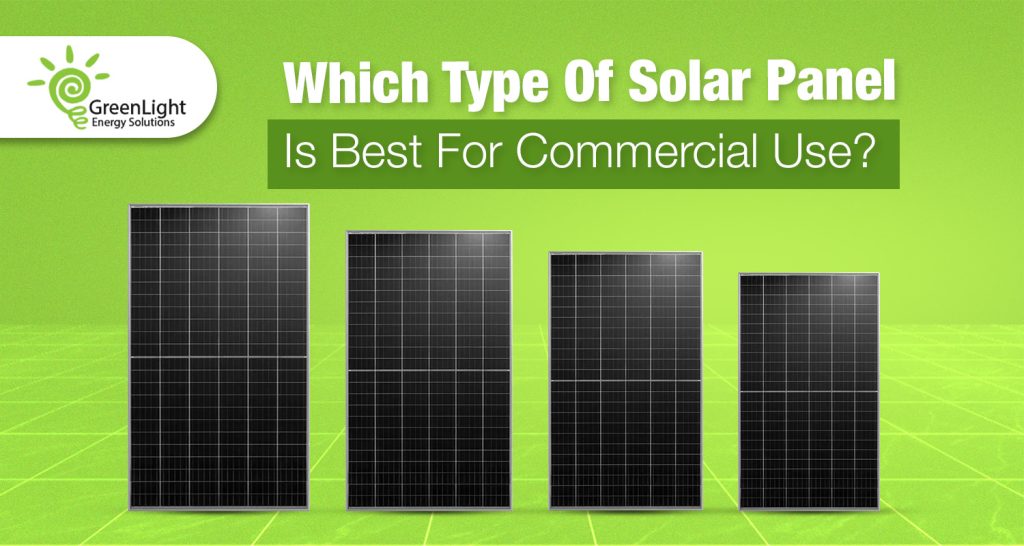
If you’re a Sydney business owner exploring solar energy, one of the first and most important questions you’ll face is: which type of solar panel is best for commercial use? With rising electricity prices in New South Wales and generous government incentives still available, going solar is one of the smartest investments your business can make in 2026. But not all solar panels are created equal, especially when it comes to large-scale commercial solar installations.
At Greenlight Solar, we specialise exclusively in commercial solar panels Sydney businesses trust from Parramatta to the CBD, from the Inner West to the Northern Beaches. In this comprehensive guide, we break down every major solar panel type, compare their performance for commercial applications, and help you identify the ideal solution for your business premises.
Why Solar Panel Type Matters for Commercial Properties in Sydney
Commercial solar panels are fundamentally different from residential installations. A typical Sydney business may require anywhere from 30 kW to over 500 kW of solar capacity, covering large flat rooftops, carpark canopies, or ground-mounted arrays. The stakes are higher and so is the savings potential.
The wrong panel choice can mean:
- Lower energy yield from limited roof space
- Higher degradation rates, reducing output over 25+ years
- Reduced return on investment (ROI) and longer payback periods
- Incompatibility with Sydney’s high-irradiance, high-heat climate
Sydney receives approximately 4.8–5.2 peak sun hours per day, making solar panel efficiency commercial grade a critical factor in maximising your investment.
The Main Types of Commercial Solar Panels Explained
There are five primary solar panel types for commercial use you’ll encounter when shopping for business solar installation Sydney wide. Here’s what you need to know about each:
1. Monocrystalline Solar Panels (N-Type) — The Gold Standard
Monocrystalline solar panels Sydney installers recommend most are those built on N-type silicon. Made from a single pure silicon crystal, these panels deliver efficiency ratings of 20–24% the highest available from standard commercial panels today.
Modern monocrystalline panels are manufactured using N-type TOPCon panels Sydney suppliers carry, including TOPCon (Tunnel Oxide Passivated Contact) and back-contact (IBC/XBC) cell designs. N-type cells offer superior long-term performance, maintaining 90–95% of their original output after 25 years compared to just 80–90% for older P-type panels.
Why they’re ideal for Sydney commercial properties:
- Highest energy output per square metre crucial for rooftops with limited space
- Excellent performance in Sydney’s summer heat, with temperature coefficients as low as -0.29%/°C
- Lowest degradation rates in the industry
- Backed by 25–40 year warranties from tier-1 manufacturers like SunPower, REC, and Aiko
Best for: Office buildings, retail centres, warehouses, and any Sydney commercial property with limited usable roof area that wants maximum energy output.
2. Monocrystalline PERC Panels — Proven Commercial Performance
PERC (Passivated Emitter Rear Cell) technology was the industry standard throughout the 2010s and still represents excellent value for many commercial applications. PERC adds an extra reflective layer behind the silicon cell to recapture light that would otherwise be lost, boosting efficiency by up to 5% more than standard panels with improved low-light performance.
Modern PERC solar panels deliver efficiencies of 20–22% with 25-year performance warranties as standard across brands like Trina Solar (Vertex S+), Canadian Solar (HiKu), and Jinko Solar (Tiger NEO). These are among the most popular choices for commercial solar panels Sydney wide due to their reliability, Australian distributor networks, and competitive pricing.
Best for: Mid-sized commercial systems and businesses prioritising competitive upfront cost without sacrificing long-term reliability.
3. Bifacial Solar Panels — Maximum Yield for Large Commercial Roofs
Bifacial solar panels commercial installations increasingly rely on thanks to their unique dual-surface design. Unlike traditional single-face panels, bifacial modules feature transparent back sheets or dual-glass construction, allowing them to generate electricity from both the front and rear surfaces by capturing reflected light known as albedo from the surface below.
On commercial flat rooftops in Sydney particularly those with white or light-coloured membranes bifacial panels can generate 5–30% more total energy than equivalent single-face panels. Most bifacial solar panels available in Australia today use N-type TOPCon or PERC monocrystalline cells, combining high efficiency with dual-face energy capture.
Additional advantages of bifacial panels for commercial use:
- Dual-glass construction improves durability and weather resistance ideal for Sydney’s coastal and storm-prone environments
- PID (Potential-Induced Degradation) resistance leads to slower annual degradation rates
- Eligible for higher STCs (Small-Scale Technology Certificates) due to higher rated output
- Can be installed vertically on facades or at elevated angles to maximise rear-side gain
Best for: Larger commercial rooftops, carpark canopy systems, ground-mounted commercial arrays, and Sydney businesses with light-coloured or reflective roof surfaces.
4. HJT (Heterojunction Technology) Panels — Premium Efficiency for Demanding Applications
HJT solar panels combine monocrystalline silicon with thin-film amorphous silicon layers to achieve some of the highest efficiencies available today up to 25% for commercial-grade units. The standout feature of Heterojunction Technology is its exceptionally low temperature coefficient, as low as -0.24%/°C meaning these panels lose far less output on Sydney’s hot summer days than any other technology available.
REC Group’s Alpha Pure series, featuring HJT cells at 22.6% efficiency, is consistently rated by Australian solar installers as a top-tier choice for demanding commercial solar installations. HJT panels also have minimal light-induced degradation (LID), ensuring reliable performance over a 30+ year lifespan.
Best for: High-performance commercial installations, Sydney businesses in heat-intensive environments such as Western Sydney industrial areas, and projects where maximum long-term yield is the priority.
5. Thin-Film Solar Panels — Large-Scale & Flexible Applications
Thin-film panels including CdTe, CIGS, and amorphous silicon types are significantly lighter and more flexible than crystalline silicon panels. While their solar panel efficiency (10–18%) is lower, they perform well in diffuse light conditions and are well-suited to very large-scale installations where roof load capacity is a structural concern, such as older industrial buildings or carpark shade structures.
Thin-film is not typically the first choice for standard commercial solar panels Sydney rooftops, but they remain relevant for utility-scale projects and building-integrated photovoltaics (BIPV). Warranties are typically shorter at 10–15 years.
Best for: Large-scale utility projects, BIPV installations, or situations where panel weight is a critical structural constraint.
Commercial Solar Panel Comparison — Quick Reference Guide
| Panel Type | Efficiency | Best For | Cost (AUD) | Warranty |
| Monocrystalline N-Type TOPCon | 20–24% | Limited roof space, max output | Mid–High | 25–40 years |
| Monocrystalline PERC | 20–22% | Standard commercial rooftops | Mid | 25 years |
| Bifacial N-Type TOPCon | 22–24%+ | Large flat commercial roofs | High | 25–30 years |
| HJT Heterojunction | Up to 25% | High-performance, high-heat systems | Premium | 25–30 years |
| Thin-Film | 10–18% | Large-scale utility / carparks | Low | 10–15 years |
Which Solar Panel Is Best for Your Sydney Commercial Property?
Based on Greenlight Solar’s extensive experience with commercial solar installations across Sydney, our recommendation for most businesses is clear: N-type monocrystalline panels (TOPCon or HJT), ideally in a bifacial configuration for flat commercial rooftops.
Here’s a breakdown by business type:
| Business Type | Recommended Panel |
| Office Buildings (CBD / Inner Suburbs) | N-type TOPCon or HJT — high efficiency essential for space-limited rooftops |
| Warehouses & Distribution Centres | Bifacial N-type TOPCon — large flat roofs maximise rear-side albedo gain |
| Retail Shopping Centres | Monocrystalline PERC or bifacial — balance of performance and cost |
| Industrial Facilities (Western Sydney) | HJT panels — best temperature performance in high-heat environments |
| Carpark Canopy Systems | Bifacial — elevated mounting ideal for dual-side energy capture |
| Large Industrial / Utility Scale | Thin-film or ground-mount bifacial — lower cost per watt at scale |
Key Factors Sydney Businesses Should Consider When Choosing Solar Panels
Beyond panel type, several additional factors will influence your business solar installation Sydney decision:
Roof Space & Structure: The available area and load-bearing capacity will determine solar panel type and system size. A structural assessment is included in every Greenlight Solar commercial proposal.
Energy Consumption Profile: High-consumption businesses such as cold storage and manufacturing benefit most from high-efficiency solar panels that maximise daytime generation.
NSW Government Incentives: Under the federal STC scheme, commercial solar systems are eligible for significant upfront rebates. Larger and more efficient systems receive higher STC values and the rebate decreases every January, so the sooner you act, the better.
Inverter Technology: Panel choice must be paired with the right inverter string, microinverter, or DC optimiser depending on shading conditions and system layout.
Warranty & Manufacturer Support: Always choose tier-1 panels with Australian distributor networks and at minimum a 25-year performance warranty for commercial installations.
ROI & Payback Period: Most Sydney commercial solar systems achieve payback periods of 3–6 years, with a 25+ year system lifespan delivering exceptional long-term ROI.
What Sets Greenlight Solar Apart in the Sydney Commercial Market?
After analysing leading competitor content from Solar Choice, SolarQuotes, Cyanergy, Skyline Solar, and Isolux Solar, here is what most competitors miss and what Greenlight Solar addresses in every commercial project:
- Location-specific expertise: Sydney’s coastal salt air, varying irradiance zones, and network tariff structures require locally informed advice not generic national guides.
- Commercial-only focus: Unlike mixed residential and commercial installers, Greenlight Solar works exclusively on commercial solar systems from 30 kW upward.
- Full lifecycle support: From design and CEC-accredited installation through to monitoring, maintenance, and warranty claims we’re with you for the life of your system.
- Independent product selection: Greenlight Solar recommends panels based on performance data and your specific site conditions, not supplier rebates.
- Free commercial solar assessment: We offer no-obligation site assessments across all Sydney metro areas including Parramatta, Blacktown, Liverpool, Sutherland, Chatswood, and the Sydney CBD.
Conclusion:
Choosing the right commercial solar panels for your Sydney property is one of the most impactful energy decisions you’ll make as a business owner. The market has evolved dramatically polycrystalline panels are now obsolete, and the real choice today is between premium N-type monocrystalline technologies: TOPCon, HJT, and bifacial configurations.
For most Sydney commercial properties in 2026, Greenlight Solar recommends:
- N-type monocrystalline TOPCon or bifacial panels for standard commercial rooftops
- HJT panels for high-heat environments or maximum-performance requirements
- Bifacial configurations for large flat rooftops with light-coloured or reflective surfaces
The right choice depends on your roof structure, energy profile, budget, and long-term goals and that’s exactly what Greenlight Solar’s no-obligation commercial assessment is designed to determine.
Frequently Asked Questions (FAQ)
Q1: What is the most efficient solar panel for commercial use in Sydney?
The most efficient solar panels for commercial use in Sydney are currently N-type HJT panels, with efficiencies up to 25%. However, for most commercial applications, N-type TOPCon monocrystalline panels — offering 22–24% efficiency at a more competitive price — provide the best balance of performance and value. Top brands include Aiko (Neostar), REC (Alpha Pure), and SunPower (Maxeon).
Q2: Are bifacial solar panels worth it for commercial properties in Sydney?
Yes — for many commercial properties in Sydney, especially those with flat rooftops, white roofing membranes, or elevated ground-mount configurations. Bifacial solar panels commercial installations benefit from 5–30% more energy generation compared to monofacial equivalents. Greenlight Solar conducts a free albedo assessment as part of every commercial proposal to determine whether bifacial technology is right for your site.
Q3: How much does a commercial solar system cost in Sydney?
Commercial solar installation Sydney costs vary based on system size, panel type, and complexity. A quality system using N-type panels typically ranges from $0.85–$1.10 per watt installed before rebates. A 100 kW system for a mid-sized Sydney warehouse may cost $85,000–$110,000 before STCs, with rebates potentially reducing this by $15,000–$30,000 depending on your postcode zone.
Q4: What solar panels do top Australian solar installers recommend?
According to SolarQuotes’ 2025 Installer Choice Awards, the most recommended panels are Aiko Neostar (27% of installer votes, 22.8% efficiency) and REC Alpha Pure (16% of votes). For value-focused commercial solar panels Sydney projects, Trina Solar Vertex S+, Jinko Tiger NEO, and Canadian Solar HiKu remain consistent industry favourites.
Q5: How long do commercial solar panels last in Sydney’s climate?
Quality N-type commercial solar panels are rated to perform for 25–30 years, with leading manufacturers like SunPower offering up to 40-year warranties. Annual degradation rates for premium N-type TOPCon and HJT panels are typically 0.3–0.45%, compared to 0.5–0.7% for older P-type technology — a meaningful difference over a 25-year commercial system lifespan.
Q6: Does Greenlight Solar offer commercial solar installations across all of Sydney?
Yes. Greenlight Solar provides commercial solar installations across all Sydney metropolitan areas including the Sydney CBD, Inner West, Eastern Suburbs, North Shore, Northern Beaches, Parramatta, Western Sydney (Blacktown, Penrith, Liverpool), South Sydney, and the Sutherland Shire. We also service Greater Sydney including the Blue Mountains, Wollondilly, and the Central Coast.