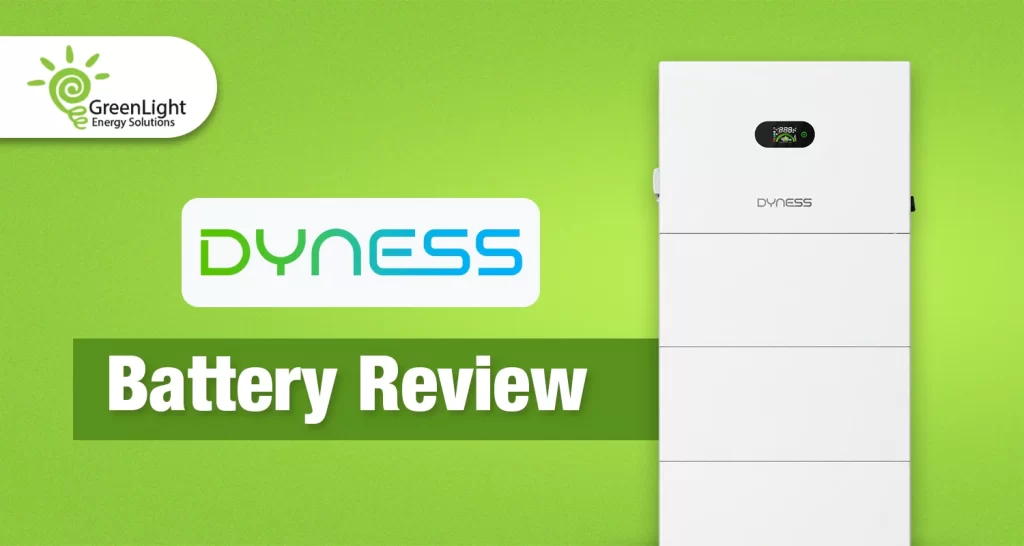
Dyness arrived in Australia with a reputation it has spent several years trying to shed. For a long stretch it was the brand that turned up on the cheapest quote in the pile, bundled with a third-party hybrid inverter, and homeowners treated it accordingly. The current lineup is a different proposition, and anyone comparing quotes deserves a clear picture of what changed and what did not.
This Dyness battery review covers the three products an Australian household is realistically being offered: the PowerBox G2, the Cygni all-in-one, and the STACK100 Pro. We will look at what each one is actually for, how the warranty reads once you get past the headline number, and where the genuine weak spots sit.
Who Dyness is, and why that matters
Dyness was founded in 2017 and manufactures lithium iron phosphate storage out of facilities in Suzhou and Taizhou. The company reports shipping more than a million units globally and holds over 100 patents, with certification across TUV, UL, CE, JET and the Clean Energy Council listing that Australian rebates depend on.
More relevant for a homeowner: Dyness now runs a dedicated Australian service centre, one of thirteen global support hubs. That detail is worth more than any specification. The defining risk with a mid-market battery brand is not that the hardware fails, it is that the hardware fails in year seven and nobody answers the phone. A local parts and service presence does not eliminate that risk, but it changes the odds considerably compared with a brand supported entirely from overseas.
The current Australian range
| Product | Type | Capacity | Best suited to |
| PowerBox G2 | Low-voltage, wall-mounted | 10.24kWh nominal, approx 9.7kWh usable | Retrofit to an existing hybrid inverter |
| Cygni | All-in-one with built-in inverter | 7.68kWh to 46.08kWh usable, 8kW or 10kW output | New installs wanting one tidy unit |
| STACK100 Pro | High-voltage modular stack | 15.36kWh to 76.8kWh, scaling far beyond with parallel clusters | Large homes, light commercial |
PowerBox G2
The straightforward option. It is a wall-mounted low-voltage pack that needs a compatible hybrid inverter to function, so it suits a household that already has a suitable inverter or is happy to pair one. Around 9.7kWh of usable energy covers a typical evening peak and overnight base load for a smaller household.
This is the Dyness most people will be quoted if they are adding storage to a system installed in the last few years. Whether that retrofit path makes sense for your setup is worth reading about separately in our guide to adding a battery to existing solar.
Cygni
The Cygni is Dyness attempting to compete at the front of the market rather than the value end, and it is the most credible product in the range for mainstream households. Battery and hybrid inverter come as one integrated unit at either 8kW or 10kW output, with stackable modules taking usable capacity from 7.68kWh up to 46.08kWh.
The install-side features are genuinely good: wiring-free stacking, one-click commissioning, and VPP-ready functionality out of the box. For the homeowner that translates to a shorter install, fewer boxes on the wall, and one manufacturer responsible if something misbehaves rather than a battery supplier and an inverter supplier pointing at each other.
STACK100 Pro
The heavy end. A rack-free, high-voltage stack built from 5.12kWh modules, starting around 15.36kWh and scaling to 76.8kWh in the Australian listings, with parallel clusters taking it far higher for commercial sites. It supports 1C charge and discharge, which means a pack can fill or empty in roughly an hour rather than crawling, and that matters if you want to soak up a short burst of midday solar or ride out a heavy evening load without the battery becoming the bottleneck.
Dyness lists IP66 protection, a six-layer protection architecture, aerosol fire suppression, natural convection cooling with no fan, more than 8,000 cycles and around 95% usable capacity per module.
Read the warranty, not just the number
Dyness offers a 10-year product warranty across its current Australian range, with a guaranteed capacity retention of 70% at the end of the term. That is competitive without being market-leading. Several rivals now offer 12 to 15 years.
The clause that deserves attention is throughput. Dyness warranties end when the battery has delivered a defined total amount of energy, whichever comes first. In ordinary residential use that allowance works out to roughly one full cycle per day or better, so a normal household will reach the ten-year mark before exhausting throughput. Where it bites is aggressive usage: a home cycling the battery twice daily on a time-of-use arbitrage strategy, or a VPP participant whose battery is dispatched hard by the aggregator, can burn through that allowance early.
If you are considering joining a VPP, check the throughput figure against the dispatch pattern your program expects before you sign. This applies to every brand, not just Dyness, and it is the single most commonly overlooked line in a battery contract.
The historical criticism worth noting is that Dyness warranty documentation used to be difficult to locate. It is now published on the Australian site, and any reputable installer will provide it at quote stage. Ask for it.
Safety and build quality
Lithium iron phosphate is the right starting point, with far more thermal stability than the chemistries used in electric vehicles, and every current Dyness residential product uses it.
The STACK100 Pro carries the most comprehensive protection package in the range: IP66 ingress rating, temperature probes throughout the stack, an aerosol suppression system Dyness states can detect and extinguish a fire within five seconds, and optional aerogel fire barriers. Cooling is by natural convection, which means no fan to fail and no audible hum near a bedroom wall.
The Cygni is described as outdoor capable with an operating range of 0°C to 50°C. That upper figure is adequate rather than generous for Australia, and like effectively every battery it will derate as it approaches the limit. Practically, that means siting matters: a west-facing brick wall in Western Sydney in February is a poor choice regardless of brand. Our overview of solar battery pros and cons covers the thermal derating issue in more detail.
Inverter compatibility
The PowerBox G2 and STACK100 Pro both require a compatible hybrid inverter, and Dyness promotes broad compatibility across hybrid and off-grid systems rather than locking you to one brand. Solis pairings are common in the Australian market, and our Solis inverter range page covers the matching units.
Broad compatibility is a real advantage over closed ecosystems, but it carries a catch: when a battery from one manufacturer talks to an inverter from another, firmware mismatches are the most common source of the odd behaviour owners report. The Cygni sidesteps this entirely by integrating both. If you want fewest possible points of failure, that is the argument for choosing it over the modular options. If you are unsure which architecture suits your site, our explainer on AC-coupled versus DC-coupled batteries is the place to start.
Rebates and cost position
Dyness products listed with the Clean Energy Council qualify for the federal Cheaper Home Batteries Program, which applies its discount upfront through Small-scale Technology Certificates rather than as a later claim. The rate is highest on the first 14kWh of usable capacity and steps down through higher bands, and the certificate value itself reduces each January, so timing affects the final figure.
A 10kWh PowerBox G2 sits comfortably inside the top-value band. A 46kWh Cygni will claim across several bands, so the effective discount per kilowatt-hour drops as capacity rises. Our federal solar battery rebate guide sets out the tier structure and which state incentives stack on top, and our solar battery cost breakdown covers what the rest of the installed price consists of.
Dyness generally lands below premium brands on installed cost for comparable usable capacity. That price gap is the brand’s core proposition and it is a legitimate one.
The honest criticisms
Owner feedback is not uniformly positive, and a useful review says so. Reported issues cluster around software rather than hardware: battery management behaviour that owners find conservative, including systems that appear to prefer sitting near full charge, and occasional awkward interactions with paired third-party inverters around how surplus solar is handled when the battery is already full.
Hardware feedback is considerably better, with build quality and finish on the Cygni in particular rated highly by installers. Long-term Australian field data on the newest models is still thin, simply because they are new. That is a genuine unknown, not a flaw, but it is the reason a brand like this sits a step behind the established names on risk rather than on specifications.
Who the Dyness range suits
It makes sense if you want meaningful usable capacity at a lower installed cost than the premium tier, you value modular expansion, or you want an all-in-one unit with VPP capability built in. The STACK100 Pro is a strong fit for high-consumption homes and small commercial sites where the 1C rate and stack scalability earn their keep.
Look elsewhere if you want the longest warranty on the market, the deepest Australian service history, or a battery whose software has been refined over many years of local field use.
Verdict
Dyness has moved from budget alternative to credible mid-market contender, and the Cygni is the product that earns that reassessment. The hardware, chemistry and safety engineering are sound, the local service presence is real, and the price position is the point.
The trade-offs are a 10-year warranty where premium competitors now offer more, and software that reviewers consider the least polished part of the package. If those sit comfortably with you, the value case is strong.
Greenlight Solar supplies and installs the Dyness range and can size it against your actual evening load. Compare it against alternatives in our guide to the best solar batteries in Australia, browse the full solar battery range, or request a quote.
FAQs
Is Dyness a good battery brand?
It is a credible mid-market brand rather than a premium one. The chemistry, safety engineering and local service presence are sound, and pricing is competitive. Where it trails the top tier is warranty length and the maturity of its battery management software.
How long does a Dyness battery last?
The product warranty runs 10 years with 70% capacity retention guaranteed at the end of that term, subject to an energy throughput cap. Under typical household use of around one cycle per day, the ten-year term is reached before the throughput limit.
Which Dyness battery is best for a family home?
For most households the Cygni all-in-one is the strongest fit, since battery and inverter come integrated and capacity scales from 7.68kWh to 46.08kWh. The PowerBox G2 suits homes retrofitting storage to an existing compatible hybrid inverter. Our guide on what size solar battery you need helps narrow the capacity.
Can a Dyness battery be installed outdoors?
The STACK100 Pro carries an IP66 rating and the Cygni is rated as outdoor capable within a 0°C to 50°C operating range. Placement still matters, since any battery derates in extreme heat. Avoid west-facing walls with direct afternoon sun.
Does a Dyness battery work in a blackout?
With the correct inverter and backup wiring, yes. The Cygni includes its own hybrid inverter, which simplifies the configuration. What those circuits can realistically run is covered in our article on what a home battery can power in a blackout.
Is Dyness eligible for the federal battery rebate?
Yes, where the specific model is Clean Energy Council listed and installed by an accredited installer. The discount is applied upfront at point of sale through STCs.
Can I add more capacity to a Dyness battery later?
Both the Cygni and STACK100 Pro are modular, so capacity can be added by stacking further modules. Confirm the maximum stack size for your configuration at the time of install so the initial inverter sizing does not limit later expansion. Our guide to installing a solar battery covers the planning side.